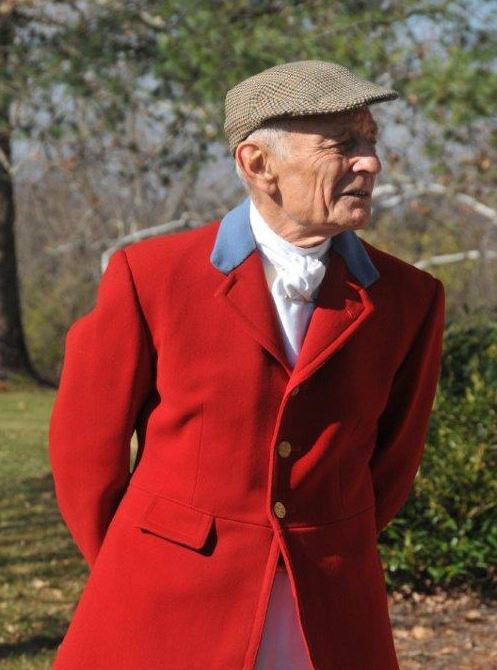
Hugh Motley, ex-MFH (1955–2016)

Hugh Motley, MFH with the Keswick foxhounds / Courtesy of the Motley Family
Hugh Douglas Camp Motley, ex-MFH of the Keswick Hunt (VA) and a highly-regarded horseman who started his own bloodstock agency and sold Thoroughbred horses at many of America’s premier racing sales, died in Wellington, Florida on January 9, 2016 of complications from pneumonia. He was sixty.
Hugh foxhunted all his life and served as Master of Foxhounds for the Keswick Hunt (VA) from 2000 to 2005. He also played polo for many years as a member of the Charlottesville Polo Club.
Jake Carle, longtime Master and huntsman at Keswick, remembers Hugh from the time he was hunting ponies. “He was game as hell,” Jake recalls. “He would go anywhere on his pony.”
“We bonded instantly because we both stuttered as kids, so I understood. Later, he whipped-in to me. When it was time to name a new Joint-Master, he was the only person I trusted to maintain the standards. And he did.
“He hired [huntsman] Tony Gammell, and they had a bond. He had the most wonderful sense of humor, and we all will miss him terribly. He’s one of only a few people I know who was liked by everyone who met him.
Author Martha Wolfe to Speak at VFC Annual Meeting
The Virginia Foxhound Club Annual Meeting, luncheon, and silent auction are scheduled for Sunday, February 14, 2016. This year’s guest speaker will be Martha Wolfe, foxhunter and author of The Great Hound Match of 1905: Alexander Henry Higginson, Harry Worcester Smith, and the Rise of Virginia Hunt Country. “There was to be a contest, a […]
Sally Tufts, ex-MFH (1924–2016)
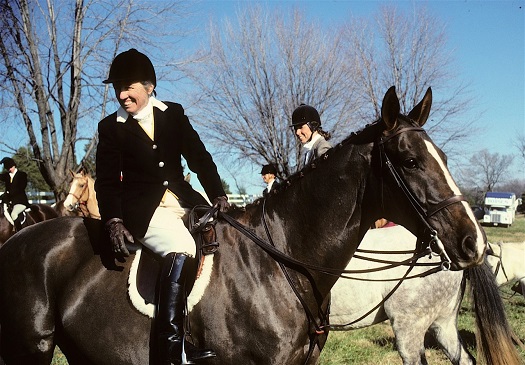
Douglas Lees photo
Sally Spilman Tufts passed away peacefully on January 1st, 2016 at age ninety-one. A passionate horsewoman and lifelong foxhunter, she was Joint-MFH of the Warrenton Hunt (VA) for twenty-two years.
How many times have I recalled the first time we met? It was the moment when I, a Northerner, learned the definition of a Southern Lady—a woman who could say the hard thing and make it taste like honey.
About thirty-five years ago, before I had even moved to Virginia, a friend from Massachusetts and I went for a day’s hunting with Warrenton. For whatever reason, my friend’s horse decided to stop at virtually every fence. We were proving to be the cappers from hell. I was embarrassed, but the word, embarrassment, had never been a part of my friend’s lexicon. He just kept trying. At one fence, after several fruitless attempts, a hospitable Warrenton rider offered to get on the horse and jump him over so we could catch up to the field. Even he was unsuccessful, so he and another gracious rider took us through a gate—the nadir of the day’s experiences. Thankfully, the endless day finally ended, and, back at the trailers, Master Sally Tufts came up to us.
Eleven Years of England’s Hunting Act
Liz Callar photoIt’s been eleven years since England’s Hunting Act of 2004 was enacted by the Labour government, and ten years since the Act was put into effect. So what happened this year?
After the May elections, Prime Minister David Cameron found himself leading a Conservative Party majority government for the first time. Pro-hunting Conservatives were ecstatic and looked to Cameron to make good on his pledge to bring a free vote to the floor in Parliament. They sought first to abolish the Act, then later hoped to at least modify the Act. Cameron, however, was never sufficiently confident to bring either proposal to the floor. Too many members of his own party, not to mention the Liberal opposition, pledged to oppose him on the issue.
That was the bad news. There was news this month, however, with potential for positive development.
Eleven Years of England’s Hunting Act
Liz Callar photoIt’s been eleven years since England’s Hunting Act of 2004 was enacted by the Labour government, and ten years since the Act was put into effect. So what happened this year?
After the May elections, Prime Minister David Cameron found himself leading a Conservative Party majority government for the first time. Pro-hunting Conservatives were ecstatic and looked to Cameron to make good on his pledge to bring a free vote to the floor in Parliament. They sought first to abolish the Act, then later hoped to at least modify the Act. Cameron, however, was never sufficiently confident to bring either proposal to the floor. Too many members of his own party, not to mention the Liberal opposition, pledged to oppose him on the issue.
That was the bad news. There was news this month, however, with potential for positive development.
When Foxhounds Hunt Both Fox and Coyote
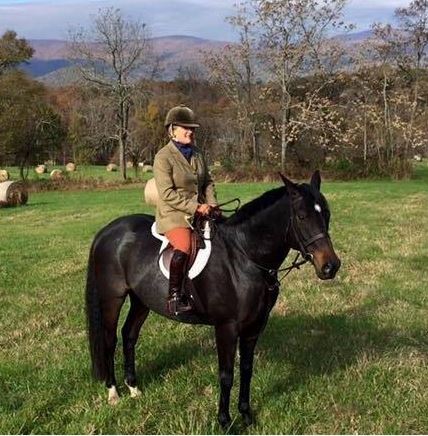
Betsy Smith in Virginia’s Old Dominion Hunt country / Emma Rowe photoFoxhunting remained pure in much of rural Virginia even as the coyote population was increasing up and down the eastern coastal states. Why much of Virginia’s hunting country was ignored by coyotes is a question for another time, but there’s no doubt that canis latrans has discovered its earlier mistake and, for the last several years, has made substantial property acquisitions in the Old Dominion.
Virginia hunts are handling the situation in various ways—some considering coyote as riot, some adding the coyote to its list of bona fide quarry. For hunts in the latter category, with staff still relatively inexperienced in hunting the coyote, new questions arise for their hound breeding programs.
Betsy Smith asks whether a hound’s nose for coyote scenting should be any different than a hound’s nose for fox scenting. For a pack that hunts both coyote and fox, are there any breeding considerations when it comes to nose?
As a followup question, Betsy asks if there are other more important hound attributes than nose to consider and breed for.
We went to our Panel of Experts and asked two experienced huntsmen, C. Martin Wood, MFH, Live Oak Hounds (FL) and Marion Thorne, MFH, Genesee Valley Hunt (NY), to answer Betsy’s questions for the benefit of their less coyote-savvy friends in Virginia. Although Marty hunts in Florida, and Marion hunts in New York state, it’s uncanny how similarly they feel about what they need in their packs.
Case Against Lamerton Foxhounds Collapses in Court
Charges of illegal hunting brought against six members of the Lamerton Foxhounds in Devon (UK) by the League Against Cruel Sports (LACS) collapsed in court. The LACS dropped all charges when a previously undisclosed relationship between the League and one of its key witnesses was discovered. Expert witness Stephen Harris, professor of environmental sciences at […]
The Mockers and Lionel Edwards
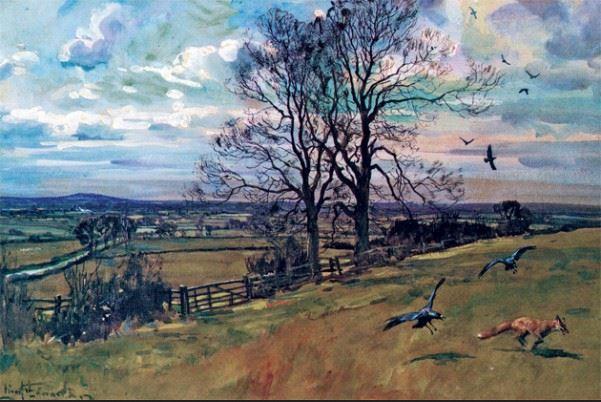
The Mockers, 1925, by Lionel Edwards, gouache (click painting for a larger version)
In a recent Country Life article, Michael Clayton proclaims The Mockers by Lionel Edwards to be his favorite painting.
Clayton is former editor of Horse and Hound, author of numerous books, and well-known as Foxford for his long-running series of hunting reports in “Foxford’s Hunting Diary.” Clayton has probably hunted with every hunt in the UK over his long career as a sporting correspondent, and has personally known certainly all of the British contemporary artists of note. Because I respect Clayton’s opinion, because I’ve loved Lionel Edwards’s work ever since I first started hunting, and because I was sufficiently struck by the drama of the scene, I thought that Foxhunting Life readers might appreciate the painting as well.
“I have seen foxes ‘mocked’ in this way by birds,” says Clayton in the Country Life article. “It symbolises just how tough nature can be.”
Indeed, the fox is not only running from a pack of hounds, seen as mere white dots in the far distance at the left, but is being cruelly mobbed by the diving, swarming crows. The masterful rendering of the landscape under a somber sky, typical to the English Shires, was one of Lionel Edwards’s special talents. What was not so typical was this view of quarry and birds in the foreground, with horses and hounds—Edwards’s usual subjects—mere suggestions in the background.
Lamerton Foxhounds Accused of Illegal Hunting in Britain
Six men affiliated with the Lamerton Foxhounds in Devon, near Okehampton, will stand trial, accused of illegally hunting a fox with hounds in contravention of the Hunting Act of 2004. Defendants are Joint-Master George Moyse, huntsman David Lewis, whipper-in Steve Craddock, and terrier men Wayne Bartlett, Gilmore Lewis, and Stephen Mitchell. The six deny the […]
A Question of Attire
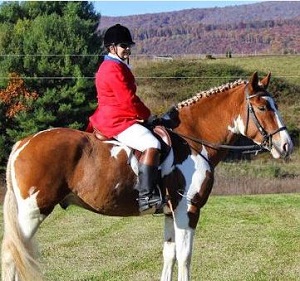
Brenda Simmons, ex-MFH, at Glenmore Hunt Opening Meet, 2014Brenda Simmons is an ex-Master of the Glenmore Hunt (VA). While an active Master, Brenda, who also whipped-in at the time, wore a scarlet coat.
Brenda asks, “Being an ex-MFH, is it still correct to wear my scarlet coat even though I am a lady?”
When visiting other hunts for joint meets, Brenda tells us that she wears a black hunt coat with Glenmore buttons, colors on the collar, and black boots with patent leather tops, even though Glenmore members may have been invited to wear their colors. When capping at other hunts—no joint meet—Brenda wears a plain black hunt coat, no colors, and plain black boots.
At Glenmore, however, she continues to wear her scarlet coat and wonders if she is correct in doing so. We asked two members of our Panel of Experts for their opinions, and your editor weighs in as well!