Hounds Came First for Cheshire’s Ivan Dowling
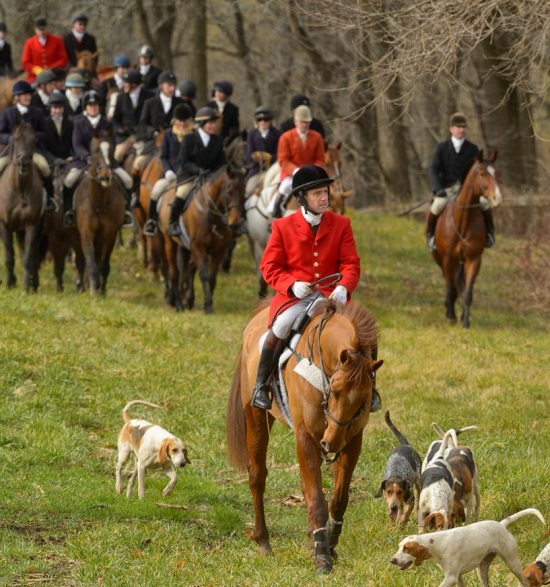
Huntsman Ivan Dowling implemented a daring — and successful — hound breeding experiment for Mr. Stewart’s Cheshire Foxhounds. / Jim Graham photo
“I’d spent several minutes trying to describe my job as huntsman to a friend” recalled Ivan Dowling, the forty-two-year-old recently retired huntsman for Mr. Stewart’s Cheshire Foxhounds (PA). “The friend looked at me and said, ‘Ivan, you mean you’re the guy on the place mat?’”
Dowling cringed a bit and smiled, “Yea, that’s me.”
Grosvenor’s Hill
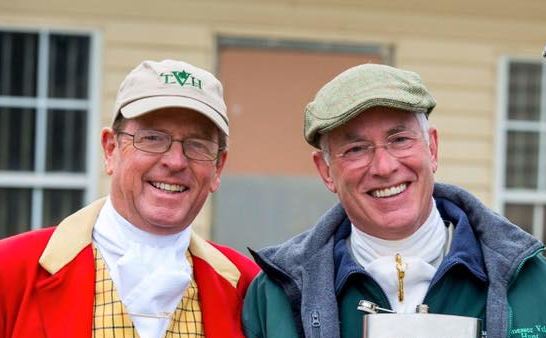
Epp Wilson, MFH, Belle Meade Hunt and Grosvenor Merle-Smith, MFH, Tennessee Valley Hunt are two men who create sport wherever they go. / Allison Howell photo
In January of 2010, Tennessee Valley Hunt had a three-day joint meet with the Belle Meade Hunt down in Georgia. Belle Meade’s MFH and Huntsman, Epp Wilson, had last hunted with TVH’s MFH Grosvenor Merle-Smith when Gro was huntsman for the Bull Run Hunt in Virginia several years earlier. They had what Epp described as an “epic” hunt chasing fox. The two huntsmen had finally organized a recap of that memorable hunt, and the expectations of both men were very high for the weekend.
Twelve of us Tennesseans trekked south to Georgia just west of Augusta. Included were Grosvenor, his wife Rosie Merle-Smith, MFH, and our TVH huntsman Beth Blackwell who brought about eleven couple of Penn-Marydels.
The Hunt
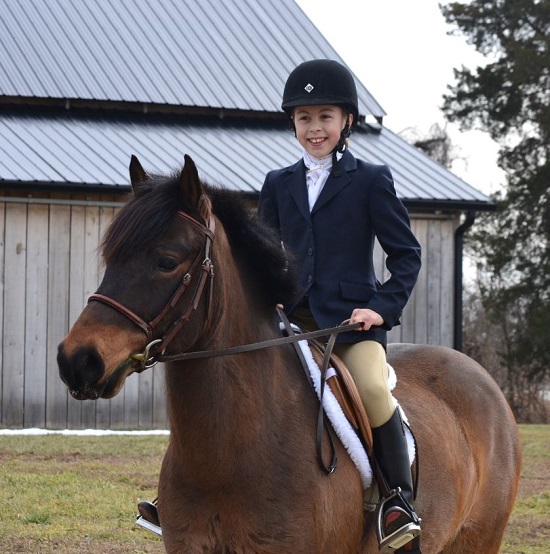
Enjoy this foxhunting essay by ten-year-old Libby Nelson. It was awarded second place in the United States Pony Clubs Hildegard Neill Ritchie Foxhunting Writing Contest. Judges were Nancy Ambrosiano, former USPC Foxhunting Committee chair; Mary Pierson, lifelong Pony Club supporter; and yours truly from Foxhunting Life. Libby is a D-2 member of the De La Brooke Pony Club in the Maryland Region and aspires to be a junior whipper-in with the De La Brooke Foxhounds.
Libby Nelson and Gallant Gabe
I was cantering through the beautiful autumn woods when someone yelled, “Fox!” My horse reared and in lightning speed I was on the ground and thought to myself, “Back to dream horse.” I had grown out of my pony a few months ago and I was looking for a calm, safe foxhunter. I was taking a gorgeous grey out hunting. He was supposed to be a “gem.” Apparently he has a fear of foxes. This guy wasn’t as much of a “gem” in the hunt field.
The next day I found a bold bay and took him hunting. I was all packed and ready to go. It was time to load him on the trailer when his owner called. She said she had forgotten to tell me that he doesn’t load without his friend, Clyde. After two hours of trying to get him to load, I had to accept the fact that I was going to miss the hunt.
The Cad, Part II
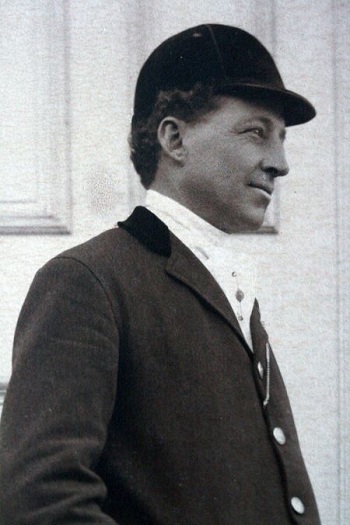
Martha wrote this story after studying the unpublished manuscript, The Life of an American Sportsman: Being Reminiscences by Harry Worcester Smith, during the course of her 2016 John H. Daniels Fellowship at the National Sporting Library & Museum in Middleburg, Virginia. (Part I was published last month.)
Harry Worcester Smith in hunting attire, circa 1910, from the Harry Worcester Smith Archive (MC0041), National Sporting Library & Museum.Undeterred by his spills the spring and summer of 1900, and against everyone’s advice, Harry entered The Cad in the $10,000, three-and-a-half mile Champion Steeplechase at Morris Park (in what is now The Bronx, NY), Saturday, October 6, 1900. Ollie Ames met him at the clubhouse that Saturday morning.
“You are not going to run The Cad are you?” Harry recalls Ollie saying. “He’ll break your neck!” Next, Mr. B. F. Clyde of Philadelphia admonished him, “Now, look here, Harry Smith, I have seen you ride a great many times around New York, Philadelphia and Saratoga; I have the greatest admiration for you as a sportsman, in fact I am very fond of you. Now, Please don’t take your life in your hands and ride The Cad today against all those professionals.” It seems Mr. Clyde had his money on another horse; Harry thanked the man and walked away. “Then, about noon,” Harry writes, “a Western Union boy came up and handed me a telegram. It was from Mrs. Smith: ‘Don’t ride, get best professional possible. Signed, ‘Mildred.’”
The Purebred and The Mutt

With permission, here is the first chapter of The Great Hound Match of 1905 by Martha Wolfe (Lyons Press). The Library of Virginia has selected Martha’s work as a potential Best Book of 2016 in the Non-Fiction category. Readers may cast their votes by clicking here.
A. Henry Higginson, MFH, Middlesex Hunt, in derby and spats with huntsman Robert Cotesworth and his imported English foxhounds of the period. / Courtesy, National Sporting Library and Museum
Storytellers claim that there is really only one story in the world: “A Stranger Comes to Town.” In this case, two strangers came to two towns in Virginia bringing with them their separate entourages—private train loads of friends and their horses, trunks of tack, boots, formal and informal clothing, food and wine, servants and of course their hound dogs. Neither Middleburg nor Upperville, Virginia, had seen the likes since J. E. B. Stuart established his headquarters at the Beverage House (now the Red Fox Inn) in Middleburg during the Gettysburg Campaign. Alexander Henry Higginson of South Lincoln and Harry Worcester Smith of Grafton, Massachusetts had determined that the Loudoun Valley in Virginia’s pastoral Piedmont was the best place to prove the relative worth of their chosen foxhounds.
The Purebred and The Mutt
With the kind permission of the author, here is the first chapter of The Great Hound Match of 1905 by Martha Wolfe. The Library of Virginia has selected Martha’s work as a potential Best Book of 2016 in the Non-Fiction category. Readers may cast their votes by clicking here.
A. Henry Higginson, MFH, Middlesex Hunt, in derby and spats with huntsman Robert Cotesworth and his imported English foxhounds of the period. / Courtesy, National Sporting Library and Museum
Storytellers claim that there is really only one story in the world: “A Stranger Comes to Town.” In this case, two strangers came to two towns in Virginia bringing with them their separate entourages—private train loads of friends and their horses, trunks of tack, boots, formal and informal clothing, food and wine, servants and of course their hound dogs. Neither Middleburg nor Upperville, Virginia, had seen the likes since J. E. B. Stuart established his headquarters at the Beverage House (now the Red Fox Inn) in Middleburg during the Gettysburg Campaign. Alexander Henry Higginson of South Lincoln and Harry Worcester Smith of Grafton, Massachusetts had determined that the Loudoun Valley in Virginia’s pastoral Piedmont was the best place to prove the relative worth of their chosen foxhounds.
It was November of 1905, the peak of foxhunting season across the Midlands of England and up and down the east coast of North America and these folks had come south from already snow-covered New England to the relatively mild winter in Virginia to hunt her plentiful red foxes. There was to be a contest, a Great Hound Match, between two packs of foxhounds, one English and one American. The English hounds carried, on their great stout forearms and deep chests, the monumental weight of centuries of foxhunting in England and were expected to make their hound dog ancestors proud of their New World conquest. The American hounds were expected to show those stodgy old Brits how it was done over here—with spunk and intuition, individuality, drive and nerve. Of course the dogs just wanted to chase a fox or two; it was their Masters who loaded the poor hounds and The Match, this moment in history, with the weighty question of worth.
Pink Gin—The Beer-Swilling Timber Horse
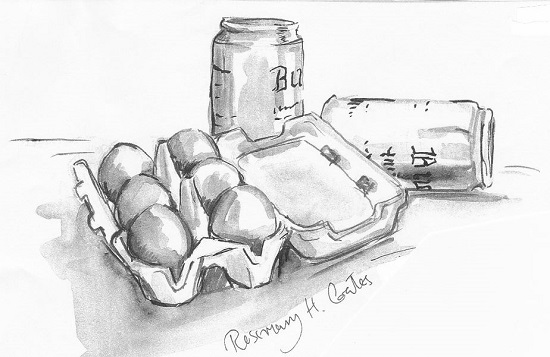
Back in the late 1950s, Deirdre and her friend Sarah, both just nineteen, came to America. The pair had left Britain, where post-war ration books were still in use. Sarah was to train horses and riders for Jamie Kreuz at Bryn Mawr Farms outside Philadelphia. Deirdre was to work for the Insurance Company of North America in Philadelphia and help Sarah on weekends. What follows is Part III of their adventures, which have included Part I: “How to Bridle a Green Field Hunter,” and Part II: “The Witch With Warts.”
Illustration by Rosemary Coates
We had not been long in the States when Pink Gin arrived at Bryn Mawr Farms. Billy, who mucked out for us, was, as usual, the first to find fault with him.
“He do get drunk, he do. Proper beer-swiller he be. And he eats eggs and molasses with all his feed. Lord, if only I could eat like that!”
Pink Gin (not his real name) was a timber horse with a record of wins. Since most timber racing is in the spring, pre-season training often means blizzards and temperatures averaging ten degrees Fahrenheit. This was one of the reasons for the high-calorie diet that included beer and eggs.
The Cad, Part I
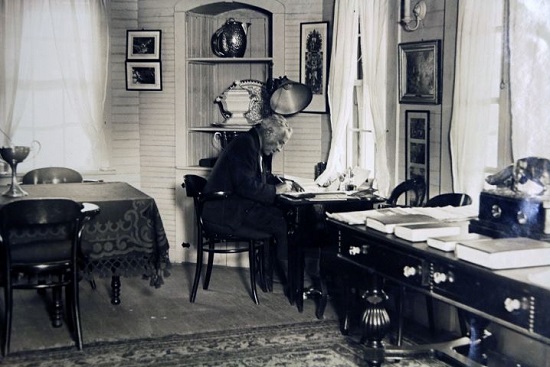
Martha wrote this story after studying The Life of an American Sportsman: Being Reminiscences by Harry Worcester Smith during the course of her 2016 John H. Daniels Fellowship at the National Sporting Library & Museum in Middleburg, Virginia.
Harry Worcester Smith at his writing desk, possibly in Aiken, SC or Grafton, MA / Courtesy of NSL&M
I’m not sure that many people would have characterized Harry Worcester Smith as a good-for-nothing “cad.” On the other hand, neither might they have called him a gentleman. He was highly opinionated and he had a temper. He had a wicked sense of humor and he suffered no fool. He was a scalawag, a bit of a braggart, maybe a knave, possibly a scoundrel. It’s perhaps divine providence or poetic justice that his favorite horse, his horse-of-a-lifetime, was named “The Cad.”
Colour

We see every color of horse in the hunting field. And while foxhunters really shouldn’t care about color, I’m guessing that many riders have a preference. Right or wrong, I know I do. In this photo, several horses of varying colors are crossing the country well. We may be missing more colors than we care to, but we hope you’ll get the idea.
Keeping up with the Blue Ridge hounds in Virginia are (L–R) Cyrus (a paint) owned and ridden by Karel Wennink; Guitar (a “black-pointed bay”) owned and ridden by your editor; Hot Rize (a “black-pointed bay” and winner of the 2014 Virginia Gold Cup) owned and ridden by Russell Haynes; and Very Berry (a roan) owned and ridden by Jef Murdock, MFH, Old Chatham Hunt (NY). / Nancy Kleck photo
Colour by Edric G. Roberts
The old saying, so often repeated,
That ‘there never was yet a good horse
Of a really bad colour,’ is greeted
With a shrug, as a matter of course;
To the past it is now relegated
As the lore of some old-fashioned school,
Which believed in tradition that rated
An exception as proof to the rule.
The Lad and The Huntsman
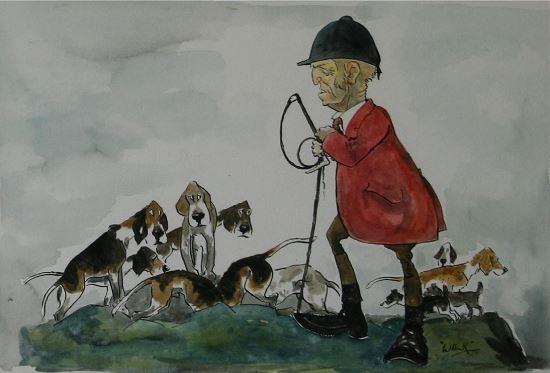
What follows is the author’s Introduction to his forthcoming book, Chappie: color cover, black and white illustrations, about 6 x 8-1/4 inches, $45.00 USD (price includes postage), release date August, 2016. Fifty copies will be printed; half are already pre-sold. Click for purchase instructions.
Chappie, painting by Wilk, reproduced with permission
One morning in the early 1960s, a young lad took a day off school to go hunting; he had planned it down to the smallest detail. Hounds were meeting in the Troutbeck valley at 9:30, but that was on the other side of the 1601-foot-high fell known as Wansfell Pike. As usual he left home about 8:15 am but instead of heading for the playground near the church to meet his mates and play football, he turned left at the Salutation Hotel and took the road for Wansfell.