
Running Commentary on a Point-to-Point
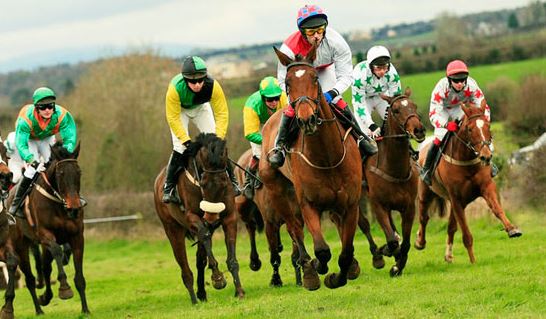
Will yis stop pushing behind there or you’ll land me into the ditch. Can you see the horses, Mary Ellen? They’re down at the starting post; and I’ll be down in this drain if yis don’t quit shoving. Haven’t you the whole country for a grand-stand, and why must you all crowd me off this one bit of a bank? There’s lashings of room for all, if yis id have a bit of —. Oh, be the lord Harry! They’re off! There’s the hunting horn. Can you hear it, Mary Ellen? Great God, how the sound of it warms my old heart.
What a wonderful start! There’s The Holy Terror lying third with our wee Jamesy riding him. Can you see his green jacket, Mary Ellen? They’re coming to the first jump. God be with the day when I could show them boys how to ride a Point-to-Point: but these old rheumatics—these old rheumatics! Now they’re at it. They’re over. Wee Jamesy’s there, Mary darling, and going like a Trojan. Now they’re coming to the first bank. Jamesy’s dropped back to fourth. That’s what I like to see! Holding his horse together: just what his father would have done. Leave the pace-making to someone else.
Duhallow Foxhounds at Monymusk Stud
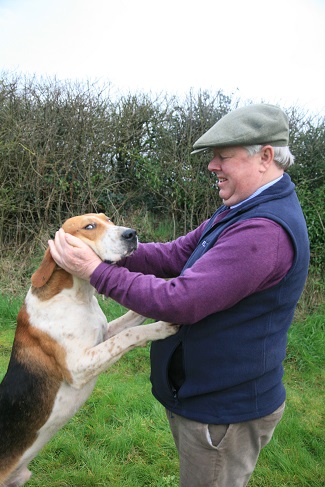
Author and friend / Catherine Power photoWith the season winding down, we decided to keep the best wine ’til last…or very nearly so. Monday saw us with the “Dashing” Duhallow at their meet at Monymusk Stud in Kanturk. The Duhallow is the oldest hunting establishment in Ireland with foxhounds, and has hunted the country continuously since 1745. The market town of Kanturk is looked on as the capital of the ancient barony of Duhallow, so it seemed a suitable venue on which to end their season.
Monymusk, now the property of Duhallow Senior Master Kate Jarvey, was bound to be a gala occasion, and so it proved. Kate holds the unique distinction of being Master of two of Ireland’s leading packs simultaneously—the Duhallow and neighbouring Scarteen. Her great-grandfather was Ely Lily of pharmaceutical fame, and she was brought up during Cape Cod summers near the Kennedy family. Kate is also a former chairman of the Irish Masters of Foxhounds Association. Sadly she was not riding as she is recovering from a broken hip, the result of an unfortunate schooling fall just after Christmas.
Riding a Point-to-Point
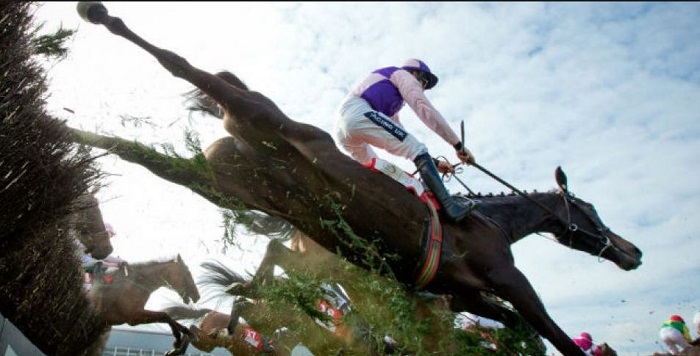
We are all lined up at the starting-post in the nearest thing to a straight line that a troublesome bay horse will allow. His green-clad rider is fighting desperately to prevent the brute from savaging every other fairly-well-behaved entrant in the race. Soon “Away you go! And good luck to you!” is heard as the flag drops; and the Starter sends a further God-speed to our thundering hooves with the merry notes of a “Gone Away” on his hunting horn.
The first fence looks like a strip of dark green canvas stretched between two groups of people. With a railing of human beings lining its approach on left and right, horses seem distracted, and treat the fence rather carelessly. Luckily it is only a simple gorse-built affair; though the horse on the left refuses it.
Flinging it behind, horses race away with renewed fury. The chestnut in front is setting a terrific pace. His rider endeavours to get him settled down, but with little success, and he leads over the first bank like a Derby winner. People are no longer crowding the fences and horses have less to distract them at their work. An open ditch yawns malevolently, but the pace affords scant opportunity for an examination of its width. A bank looms in front, and if that chestnut leads us to it at this pace some of us will see the inside view of an ambulance. Every stride makes it grow bigger. The chestnut’s at it he’s over; bay beside him crashes—went too close and hit his knees two horses out of it already. “Hey! Don’t ride me in on top of him! Pull over!”
How Randy Rouse’s National Fence Saved Steeplechasing
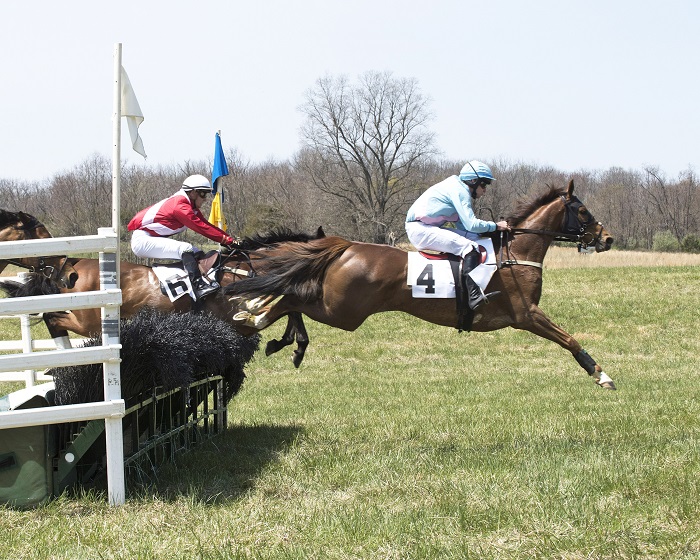
Steeplechase horses swish through the man-made national fences routinely at most hurdle races around the country today. Brush fences were once expensive and time-consuming to set up, and racetracks were dropping steeplechase races from their cards. / Joanne Maisano photoIt was autumn of 1973, and the world was in turmoil. U.S. forces were pulling out of Vietnam, the Watergate scandal was rocking the nation, and a looming energy crisis was getting global traction.
The steeplechase circuit, too, was in a state of flux. The year before, the bottom had fallen out of the industry. New York basically kicked out the jumpers and went from eighty-three jump races at Belmont, Aqueduct, and Saratoga in 1970 to fifteen in 1973. And those were at Saratoga only.
An American Foxhunter Meets the Irish Banks
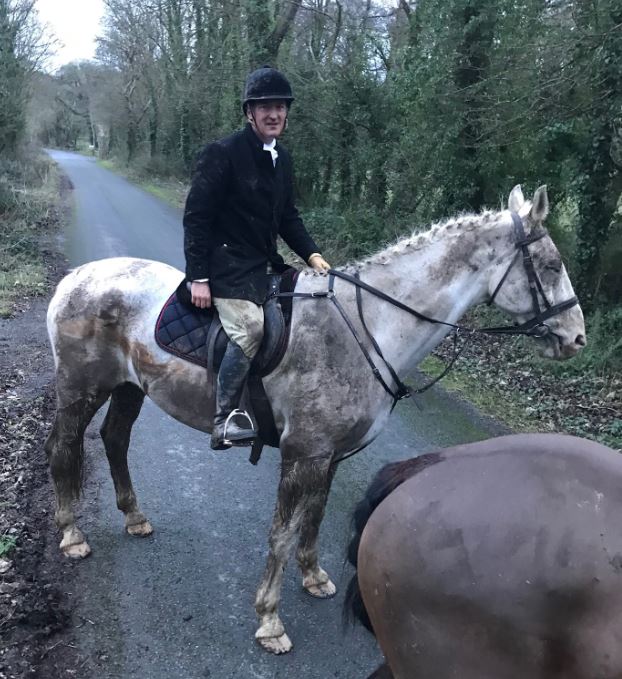
The author on Gus: muddied but unbowed / John Flavin photoDid you ever hear the expression “cheating death?” This question was posed to me by Bob Goodman, my newfound friend and fellow foxhunter, as we both emerged from one of those double drain jumps common to the south of Ireland. The question carried added meaning coming from Bob, a former Air Force fighter pilot with 336 combat missions in Vietnam.
I arrived in Ireland on January 18, 2019 and made my way from the airport straight to Flavin’s stable near Tramore in County Waterford to practice jumping banks and ditches before the next morning’s hunt. On a good horse who knew his business, I found these obstacles to be easy enough, and I was assured that actual hunt conditions would be no more challenging than these practice jumps. Although confident, I had a sense that actual conditions might in fact be different…
Ancestors In The Dark
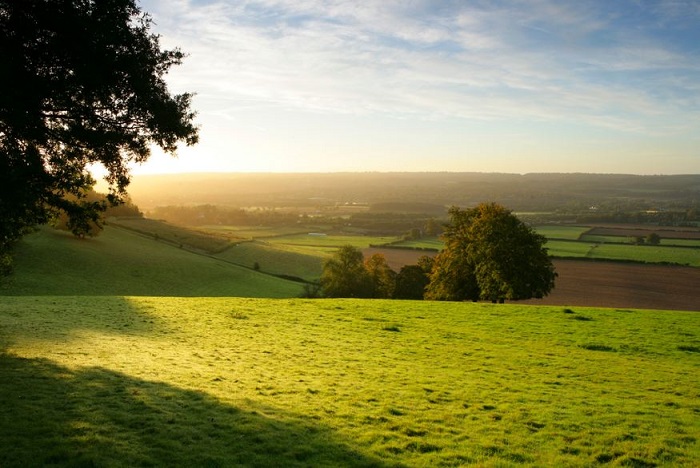
North Downs Way, Kent, England
The light fades fast on a December day in the rolling chalk hills, the centuries-old beech woods, and the ancient countryside of the North Downs in the county of Kent in England. It is Roman country…old Roman country. The Roman presence can still be seen and felt there. Watling Street, now a motorway, was built by the Romans to conduct their chariots from the chalk cliffs of the coast at Dover to old Londinium. London today, of course. Straight as an arrow and solid as the rock foundations on which it was built. In places, you can still see the wheel ruts worn down by the centuries of travel.
Here too, in the well-trodden countryside, ancient history’s presence is felt as the Pilgrim’s Way meanders through the landscape from Winchester to the Thomas Becket shrine in Canterbury Cathedral. Much of the route of the Pilgrims Way follows an ancient track dating back to 500 BC.
Young Handlers Classes Popular in UK
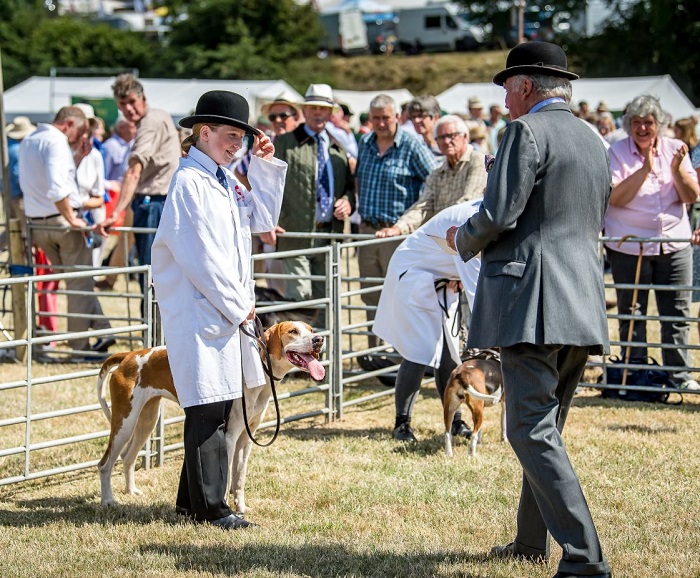
Captain Ian Farquhar and young handler at the West of England Hound Show, Honiton, in 2018 / Sarah Farnsworth photo
In response to the success and popularity of the Young Handlers Class established at the West of England hound show at Honiton, the organisers of The Harrogate and Peterborough hound shows have decided to hold their own young handlers classes for all hunts exhibiting at these shows in 2019.
Young Handlers Classes have been held for a great many years in the United States, chiefly at the Virginia and Bryn Mawr Hound shows, so we were delighted when, in the summer of 2016, the first Young Handlers Classes were held in England at some of our northern shows. The enthusiasm and zeal of these youngsters was remembered by those who ‘organise,’ and the following year at Honiton a full class of twenty youngsters put themselves forward to compete for the Captain Ronnie Wallace MFH Perpetual Memorial Trophy. The winner also received a hunting horn, and rosettes commemorating their participation were awarded to all entrants.
Grallagh Harriers at Meadow Court Hotel, Galway
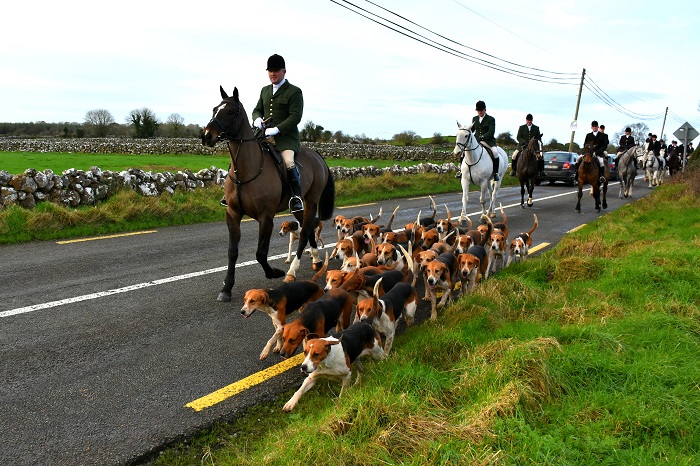
The Grallagh Harriers Master and huntsman David Burke and field move off from the meet at the Meadow Court Hotel near Loughrea. / Noel Mullins photo
The Grallagh Harriers hunt much the same country as the Galway Blazers. The meet was at Meadow Court Hotel in Co. Galway, near my hometown of Loughrea. It brought back many happy memories so close as it is to St. Clerins, the former home of film director John Huston who wrote the screen play and/or directed such classic films as The Maltese Falcon, Treasure of the Sierra Madre, Asphalt Jungle, African Queen, and Moby Dick. The list goes on. He won the Oscar twice and directed his father Walter and his daughter Anjelica to Oscar-winning roles as well.
John Huston was MFH of the Galway Blazers in the 1960s. It was nothing unusual to see his house guests following the hunt by car―Hollywood film stars like Cary Grant, Spencer Tracy, Katherine Hepburn, Orson Wells, playwright Jean Paul Sartre, or Paul Newman who bought a Connemara Pony from Lady Anne Hemphill.
Siegfried Sassoon, Foxhunting, and the Great War
Siegfried Loraine Sassoon (1886-1967), poet and novelist, platinum print, wearing military uniform with the collar badges of the Royal Welsh Fusiliers and hat, Beresford’s stamp and copyright line on verso, 6 x 4½ in (15.2 x 11.5 cm). Accessed via Wikimedia Commons, January 2019.The National Sporting Library in Middleburg, Virginia, holds some 956 books on “foxhunting,” ranging in date from J. Roberts, An Essay on Hunting (1733) to Alastair Jackson, Lady of the Chase: The Life and Hunting Diaries of Daphne Moore (2018). Anyone likely to be visiting this website will know all the familiar names, from the prolific Nimrod and Robert Smith Surtees, to the less widely published William Scarth Dixon and Willoughby de Broke (Richard Greville Verney), to writers primarily known for one seminal work: Anthony Trollope, Hunting Sketches (1865), or George Whyte-Melville, Riding Recollections (1878).
The Library’s holdings from the twentieth century alone total an impressive 602 works. They also include many by familiar names, such as the “standards” J. Stanley Reeve and A. Henry Higginson or, more recently, Michael Clayton and Alexander Mackay-Smith, as well as a number of influential works by women writers, such as Lady Diana Shedden and Lady Apsley, “To Whom The Goddess . . .”—Hunting and Riding for Women (1932), Lida Fleitmann Bloodgood, Hoofs in the Distance (1953), and E.V.A. Christy, Cross-Saddle and Side-Saddle (1932), one of many books on equitation that include the demands of riding across country.
Many of the 20th century works, most of them held by NSLM, date to the interwar years. Citing 177 examples, Anne Grimshaw (see list of Works Cited below) has estimated that books specifically on hunting published in England between 1919 and 1945 accounted for “25% of the total output of equestrian literature” (Grimshaw, 160). Included in this group is at least one title of signal literary merit: Memoirs of a Fox-Hunting Man, published by the distinguished poet Siegfried Sassoon in 1928 as the first volume of what would become a Great War trilogy, The Complete Memoirs of George Sherston (1937).
The Scarteen at Lattin and Knockcarron
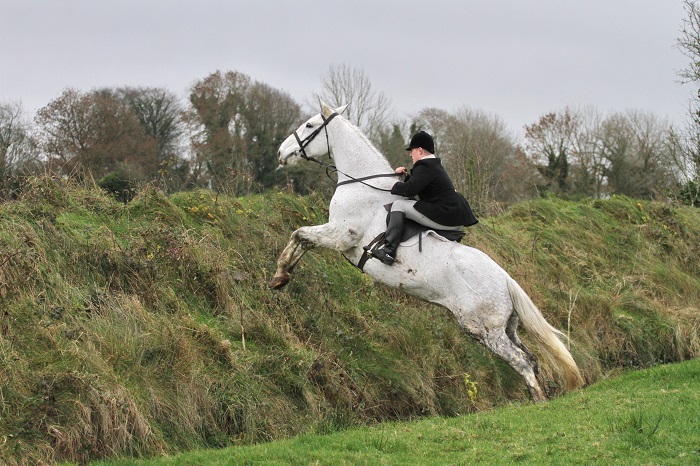
John Halligan stretches for a big double at Lattin. / Catherine Power photo
Spoiled for choice with three top-class Scarteen meets back-to-back, it appeared only logical to cover all three. With Christmas comes a choice of great hunting, and with scent (that essential but illusive ingredient) improving daily, the omens were good. And so it proved.
The little village of Lattin is so called because it was a seat of learning in the middle ages. The story goes that a weary traveller asked the way to Emly Cathedral of three roadside workers. The first answered in Gaelic while the second disagreed in Lattin, but the definitive directions were given in Greek. Gone are the classics, and the little village on the Tipperary/Limerick border would hardly warrant a backward glance from motorists today, but on a Scarteen hunting day it becomes a mecca. Keen enthusiasts arrange days off, marriages are postponed, and births delayed so that they might be there because it is a special place. Horses had been rested or galloped with the point-to-pointers in preparation for the day.