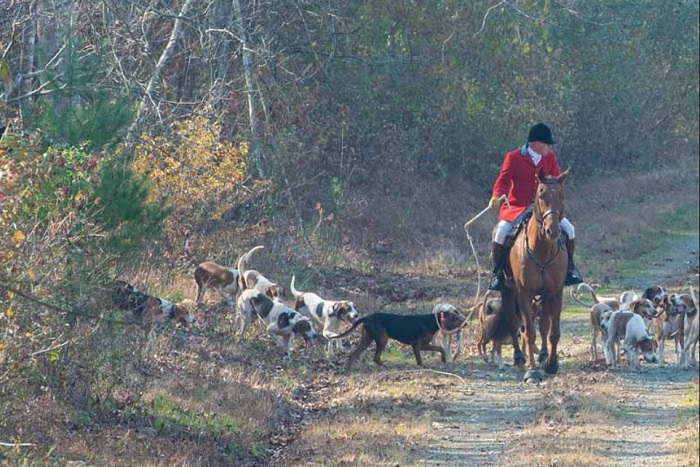
 Professional huntsman Matthew Cook and hounds of the Farmington Hunt (VA). / Cathy Summers photo
On a hot midsummer afternoon, huntsman Matthew Cook rode up to meet me on a green John Deere lawn mower. Cutting grass is just part of the work it takes to maintain the grounds and kennels at the Farmington Hunt Club (VA), home to sixty noisy, rambunctious foxhounds.
Coming to Farmington in the summer of 2013 from the Los Altos Hunt in northern California, Cook faced a new set of challenges, both in topography and local culture. He was learning his new job in the shadow of the forty-year reign of the revered Jill Summers, MFH, whose practice and policy of hunting only foxes laid the foundation for Farmington’s hounds. The pack was bred and trained to ignore anything non-vulpine.
Coyotes were a growing threat to the ecosystem in Virginia, and Farmington remained one of the last recognized hunt clubs in America that had not yet loosened its rules as to acceptable quarry and submitted to the pressure of coyotes moving into the area.
Cook arrived with the right experience. He had hunted coyotes almost exclusively while working in California and Nebraska. Coyotes were moving into Virginia and the fox population was adapting.
“It was frustrating for the hounds and for the staff to have to continually stop them when they’d get on [the scent of] a coyote. It just seemed like time to make a change,” Cook recalled.
Cook and his family are British by birth and Virginians by choice. Trained in England, Cook started his professional career after high school as a gamekeeper, later moving into hunt service as kennel man and whipper-in and ultimately moving to America after an intermediate assignment with a private hunt club outside Rome, Italy. When the position of huntsman opened at Farmington, the Cook Family had young children and enough youthful energy to move cross-country with their own dogs and horses in tow. Cook took over the job left behind by fellow countryman Daron Beeney, who had served as huntsman for Farmington for more than a decade and left big boots to fill.
Nearby in the stable, three horses and a gang of house dogs and cats milled about as Cook’s wife Julie and eight-year-old daughter Pippa fed the staff horses before turning them out in nearby paddocks. Chores are a family affair, carried out all year long in all weather, twenty-four hours a day, seven days a week, through heat of the summer and frozen days of winter. As summer winds down, the professional huntsman’s work to prepare the pack for the coming season is about to begin.
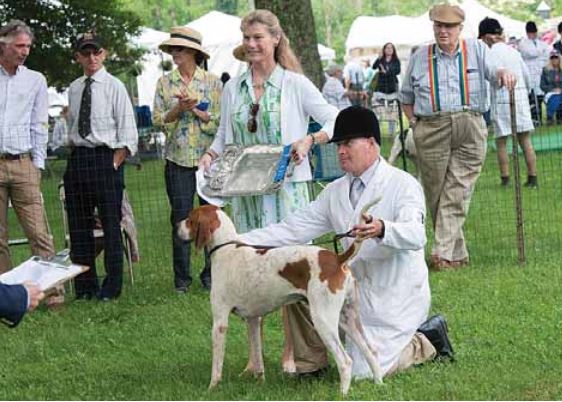 Joy Crompton, MFH displays trophies won by Farmington’s American foxhound at the Virginia Foxhound Show. Huntsman Matthew Cook shows his winning hound.
It is quite a challenge to get a group of hounds to work well together, especially those not expected to, in fact trained not to hunt coyote. Over the last four seasons, Cook has culled the older hounds that were no longer able to keep up, trading them to neighboring hunts, and taking on younger hounds that showed potential. By participating in foxhound performance trials, such as the event Farmington attended at the Belle Mead Hunt in Georgia last January, and entering regional hound shows, such as the Virginia Hound show held each year in Leesburg in May, he has strengthened relationships with other huntsmen with whom a fair bit of trading and breeding takes place.
According to guidelines set by the Masters of Foxhounds Association, foxhounds are not sold. Ownership is transferred by drafting and cross-breeding between clubs under the direction of Masters in cooperation with the professional huntsman.
Cook consults with other hunt Masters to breed Farmington hounds for desirable traits such as good voice (the term used to describe a hound’s cry following a scent). Much of Farmington’s territory has smaller parcels of farmland interspersed with woodlands and streams with steep and rugged banks that can play havoc with sight and sound. “When they are hunting along the river or behind a ridge, I can’t always see them, but I need to be able to hear them!” Cook said.
He is pleased with the pack’s progress under the new expectations. “I think the pack is starting to come together,” he said. “It takes three years to make a good hound. It’s a real investment. Ideally, in order to compensate for natural attrition due to age, infirmity, and changes in circumstances that account for an annual turnover of about twenty percent, I would like to have up to forty couple of hounds in our pack, and that takes time.”
Farmington hunts over land in southern and northwestern Albemarle and Greene counties, the hunting borders of which are recorded by the Masters of Foxhounds Association, an international association that governs all hunts in North America and Canada. The Association was established in 1907, initially to prevent territorial conflicts between hunt clubs and to maintain a stud book of foxhound pedigrees.
Permission to hunt is granted by private landowners willing to allow access to their farms. Joy Crompton, Joint-Master of the Farmington Hunt Club, said, “Permission to allow foxhunting is not so much a service for the farmer but a field sport for the enjoyment of the landowners who ride and the people who support the conservation of the land required to fox-hunt. Killing the fox or the coyote is not the goal so much as the challenge and fun of the chase. It’s a privilege and pleasure getting out in the beautiful countryside that we have, and appreciating the natural environment, with the desire to preserve and protect the wildlife that live there.”
Cook echoed Crompton’s words. “Enjoyment,” he said. “I just want to see people out here enjoying the sport.”
This year, Cook will start the informal hunting season, designed to train young hounds to hunt, in early September with a pack of approximately twenty-eight couple of mostly American hounds. As the weather turns cooler and the farmland is cleared of harvested crops, the formal hunting season will begin. The season will continue throughout the winter until mid-March, just before the next generation of fox kits and coyote pups are born and the cycle of life begins anew.
Posted February 19, 2018
A similar article appeared in The Virginia Sportsman, Winter, 2017 Edition.
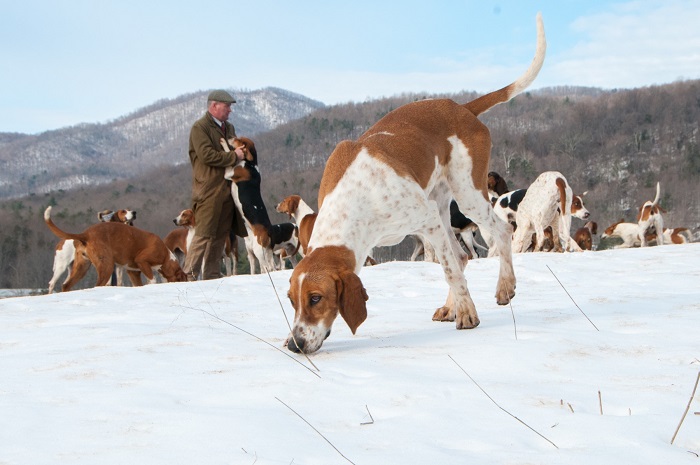 Farmington huntsman Matthew Cook walks out hounds on a non-hunting day. / Chris Middleton photo