
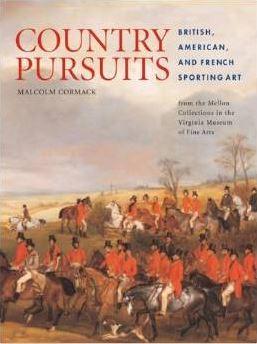
 Country Pursuits: British, American and French Sporting Art from the Mellon Collections in the Virginia Museum of Fine Arts, by Malcolm Cormack, Published by the Virginia Museum of Fine Arts in association with the University of Virginia Press, 2007, 474 pages, illustrated, $62.00What a debt we all owe the late philanthropist Paul Mellon, whose love of horses and horse sports was expressed through the fabulous art collections that he so generously shared with us.
The Eclipse Award-winning breeder saddled legendary Thoroughbreds Sea Hero, Arts and Letters, and Mill Reef, just to name a few. His first British art purchase, in 1936, was a painting of a racehorse, “Pumpkin with a Stable-lad” by George Stubbs, said to be his favorite painting by one of his favorite artists. Pumpkin won sixteen out of his twenty-four races at Newmarket turf in the late 1770s and was described as an excellent runner.
“It was my very first purchase of a painting,” Mellon recalled later, “and could be said to be the impetus toward my later, some might say gluttonous, forays into the sporting art field.”
That Stubbs painting was donated to his alma mater, Yale, but the Virginia Museum of Fine Arts was another lucky recipient of Mellon’s “gluttonous” obsession with sporting art. Mellon’s donations are explored in Country Pursuits: British, American and French Sporting Art from the Mellon Collections in the Virginia Museum of Fine Arts by Malcom Cormack. Cormack was the Paul Mellon Curator at the VMFA in 1991 until his retirement in 2004. He also once served as the Curator of Paintings at the Yale Center of British Art established by Mellon.
Mellon’s interest in sporting art was rooted in his days as a student at Cambridge (1929-1931) when he hunted with the Fitzwilliam, Quorn, Belvoir, and Pytchley hunts. He also was a frequent spectator at Newmarket, where he developed a love of horse racing. Self-described as a “galloping Anglophile,” Mellon was an accomplished rider, later becoming the revered Joint-Master of the Piedmont Fox Hounds (VA).
Mellon always felt like British sporting art was not appreciated as “true art,” writes Cormack. One London art dealer said of Mellon that “It took an American collector to make the English look again at their own paintings.”
The Mellon Collections artwork includes scenes of horse racing, foxhunting and coursing, shooting and fishing, coaching and carriages, and other country pursuits by artists such as George Stubbs, John Wooton, Sir Alfred J. Munnings, Alfred de Dreux, Edward Troye (currently featured, through March 29, 2015, at the National Sporting Library and Museum (NSLM) in Middleburg, Virginia), and others not as well known. Cormack introduces each of the three collections—British, American, and French—with an essay about the sports of the time and how the artist and his art fit into that history.
The full-color photos of each painting are accompanied by meticulously researched descriptions, and Cormack often gives the reader an insider view of what is going on. In many of the foxhunting paintings, the riders are real hunt members. And some artwork is quite humorous. A series of ten paintings by British artist John Ferneley Sr. shows Count Sandor’s many misadventures in the hunting field. The poor count is shown breaking fences, getting kicked, and taking a damp dive into a ditch, but the last sketch portrays the count “doing the thing well” as he daringly jumps one-handedly without falling off.
Cormack includes short biographies of the artists and the provenance of each painting, including a portrait of Napoleon III once owned by Empress Eugenie.
At $62.00 and a hefty 474 pages, the beautifully produced book commands a royal price, but it can be found online for less, a bargain for the wealth of beauty and knowledge on its pages.
In his autobiography Reflections in a Silver Spoon, Mellon wrote: “I have been an amateur in every phase of my life; an amateur poet, an amateur scholar, an amateur horseman, an amateur farmer, an amateur soldier, an amateur connoisseur of art, an amateur publisher, and an amateur museum executive. The root of the word ‘amateur’ is the Latin word for love, and I can honestly say that I’ve thoroughly enjoyed all the roles I have played.”
And aren’t we lucky he preserved such an immense body of work for us, not only in his own collections, but worldwide by helping to establish sporting art as a worthy genre of the fine arts.
Posted March 20, 2015