
My top moment of any Blackthorn & Brook holiday comes as our guests pull up after a run having encountered their first hedge. They make a fuss of their horse, turn to me and grin.
“I see what you mean about sitting up!” is a recurring comment.
Hedge-hopping is a much discussed feature of our holidays. The subject is met with excitement, trepidation, anticipation, fear, bravado, and everything in between, as it really is an unknown quantity for the majority of our American guests.
With this in mind, we have put together a short video and accompanying blog below, explaining a little of how we prepare ourselves and our horses for popping the hedges in style. What follows is a collection of basic principles that work for us. If anyone has questions or comments—challenges, improvements, ideas—we’d love to hear from you.
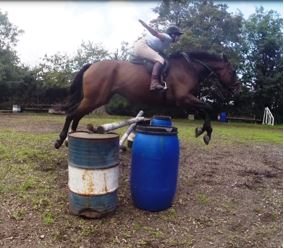 Megan works on her balance; no need for smart facilities!Starting Point
We understand that not everyone has the facilities to school their horse on an all-weather surface and practice over a cross-country course. (Nor do we!) These exercises can be mimicked with very basic drums and poles and the odd cross country fence. A hedge-like appearance can be given to a fence with the help of some brush. The idea is to get used to a hairier-looking fence.
Ideas to Consider
The main difference between jumping a hedge and jumping a rail is that you can’t see through a hedge. This means that you and your horse may not know how wide it is, or what is on the other side. There could be a ditch, wire, a boggy patch of ground, or a big drop.
To guard against the unknown, and to make sure we stay in the plate, it is often better to attack a hedge with a bit more impulsion than we would a rail fence. We want to make sure we clear the width of the hedge, plus any ditch.
It is better not to worry about seeing a stride. An experienced horse, like those we mount guests upon, will do it for you.
A more upright position (particularly on landing) helps to stop us from being thrown forward on landing.
We need to allow the reins to slide through our hands to make sure we don’t jab our horse in the mouth, and to allow him to balance.
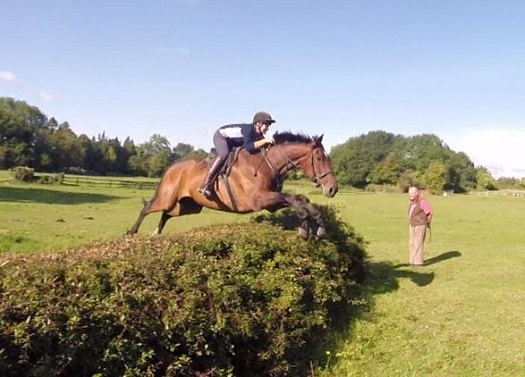 Soft hands and impulsion allows my horse to stretch over a hedge — under Grandpa’s watchful eye!
Rider’s Position
The aim is to remain safely in the saddle without getting in the way of our horse. We find the following three principles helpful.
Legs:
Keep them strong around the horse to give him confidence and maintain impulsion, with heels down as always. It helps to try not to let the legs creep too far back as you jump, as this will make you tip forward on landing.
Hands:
Soft hands are important so the horse can stretch and remain confident. During any iffy moments, it’s good to get in the habit of grabbing the neck strap to keep your balance, letting the reins slide so that the horse can balance himself.
Sit up:
Sitting and looking up keeps your weight back, making sure you aren’t thrown forward on landing, should there be any little surprises.
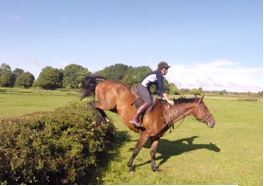 Sitting up on landing, legs forward, and letting the reins slide makes sure my horse stays confident and I stay in the plate!The Horse
Any horse you ride on one of our holidays will know his job. He will also be used to being left pretty well alone to tackle a hedge. To make his job easier, and to jump safely, here are three more principles to keep in mind.
Rhythm:
It is good to maintain a strong, forward canter into a hedge to make sure you clear its full width.
Straightness:
As with any fence, it is important to stay straight. With hedges in particular, jumping at an angle makes them even wider than they are! And by holding a straight line to the hedge, you minimize chances of collision with another horse.
Positivity:
Riding positively keeps the horse confident; in that frame of mind, he’ll keep jumping for you all day!
Final Thoughts
Please enjoy our accompanying video, and we look forward to seeing you mounted on a Blackthorn & Brook horse, jumping hedges in style with us in the very near future!