
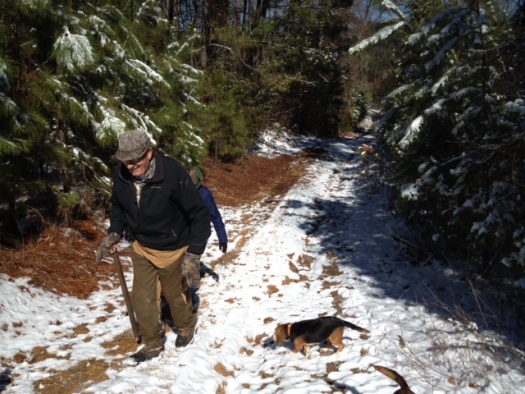
 Beagle huntsman Dalton Reeves
“My name is Dalton Reeves, I’m eighty years old and a retired high school football coach and teacher, originally from South Carolina,” our huntsman said, introducing himself to his field of foot-followers—mainly foxhunting guests and members participating in Belle Meade’s “Gone Away with the Wind” Hunt Week—some of whom were out beagling for the first time.
“I’m very happy to hear that I’m following an eighty-year-old huntsman,” I replied. “It means I’m not likely to get left too far behind, the prospect of which has been worrying me.”
“No worries,” Mr. Reeves assured me. “I’ve got two knee replacements and one new hip; I don’t travel too fast any more.”
That said, by the time Mr. Reeves brought the beagles in four hours later, I had been back to the deer camp meet three times to stick my boots into a fire blazing in an outdoor pit to thaw my toes. I also had a bite of breakfast and took a side trip with John McNeil, Sr. to the Rock House—thought to be the oldest house in the state of Georgia—previously a part of the McNeil property, over which the beagles were hunting, but now in the hands of the historical association. In between my retreats to comfort, I enjoyed along with the rest of the field several hours of hound music—some with voices that represented the beagle version of the booming “aroos” of the Penn-Marydel foxhound.
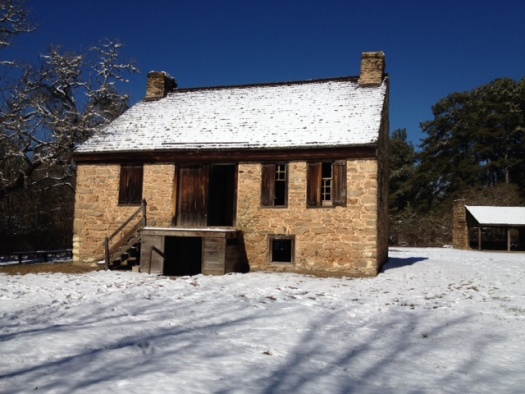 The Rock House, thought to be the oldest house in the state of Georgia
Populating the field were visitors Gwen Alred and whipper-in Barbara Smith from the Marlborough Hunt (MD) and Mike Coke; Terry, Emmaline, and Wilkes Cooper; Field Master Jean Derrick; Winser Exum; John McNeil; Chandler Tolbert; and Nancy Wilson from the Belle Meade Hunt on this cold but beautiful morning.
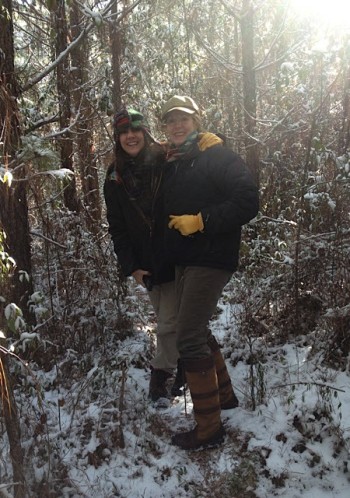 Beagling foxhunters Nancy Wilson, Belle Meade Hunt and Gwen Alred, Marlborough Hunt / Barbara Smith photoBelle Meade kennelman Chuck Terry brought four of his beagles to put in with Dalton Reeves’ four to make up our pack of eight beagles. No whippers-in were needed; the pack worked earnestly for our sport and stayed well in touch with their huntsman.
We had bright sun in a deep blue sky above and dry, powdery snow under our boots. Unusual for Georgia, the snow had fallen two days earlier but temperatures still dwelled in the basement. Any patches of bare ground were still frozen when the beagles were put into the first covert.
Unused to these scenting conditions—difficult enough even for hounds accustomed to frozen ground—the beagles had trouble pressing their quarry for the first hour. To their credit, however, every hound worked busily and happily—finding, losing, hunting, and finding again, continuously, without great reward. Slowly, though, as the sun arced higher, we could feel the snow softening underfoot, the bare patches beginning to yield footprints. Gradually scenting improved, and hounds were increasingly rewarded for their efforts. A rabbit was found that gave the pack a good run for a solid hour. The music soared through several circuits within the covert—large enough and thick enough to quash chances of any sensible rabbit quitting its environs and breaking into the open.
Another fine run of about forty-five minutes duration gave the field more music and an appetite for a hearty southern breakfast of egg casserole, sausages, biscuits, and grits prepared and served up by host John McNeil in his spacious and well-equipped camp kitchen—a converted migrant labor barracks harking back to a bygone era when the surrounding land, now grown up in pine trees and a thick undergrowth, was open cotton fields.
Posted February 10, 2014