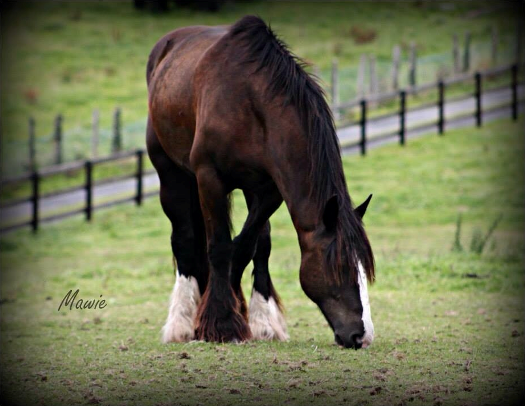
 Midnight, a 16-hh black Irish cob at Coopers Hill is everyone’s favorite, young and old.
How do I match riders I have never met with horses that will take care of them out hunting? The answer to that question starts with how the animal was gentled into riding and jumping to begin with. That’s the key.
It takes a number of years to get a horse hunting right. Anyone who hunts knows that you can get pullers, stoppers, and downright cranky horses. And then there are the ones that kick, bite, and buck. An odd buck of joy is fine, but the buck that is directed toward the rider’s dismount is coming from a horse that wasn’t respected and won’t give respect.
Down through the years the locals have brought very difficult animals to our yard for breaking. But we like to turn that word—breaking—on its head. We prefer to say we gentle and respect the animal and allow them the time to come to the conclusion that it is okay to accept the bit, okay to be brushed, okay to have their feet lifted up, to be saddled and eventually mounted. Some animals accept sooner than others simply because some trust sooner than others. The manner in which this is done determines the product—the horse—you are going to mount for your day’s hunting.
No, we are not sprout eating, peace pipe-smoking tree huggers. We are as hardy as the next hunting man. But to get a horse right requires time, patience, a gentle hand, and respect. That’s how to get a horse on your side—a horse that will give you his last effort and to even reach further down and give you what’s not there to give but will give it anyway. You all know what I mean: that extra effort when it’s needed.
As the son of a lifelong horseman, who himself comes from a horsey family, we at Coopers Hill have seen these horses in all their forms, shapes, breeds, and sizes. Our family’s horse knowledge goes back centuries with working horses, carting, ploughing, and training the odd local derby racehorse or point-to-pointer. While we never had the money to compete with the group-one winners, we could compete locally. To that end we held our own, and from that recognition we were known as good people to manage and turn out a horse. We have received awards from the Association for the Prevention of Cruelty to Animals and have won many rosettes at shows with ponies and horses in hand.
So riders comes to the yard and don’t know any horse from Adam. They have no confidence in the horses’ abilities. They may fear the prospect of hiring an animal that they are not used to, one that they have never laid eyes on before. How do we get riders to overcome their apprehensions?
When riders comes to Coopers Hill to hunt, the first thing we do is go on a hack. The first hack traverses Galway city to the beach to give riders an idea of how well mannered and schooled the horses are in traffic. It also gives the riders time to get used to the animals’ nuances. It also offers me an opportunity to gauge how the rider reacts and copes with a horse they have never ridden before.
The roads to the beach are busy and full of heavy, noisy traffic. There are many obstacles to pass before we arrive at the beach. Road works, traffic lights, roundabouts, bridges, trains, and even an army firing range all have to be dealt with. Most people who visit us have only ever ridden in the safe, controlled environment of a barn, trails on a private property, or show arenas. While our horses are immune to all these distractions, it is useful for me to observe the riders and to assess how they deal with a situation they, more than likely, have never been in.
The next scheduled event is popping some poles in the arena. This gives me the opportunity to see how each rider approaches a fence and how they cope with the jump on that particular horse. At this stage I make up my mind about the suitability of horse to rider. One just acquires the art of knowing which horse suits, and if it does not, selecting one that will suit that particular rider. A mount of different abilities may be selected for the rider—perhaps an animal with a slower movement and steadier jump. One not so poppy may suit one rider but not another. By now the riders will know they can jump on the selected animal and how their horse will behave in stressful environments.
Finally, to get the riders to experience what the animals can really do, they are taken on a cross country course with over fifty fences prior to their day’s hunting. None of the fences are the same: manmade, naturals, drops, water jumps, up-turned boats. By the end of this experience, the rider’s confidence should be through the roof for his or her horse. After having successfully navigated a challenging cross country course with the hired mount, the rider has by now bonded with the horse, trusts in its abilities, and feels safe with that horse. It’s time to hunt!
How do we match the rider to the hireling? First we have the patience to get the horse right before the rider arrives. Then we take the time to educate the rider and build a confident partnership between the two. It’s simple really: time, patience, hard work, and experience.
Posted December 12, 2013
For more information, visit Coopers Hill Livery on FaceBook.