Stu Grod Retires from the Field at Eighty-Four
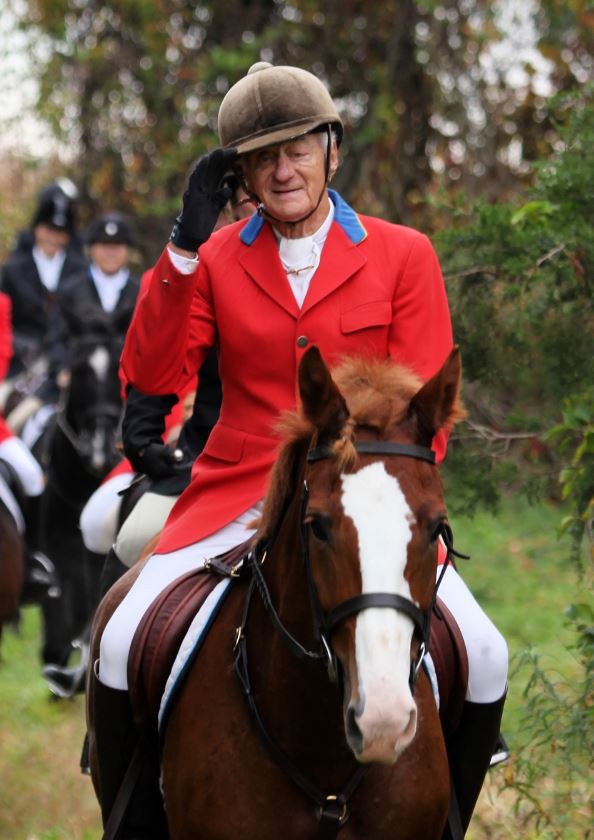
Julie Stuart Seger photoStuart Grod—popular field member of the Fairfield County Hounds (CT)—has retired after forty-three consecutive seasons hunting in the first flight. A retirement party was held in Stu’s honor at the hunt’s clubhouse on November 22, 2014, where well-known food and travel author Michael Stern read a poem he composed for the occasion.
“Build a bridge with your hands on the mane;”
“Trot smooth as you head for the jump;”
“Go light when your hands hold the reins;”
“And don’t crowd on the lead horse’s rump:”
Just some of Stu’s tips I’ve acquired
Since I started to ride with you folks.
I’ll miss you up there, you strange country squire
With your bright eyes, your wisdom, and jokes.
How They Do It at Belle Meade
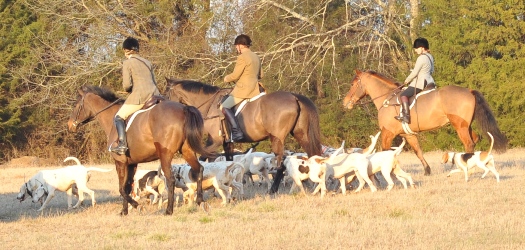
Epp Wilson, MFH and huntsman of the Belle Meade Hunt brings hounds to the first draw to kick off “Gone Away with the Wind” Hunt Week. Whippers-in Lucy Bell (left) and Natalie Gilmore flank the pack. / Lauren R. Giannini photo
“We have arranged to have ten coyotes on standby for your hunting pleasure today,” announced Joint-MFH Charlie Lewis as he welcomed guests to the opening meet of Belle Meade’s “Gone Away with the Wind” Hunt Week. It was Monday, January 27, 2014 in Thomson, Georgia. The footing was perfect and the sun was shining.
The following day it snowed, closing schools, paralyzing the Atlanta area, and prompting the governor to declare a state of emergency. The Belle Meade hosts were resilient, however, improvising substitute activities for members and guests for the very few events that had to be modified.
Hunt Week guests had come from the Blue Ridge Hunt (VA), Bull Run Hunt (VA), Golden’s Bridge Hounds (NY), Marlborough Hunt (MD), Millbrook Hunt (NY), Montreal Hunt (PQ), Moore County Hounds (NC), the Potomac Hunt (MD), Toronto and North York Hunt (ON), and the Whiskey Road Hounds (SC).
The Meet
The Belle Meade hounds typically meet at three o’clock in the afternoon. In the warmish environs of north Georgia, Senior Master and huntsman Epp Wilson likes to hunt as temperatures are dropping and scent is improving. Of course it often results in riders hacking back in the dark, and even jumping fences after sunset—an adventure in its own right for many followers!
Whipper-In: What’s In the Name?
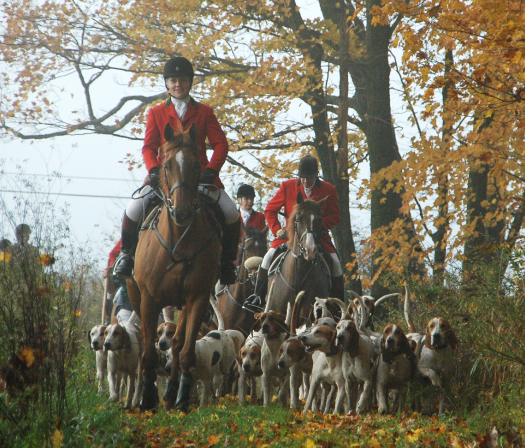
Booli Selmayr, professional whipper-in, Millbrook Hunt (NY): “A good day whipping-in is not having to be told, but instead, allowing natural instinct to guide me: listening to the horn and hounds, reading the terrain, and quickly distinguishing whether fox or coyote.” / Kirsten Edlund-Tunkel photo
Professional or Honorary
The world of whipping-in is split into two camps—professional and honorary. The professional whipper-in often fills the position to gain experience and recognition on his or her road to becoming a huntsman. As the title suggests, it is a paid position. The honorary whipper-in is not paid, is generally recruited from the ranks of the hunt membership, and generally does not aspire to become a huntsman. He or she may be a riding member or one of the Masters.
Professional hunt staff in England go through a structured period of apprenticeship. Years there are spent just doing kennel work before even being allowed to walk hounds out on exercise and before even being allowed on a horse. If recommended, they will finally be taken on as second whipper-in to a hunt. After a few moves, they may be recommended to fill an opening for a first whipper-in somewhere else. Under the system, they purposely move every few years from one hunt to another, gaining experience and exposure to different huntsmen and different methods before finally being offered a huntsman’s post. Clearly a strong foundation is laid through such a rigorous system.
Whipper-In: What’s In the Name?
This article was first published in 2013. With an archive of thousands of articles available on our website, we hope you will agree that at least a few are worth republishing!
Booli Selmayr, professional whipper-in, Millbrook Hunt (NY): “A good day whipping-in is not having to be told, but instead, allowing natural instinct to guide me: listening to the horn and hounds, reading the terrain, and quickly distinguishing whether fox or coyote.” / Kirsten Edlund-Tunkel photoTo the uninitiated, the term whipper-in might conjure images of a callous fellow laying his whip across the backs of hounds for every infraction. In fact, the whip is used primarily for its loud crack as an attention-getter. The explosive noise breaks the concentration of hounds from whatever they are doing that the whipper-in wants to stop.
Turning the Tables: Aiken Foxhunters Travel North
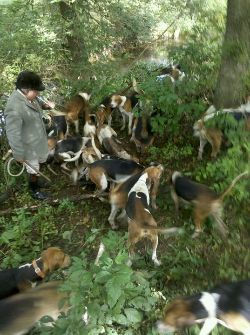
Loudoun West huntsman Martyn Blackmore blows his fox to ground.Aiken Hounds huntsman Katherine Gunter and I had been planning this trip for months. South Carolina summers are tough, and no sooner had we returned to Aiken after the 2011 Virginia Foxhound Show and found ourselves enveloped in ninety-plus temperatures that we began to think about September and a possible hunting vacation.
Everything came together well. We don’t begin our own cubhunting until October, which left September free and clear for adventure. Where shall we go? We had a wonderful invitation from friends in Millbrook, NY, so we decided to make the big push north, out of the heat first, and work our way back south.
Farmington Hunt and J.B. Birdsall Honored for Conservation Success
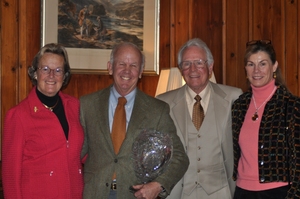
J.B. Birdsall (holding trophy) is flanked by the Farmington Masters (l-r) Carol Easter, Pat Butterfield, and Joy Crompton. Cheryl Microutsicos photo
The Farmington Hunt and J.B. Birdsall received the 2011 Hunting Habitat Conservation Award at the MFHA Annual Meeting in New York City on Friday January 28.
Each year with each recipient of this award we witness yet another testament to the role of foxhunting in the preservation of open space. Arguably no other sporting culture has done as much to preserve land and natural habitat.
But, it often takes a leader, an individual driving force, to establish a culture of conservation within an organization. J.B. Birdsall—longtime foxhunter, landowner, and hunt member—provided that passion, commitment, and leadership for the Farmington Hunt to become a force for open space conservation in their hunting country.
Whiskey Road Hunt Week, Aiken, SC
Second Installment
Betsy and friends escape frozen Virginia for a week of hunting in warmer climes. We bring you Installment Two of her daily blog, exclusive to Foxhunting Life.
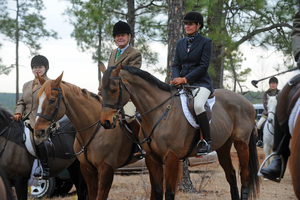
(l-r) Whiskey Road Field Master Geri Rapp, Fairfax Hunt members Ray Moffett, and PetraProbably seventy-five riders in the field this morning from the Batesburg fixture. Whiskey Road hosted a stirrup cup and snack before the meet after which huntsman Joseph Hardiman moved off with the mixed English and Penn-Marydel pack, east towards the cow field adjacent to the fixture.
Hounds struck immediately, coyote, probably, a brace or possibly a leash, and split into two or three groups. Hardiman went with one group, Master/whipper-in Lynn Smith with another, and (seemed like) Master David Smith and the main field with still another.
Whiskey Road Hunt Week, Aiken, SC
Betsy and friends escape frozen Virginia for a week of hunting in warmer climes. We bring you her daily blog, exclusive to Foxhunting Life.
First Installment
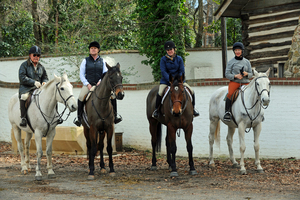
Don Palus, Dawn Cline, Maggie Johnston, and Jackie Burke stretch their horses’ legs in the Hitchcock Woods in preparation for Hunt Week in Aiken, SC.
It poured rain last night. Woke up several times with rain pelting the tin roof of our cottage, but when I opened the door to see if we were going to float away I couldn’t help notice it was weirdly warm. Like sixty degrees warm! Odd.
This morning dawned light and sunny and toasty warm. I stripped down to just my turtleneck layer for the horse trials next door.
At Full Gallop Farm, they hold training horse trials—intermediate level all the way down to beginner novice—attracting hundreds of competitors. Our Hunt Week crew is volunteering for duty to “earn” the right to school/ride/hack over their hundreds of acres of cross country jumps, show jumping fences, and dressage arenas.
Leica: Horse of a Lifetime
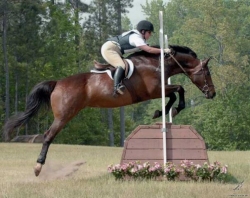
Leica was a remarkable horse whose career took her from incorrigible youngster with a vicious buck to an impressive third-place finish at age twenty-four in the grueling MFHA Centennial Field Hunter Championship. She was still hunting and showing at age twenty-seven, when she had to be humanely euthanized as the result of a pasture injury.
With her bloodlines and dazzling good looks, Leica was primed to be an outstanding dressage horse. An imported bay with touches of white, she was registered Hanoverian (by Lindberg, out of St. Pr. Kari) who was also entered in the main stud book of the RPSI (Rheinland Pfalz Saar International) and Holsteiner registries.
But after abuse from trainers who pushed her too far too fast, Leica had other ideas, says owner Julie Whitlock McKee of Grantville, Georgia. McKee acquired the hard-headed mare at age four after the trainers gave up on her. The pair did not get off to an auspicious start, with Leica rearing the first time McKee threw a leg over her. Rearing and bucking would become a regular occurrence.