David Hopkins Semmes, ex-MFH
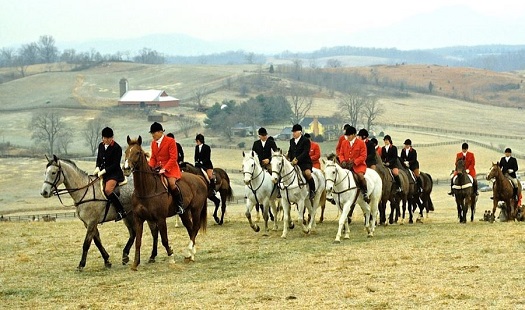
Joint-Masters David Semmes and Mildred Riddell move off at the head of the Old Dominion field from a meet at the Honorable and Mrs. Joseph W. Barr’s Houyhnhnm Farm near Hume, Virginia / Douglas Lees photo
David Hopkins Semmes—longtime Master of the Old Dominion Hounds (VA), amateur steeplechase rider, and deep-water sailor—died peacefully at his home, Indian Run Farm, near Flint Hill, Virginia, on New Years Day, just four days shy of his eighty-seventh birthday.
Born in Washington, D.C., Semmes graduated from Episcopal High School then served a tour of duty in World War II as an aviation radio crewman. He graduated from Princeton in 1949, and in 1950 served in Army intelligence on the Pusan perimeter during the Korean conflict. He worked as a government service officer in Japan, Taiwan, and Hong Kong before returning to Washington to practice law.
Semmes managed intellectual property for forty-one years, notably patenting the so-called “black box” used on airplanes, and the technology used for protective vests for jockeys.
The Galway Blazers at Craughwell
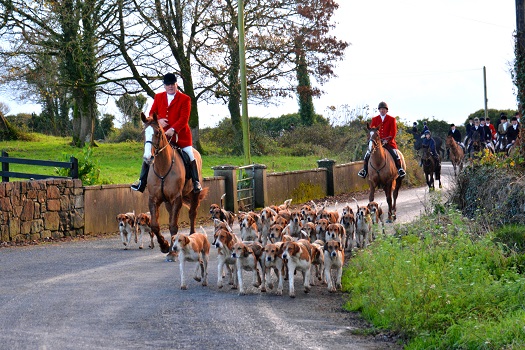
Galway Blazers huntsman Tom Dempsey and whipper-in Anthony Costello hack home after a cracking day’s hunting in Craughwell. / Noel Mullins photo
The County Galway Foxhounds (the Blazers), hunted by Tom Dempsey, had a brilliant day’s hunting at Craughwell, finding five foxes and running each one to ground.
The hunt was formed in the early nineteenth century and hunts about thirty square miles of unique limestone wall country. The first Master and huntsman was John Denis, an ancestor of the late Lady Molly Cusack-Smith, MFH, who, neé Molly O’Rourke, hunted the Blazers during World War II. There were many other well known Masters, including Isaac (Ikey) Bell, father of the modern English foxhound; American film director John Huston; and Captain Brian Fanshawe, one of England’s illustrious Masters (Warwickshire, North Cotswold, and Cottesmore) and renowned breeder of foxhounds. Two Field Masters that held office for long periods were Lady Anne Hemphill and Willie Leahy.
The Galway Blazers have some of the very best hunting country in the world. To say it is unique is an understatement, with miles of small enclosures, resulting in often fifty stone walls to the mile and uninterrupted views of hounds hunting. To hunt even once with the Galway Blazers is on most hunt followers’ bucket list.
Country Captain

With the formal hunting season upon us, it’s time to add new hunt breakfast recipes to our collection! The following recipe, sent to us by Bill Getchell, comes with an interesting history and a connection to a famous American foxhunting general and Master of Foxhounds. We have a wonderful resource of recipes (point your cursor to the Social dropdown menu), and we invite your additions.
Country Captain has been a staple of southern cooking since the first half of the nineteenth century. Originating in India, the name may be a corruption of Country “Capon.” Legend has it that a British sea captain in the spice trade brought it to the United States through the ports of Savannah and Charleston.
Mary (“Miss Mamie”) Bullard of Columbus, Georgia revived the recipe for her frequent guest, Franklin D. Roosevelt, and later served it up for Army officers passing through nearby Fort Benning, including the Master of the Cobbler Hunt, General George S. Patton. In the early days of World War II, Patton sent a message to the Bullards: “If you can’t give me a party and have Country Captain, meet me at the train with a bucket of it.” In Patton’s honor the U.S. Army added it to the Meal, Ready-to-Eat (“MREs”) rations in 2000.
How Old Hounds Pay Their Keep at Red Rock
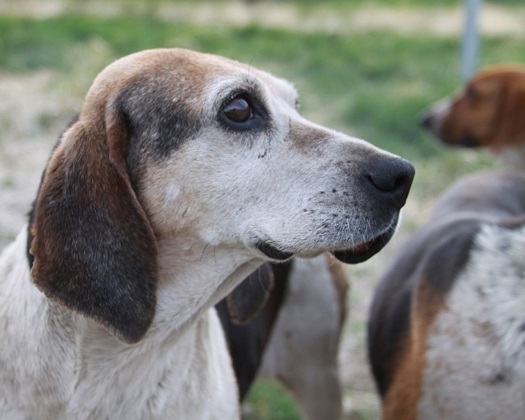
What to do with the old hounds? / Nancy Stevens-Brown photo
Most hunts are beset by similar problems: what to do with old hounds, how to attract more members, how to pay the bills, how to train staff, how to train young hounds. Lynn Lloyd, MFH and huntsman of the Red Rock Hounds (NV), found that the solution to one problem provided the key to solving several others.
What to Do with Old Hounds
The average hunting life of a hound is perhaps six or seven years. That means it is retired from the pack at age seven or eight. Beyond that age, most hounds start falling behind the pack, lacking the foot and endurance to maintain the pace over a full hunting day.
But with several years of life still remaining for the retired hounds, most hunts are hard-put to expend their limited financial resources to keep and maintain them. And here’s where Lynn Lloyd found a way to turn a burden into an asset.
How Old Hounds Pay Their Keep at Red Rock
What to do with the old hounds? / Nancy Stevens-Brown photo
Most hunts are beset by similar problems: what to do with old hounds, how to attract more members, how to pay the bills, how to train staff, how to train young hounds. Lynn Lloyd, MFH and huntsman of the Red Rock Hounds (NV), found that the solution to one problem provided the key to solving several others.
What to Do with Old Hounds
The average hunting life of a hound is perhaps six or seven years. That means it is retired from the pack at age seven or eight. Beyond that age, most hounds start falling behind the pack, lacking the foot and endurance to maintain the pace over a full hunting day.
But with several years of life still remaining for the retired hounds, most hunts are hard-put to expend their limited financial resources to keep and maintain them. And here’s where Lynn Lloyd found a way to turn a burden into an asset.
The Puppy Walker
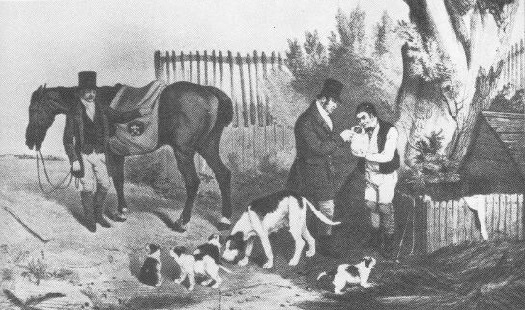
No members of your hunting community are loved by Masters and huntsman as dearly as the puppy walkers. Each year these intrepid folk accept the arrival of a couple of playful pups to their country home in early summer to teach them their names, walking on lead, a semblance of civilized behavior, and a taste of life outside the kennel.
In a couple of months, after the cuddly innocents have grown into marauding, thieving, hunting fanatics, the puppy walkers cry, “Uncle!” and the huntsman returns to reclaim them. The huntsman will be back the following summer, however, and these generous puppy walkers will smilingly welcome yet another couple of wide-eyed puppies to their property.
So, when your Masters praise the puppy walkers at the annual puppy show and bestow a small trophy upon those who walked the winning hounds, recall this poem by Will H. Ogilvie and give the puppy walkers their due!
Will You Walk a Puppy?
‘Will you walk a puppy?’ the Hunt enquired.
Being sportsmen, we did as the Hunt desired.
And early in June there arrived a man
With an innocent bundle of white and tan.
A fat little Foxhound, bred to the game,
With a rollicking eye and a league-long name,
And he played with a cork at the end of a string;
And walking a puppy was ‘just the thing.’
Joan Hopewell, ex-MFH, Dead at Ninety-Four
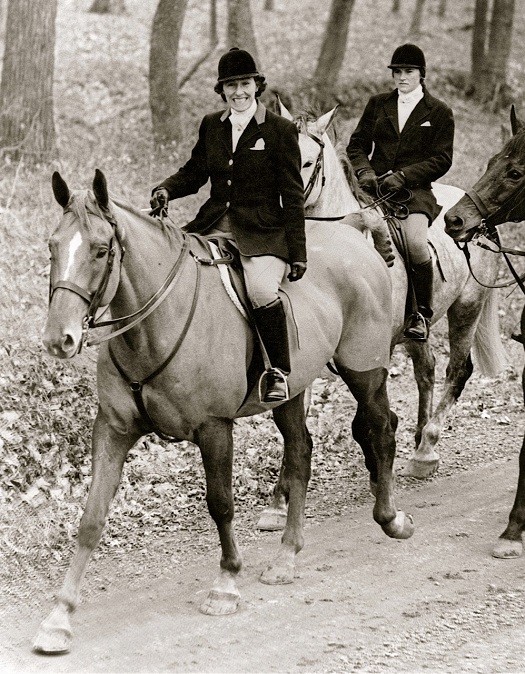
Joan Hopewell (left) and daughter Tanya hunting with the Old Domionion Hounds / Douglas Lees photo Joan Hopewell, MFH of the Old Dominion Hounds (VA) from 1976 to 1979, died in Southern Pines, North Carolina on Thursday, June 26, 2014. She was born in England in 1919 and came to the United States in […]
Mediocre or Superior Hounds: A Choice
Karen L. Myers photoEach year we hear grumblings at the hound shows questioning whether those hunts that consistently win all the ribbons are being sportsmanlike by continuing to show their hounds in all the classes. Truth be told, I have been guilty of those grumblings, but I was flat out wrong.
On the flip side, I have even heard some winning Masters express hesitation about entering their hounds in certain shows because they feel funny about dominating the ring. They shouldn’t. They are doing us a service.
If the premier breeders of foxhounds don’t persist in putting their best hounds in the ring for all to see, how will we acquire the visual standard—that mental picture—to guide us in our own breeding programs?
True, more hunts would win ribbons, and members and Masters might feel better, but what would happen to the foxhound as a breed when lesser examples pose with their trophies? We need a North Star—a constant standard—toward which to strive if we want to breed the best foxhounds we can.
The better question is why do certain hunts consistently breed the winning hounds.
Foxhunters Acquitted; Repeal the Ban Says Defense Solicitor
A British defense solicitor has called for an end to the hunting ban in England because too many prosecutions are thrown out for lack of evidence. Passion, yes, he says. Evidence, no. A Master and huntsman from the Weston and Barnwell Harriers and his whipper-in were recently acquitted in court of charges leveled by […]
William Almy III Dead at Eighty-five
William Almy III died on February 28, 2014 at age eighty-five. A native of Massachusetts, he loved riding and foxhunting in his younger days with the old Quansett Hunt of which hi father, William Almy, Jr. was Master. (His father also served, from 1960 to 1970, as the tenth president of the Masters of Foxhounds […]