Remembering the Curre on Boxing Day
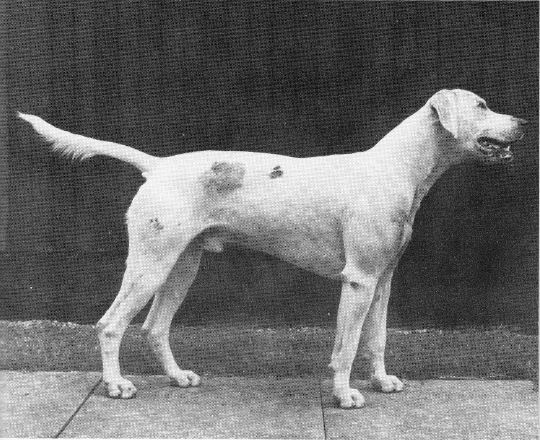
Modern English Foxhound: Duke of Beaufort’s Monmouth 1977 by New Forest Medyg 1969 Peterborough winner of the early 1900s — thick and ponderous — an example of the style of foxhound favored at the time.
Thousands of foxhunters and hunt supporters are expected to turn out in England and Wales on Boxing Day. Young and old, riders and spectators alike, entire families together for the holidays tumble out-of-doors the morning after Christmas for these traditionally celebrated meets.
“It’s the highlight of the season which starts in November,” said Peter Swann, MFH of the Curre and Llangibby Foxhounds in Wales. “This year we are expecting forty riders to take part and around five hundred spectators and supporters to join us on the green.
In Wales, the Curre and Llangibby and the Monmouthshire Foxhounds trace back to the 1600s and 1700s. The Curre remains of particular significance to foxhunters because we still see and enjoy the results of Sir Edward Curre’s bloodlines in our own Crossbreds and modern English foxhounds to this day.
It was Sir Edward Curre who provided Isaac “Ikey” Bell, father of the modern English foxhound, with the Welsh blood and the pale coloration of his breeding that has been preserved and carried on by forward-looking breeders in England ever since. Bell’s vision of the foxhound finally prevailed over the thick and ponderous, black-and-tan colored foxhounds that were fashionable early in the twentieth century. Bell’s efforts to breed lighter and more athletic foxhounds fell so afoul of the foxhunting establishment of the time that leading Masters would cross the street to avoid having to greet him.
How Domestication Has Changed the Horse’s Genes
The course of civilization was profoundly altered by the domestication of the horse on the steppes of Eurasia some 5,500 years ago. Merchants, soldiers, explorers, and adventurers of all stripes—newly empowered by the horse to gallop rather than walk—expanded trade, warfare, migration of populations, and the transmission of ideas. To understand the genetic changes wrought […]
British-Inspired Rabbit Hunt Took an Odd Turn
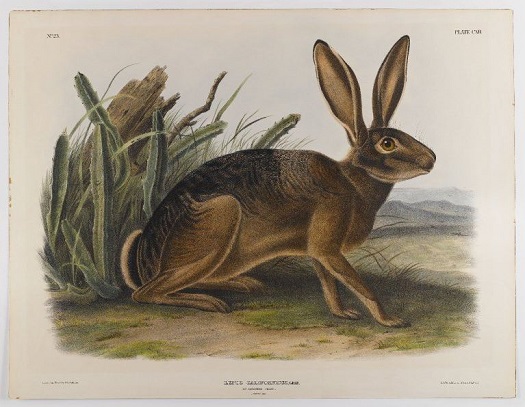
California hare by John J. Audubon
The early part of the last century saw the people of Riverside, California looking towards Great Britain for inspiration for their leisure activities.
This was chiefly because of the many British immigrants who had begun arriving here about 1889, primarily to invest in, among other things, the fast-growing orange industry. English customs were held in the highest esteem, especially among socially ambitious Americans, Tom Patterson wrote in his book, A Colony for California.
Riversiders engaged in such British activities as polo, high tea, and foxhunting. The latter did not usually include a fox, because foxes were not common in the area. Instead they substituted a more common animal, the jackrabbit. These hunts were conducted wherever a large area of open land could accommodate horses, hunters, hounds, and the prey.
The Red Rock Hounds and Their Country
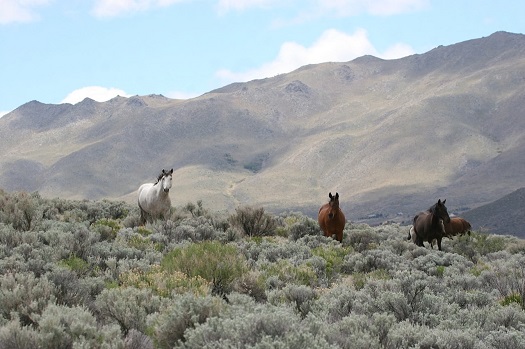
Wild horses in Nevada’s high desert / Nancy Stevens-Brown photo
I want to tell you about Lynn Lloyd’s Red Rock Hounds and the country they hunt as a short introduction to our feature story, “How Old Hounds Pay Their Keep at Red Rock.” In that story you’ll read how Lynn ingeniously transformed her elderly hounds from a burden to an asset! The old hounds pay their way by increasing membership and caps, and they throw off side benefits by helping to train young hounds and staff. And I have to believe that many hunts could do something similar to their own benefit.
The Red Rock foxhounds hunt the coyote over the high desert of Nevada, near Reno, where cowboys in dusty western hats, vests, and chaps lope after hounds in their Western saddles stirrup-to-stirrup with properly attired foxhunters posting to the trot in their English saddles.
How Old Hounds Pay Their Keep at Red Rock
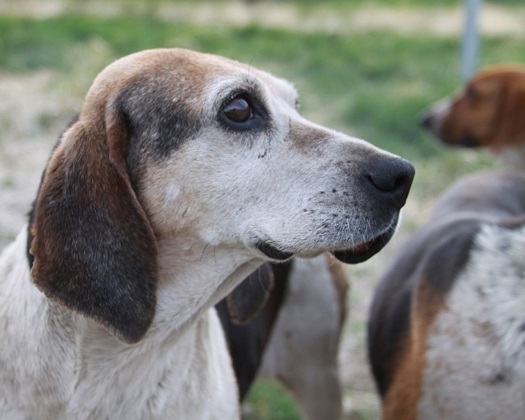
What to do with the old hounds? / Nancy Stevens-Brown photo
Most hunts are beset by similar problems: what to do with old hounds, how to attract more members, how to pay the bills, how to train staff, how to train young hounds. Lynn Lloyd, MFH and huntsman of the Red Rock Hounds (NV), found that the solution to one problem provided the key to solving several others.
What to Do with Old Hounds
The average hunting life of a hound is perhaps six or seven years. That means it is retired from the pack at age seven or eight. Beyond that age, most hounds start falling behind the pack, lacking the foot and endurance to maintain the pace over a full hunting day.
But with several years of life still remaining for the retired hounds, most hunts are hard-put to expend their limited financial resources to keep and maintain them. And here’s where Lynn Lloyd found a way to turn a burden into an asset.
How Old Hounds Pay Their Keep at Red Rock
What to do with the old hounds? / Nancy Stevens-Brown photo
Most hunts are beset by similar problems: what to do with old hounds, how to attract more members, how to pay the bills, how to train staff, how to train young hounds. Lynn Lloyd, MFH and huntsman of the Red Rock Hounds (NV), found that the solution to one problem provided the key to solving several others.
What to Do with Old Hounds
The average hunting life of a hound is perhaps six or seven years. That means it is retired from the pack at age seven or eight. Beyond that age, most hounds start falling behind the pack, lacking the foot and endurance to maintain the pace over a full hunting day.
But with several years of life still remaining for the retired hounds, most hunts are hard-put to expend their limited financial resources to keep and maintain them. And here’s where Lynn Lloyd found a way to turn a burden into an asset.
Autumn Morn: Ode to a Huntsman
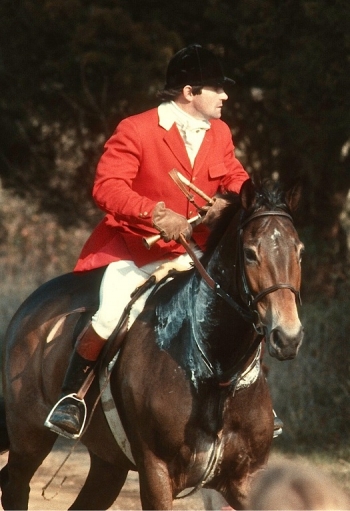
Huntsman Michael Power / Douglas Lees photoAlthough this poem was written in tribute to a huntsman in his prime, it is especially poignant because it seems to prophesy his tragic end.
Fay Bohlayer, a member of the Shakerag Hounds (GA), wrote the poem in 1981 for huntsman Michael Power on the occasion of his move from Shakerag to the Warrenton Hunt (VA). Ten years later, Bolayer’s poem was read at Power’s memorial service after he suffered a fatal accident in the hunting field. It could as well have been written for that sad occasion.
Power was a keen, hardworking, talented huntsman, and he showed exceptional sport at Warrenton. I watched one day as he had someone throw a coat over a barbed wire fence, which he then jumped to stay with hounds.
Once Bohlayer asked him which he thought was more fun: hunting or racing. Power replied, “Whichever I happen to be doing at the time.” She recalls one day behind Power when hounds were running, and to stay with them Power galloped without pause straight toward an iron gate, which he jumped. Bohlayer chose not to follow Power’s line, and after the run she came up and apologized for going around. “Not at all,” he piped in his Irish tenor. “It’s your sport, but it’s my living. I must go.”
Here’s Fay Bohlayer’s tribute to Michael Power:
Looking at the Huntsman
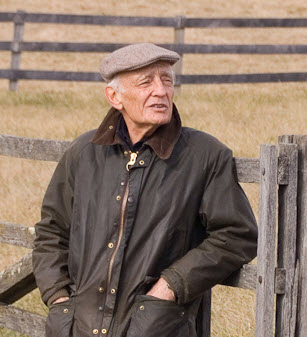
No hunting all summer. The huntsman must be having himself a nice vacation, right? Wrong. There’s an old saying that “foxes are killed in kennel,” meaning that all the good work you see in the field during the hunting season is established during the off-season in the training of the young entry and in the making of the pack. Feed, care, routine, discipline, and exercise through the hot summer months all add up to performance in the field. Then there’s the whelping and care of the puppies who will be entered not this season, but the next. All told, summer is an exceedingly busy time for any huntsman who plans to field a high mettle pack of hounds and show good sport.
As the summer weeks slide by and the start of the informal season approaches, Foxhunting Life will have a look at the huntsman in the next few issues, including some of the legendary huntsmen of the past to see what they had to teach us about the handling of hounds in the field. Chances are, when the season comes alive, you will see your own huntsman employing similar techniques in the handling of his or her hounds in pursuit of the quarry.
Carlow Famers Foxhounds at Glynn, County Carlow, Ireland
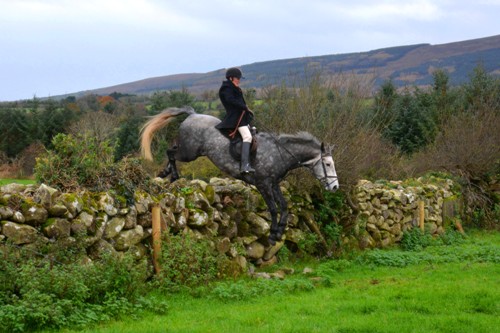
83-year-old Jack Lambert clears a double stone wall with the Carlow Farmers Foxhounds on his purebred Irish Draught hunter. Lambert is a regular visitor to the Genessee Valley Hounds (NY). / Noel Mullins photo
Only the most able riders, the foolhardy, or unsuspecting visitors go to the Carlow Farmers Foxhounds meet at John A’s Pub in Glynn. Only in parts of Galway and North Mayo have I ever seen such a succession of double stone walls that must be jumped clean because they don’t collapse. Many more cannot be jumped clean, but have to be banked. A clever and athletic horse is needed, and a rider who hangs on the reins is doomed!
Belle Meade, Beagles, and Bunnies
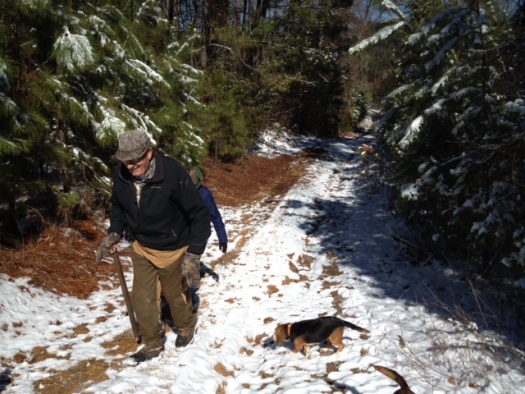
Beagle huntsman Dalton Reeves
“My name is Dalton Reeves, I’m eighty years old and a retired high school football coach and teacher, originally from South Carolina,” our huntsman said, introducing himself to his field of foot-followers—mainly foxhunting guests and members participating in Belle Meade’s “Gone Away with the Wind” Hunt Week—some of whom were out beagling for the first time.
“I’m very happy to hear that I’m following an eighty-year-old huntsman,” I replied. “It means I’m not likely to get left too far behind, the prospect of which has been worrying me.”
“No worries,” Mr. Reeves assured me. “I’ve got two knee replacements and one new hip; I don’t travel too fast any more.”
That said, by the time Mr. Reeves brought the beagles in four hours later, I had been back to the deer camp meet three times to stick my boots into a fire blazing in an outdoor pit to thaw my toes. I also had a bite of breakfast and took a side trip with John McNeil, Sr. to the Rock House—thought to be the oldest house in the state of Georgia—previously a part of the McNeil property, over which the beagles were hunting, but now in the hands of the historical association. In between my retreats to comfort, I enjoyed along with the rest of the field several hours of hound music—some with voices that represented the beagle version of the booming “aroos” of the Penn-Marydel foxhound.