Foxhunting in North America: A Brief History
Here is a concise history of foxhunting in North America from the seventeenth to the twentieth century, tracing the sport from its Colonial beginnings to organized foxhunting as we know it today. The work constitutes part of the first chapter in A Centennial View, published by the MFHA to commemorate the hundredth anniversary of the establishment of the Association.
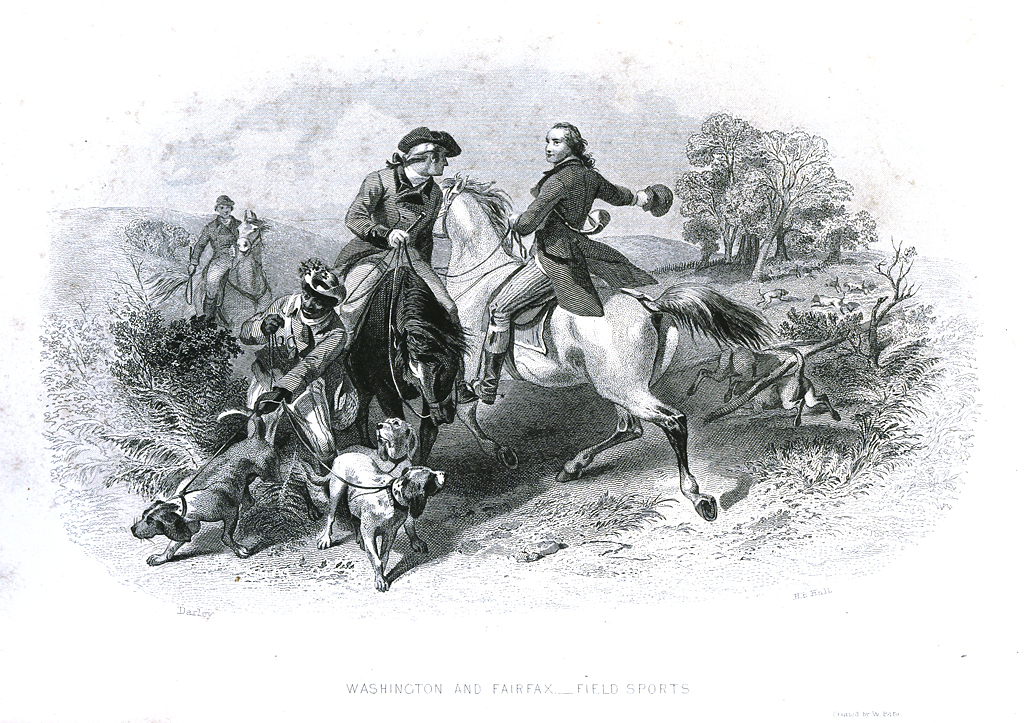
George Washington and Lord Fairfax hunting in the Shenandoah Valley
Hunting in the Colonies (1600s to 1775)
If you were a second son to a family of landed gentry living in the English countryside during the seventeenth or eighteenth century, you would have found your prospects considerably dimmer than those of your elder brother. Precluded, through the laws of primogeniture, from inheriting your father’s estate, you might have been tempted by land grants offered by the Colonial governors of Maryland or Virginia to emigrate, settle in the New World, and make your fortune there.
If you had an adventurous soul, you might have packed up your family, children, furniture, and, of course, a few of your foxhounds, and embarked on the voyage. Along with those tangible items, you would have brought your rural culture and a hunting heritage to these Provinces. By carrying on your habitual pursuits, you would make Maryland and Virginia the cradle of North American foxhunting.
From Toy Box to Art Gallery
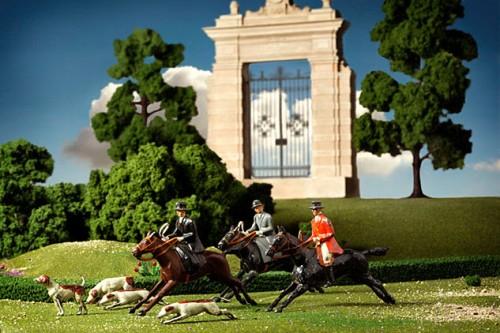
What happens when a noted photographer stumbles across a set of vintage (1930s) British cast lead toy figures of foxhunters and hounds? Award-winning photographer/author/film maker Robert Trachtenberg was captivated by the various poses and old patina on the figures. He placed them into scaled-down landscapes, illuminated them romantically, and produced a suite of seven photographs […]
A Bright Finish to a Challenging Season
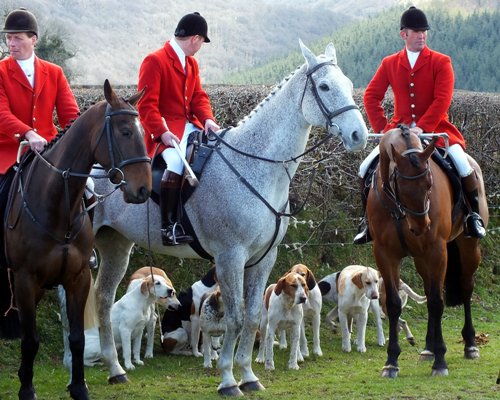
Huntsman Donald Summersgill (right) and staff with the Devon and Somerset Staghounds
As I sit and write this on the 6th of May, finally we can say we have had two days of really good weather! The sun is shining, there is not a cloud in the sky, and the birds are in fine voice. A proper English early summer’s day, which even if I say it myself we richly deserve.
However, wherever I look there are fields of oilseed rape at half the height they should be, the wheat and barley crops are as thin as I have ever seen in my lifetime, and, what is more, the weather forecast for the next day or so is for high winds and rain. The rain believe it or not is much needed even after the wettest winter on record, but the wind is something we can well do without. We have just come out of the driest April in nearly a hundred years. Never mind; I hope that you all had a good end to season and that your weather is behaving rather better than ours.
The weather notwithstanding, I think we have come out of this last season pretty well. Having had two fascinating days beagling towards the end of March with the Christchurch and Farley Hill and the Royal Agricultural College, my season came to an end with the Exmoor Foxhounds and the Devon and Somerset Staghounds at the end of April.
Brazos Valley Mystic: LIke Father, Like Son
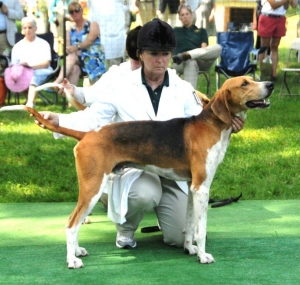
Brazos Valley Mystic 2010 / Liz Callar photoBrazos Valley Mystic 2010 was judged Grand Champion of the Southwest Hound Show for the third consecutive year, matching his sire’s outstanding performance there. The show was held on April 20, 2013 at Greenwood Farms in Weatherford, Texas.
Mystic’s success is no stroke of luck; he’s the product of a royal breeding engineered by Brazos Valley MFH Sandy Dixon. She put her own sire—Brazos Valley Catfish 2006—to a Potomac-bred bitch that she entered in 2006—Brazos Valley Meadow.
Catfish won three consecutive Grand Championships at the Southwest Hound Show in 2007, 2008, and 2009, and Meadow brought her own credentials from Maryland. She was bred by Potomac huntsman Larry Pitts and is by Potomac Jefferson, Grand Champion of both the Virginia Foxhound Show and the Bryn Mawr Hound Show in 2007. Jefferson was knockout handsome.
Hunting with Dogs in New York City
An unregistered pack of dogs is hunting in New York City according to Fox News. The Ryders Alley Trencher-fed Society has been meeting weekly at promising fixtures throughout the city for about ten years. Recently they met near City Hall on a couple of nights to draw the nearby alleys with two Border Terriers, a […]
Lonesome Palm Hounds Dissolved
The Lonesome Palm Hounds (FL) has dissolved as of May 1, 2013. Established by the Kerry Kornacki Family in 1991, the hunt was Registered with the MFHA in 1994 and Recognized in 1996. The mixed pack of Crossbred, English, and Penn-Marydel hounds hunted red fox, gray fox, coyote, bobcat, and the drag in northeastern Florida […]
Radnor Hunts the Big Bend

Radnor huntsman Joe Cassidy and hounds at Big Bend / Diana Rowland photoThe gray uncertain sky and falling barometer suggested that winter was not yet finished with us. Nevertheless, I had rearranged my previously planned trip to Aiken after Joe Cassidy called. Joe hunted Mr. Stewart’s Cheshire Foxhounds (PA) for eighteen years and is currently huntsman for the Radnor Hunt (PA). This was an opportunity for me to hunt in his back pocket.
Joe had taught me to hunt hounds while I was MFH at Loudoun Hunt (VA), and he hunted with me when I carried the horn for a couple of years, making the drive with his wife Leslie and their very large dog Luca each weekend.
The meet was at Big Bend, the long-time residence of Frolic Weymouth, well-known for his immense contributions to open space conservancy. It was a Saturday meet, March 16, 2013, and as we sat waiting for the last of the field to mount and the clock to strike 11:00, Joe turned in his saddle, handed me his horn, and quietly told me that I was hunting the pack that day. I confess to a moment of stage fright, made some knuckle-head comment about strike hounds to which he replied, “Really,” and then we headed off to the first covert—a thick patch of brambles, ground cover, and trees about the size of a football field.
Big Crossbred Turnout at Southern Hound Show
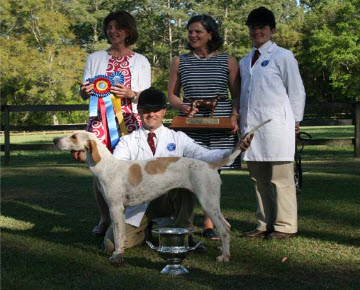
Mooreland Wary ’12, Grand Champion, Southern Hound Show / Wendy Butler photoThe seventh annual Southern Hound Show, held on April 6, 2013 at Live Oak Plantation Monticello, Florida, produced a perfect day for showing hounds—chilly in the morning and low seventies in the afternoon.
This year’s judges were Mr. Richard Tyacke, MFH and huntsman of Sir Watkin Williams-Wynn’s Wynnstay Hounds (UK), and Mrs. Tyacke who substituted for Dr. John W. D. McDonald, MFH, London Hunt (ON), who took ill the night before the show. Dr. Charlotte McDonald, MFH, London Hunt, was the apprentice judge.
Mr. Tyacke said that he was thrilled by the amount of quality he saw in every class. He was very impressed with the levelness shown, particularly in the Two Couple Classes where some hunts produced more than one entry.
As is the custom at the show, all hound types are judged together in one ring, as also happens at the Canadian Hound Show. Eight packs showed, which is one more than showed in the 35-couple-or-more in the Crossbred ring at Virginia in 2012.
Martyn Blackmore Is New Huntsman at Loudoun Hunt
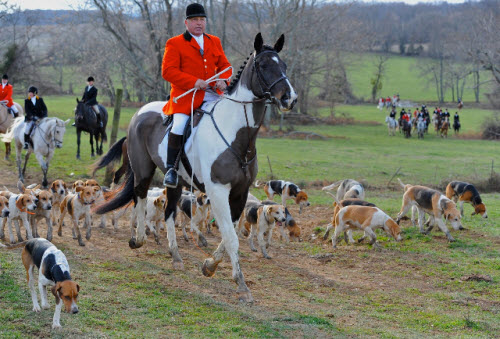
Completing the recent round-robin of “Huntsmen on the Move,” Martyn Blackmore will be the new huntsman at the Loudoun Hunt (VA) come the month of May, the traditional month for hunt staff to move to their new posts. Blackmore is the departing huntsman at the Loudoun West Hunt, just across town. With this announcement, a […]
Foxhounds With a Difference
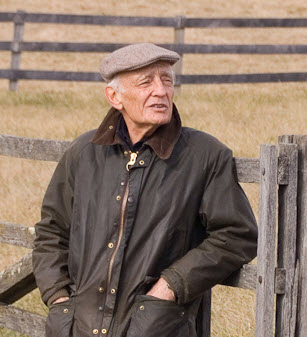
Mr. Stewart’s Cheshire Foxhounds (PA) boasts a sporting field of superb horsemen and women that love to gallop and take their own lines over the post-and-rail line fences in their country. Seven years ago, the Cheshire Masters and staff embarked on a bold experiment to breed a new foxhound for that country. Our feature article below tells of their decision to cross the The Old English (also called the Traditionally-Bred English) foxhound and the Penn-Marydel foxhound.
Their plan was a gamble because the two breeds are about as dissimilar in type as foxhounds get, and the crossing of the two types would produce litters that varied greatly from pup to pup. However, the Cheshire Masters and huntsman believed that the strong points of each type would tend to compensate for the perceived weaknesses in the other and result in a foxhound superior to either type.
Here are some examples of the perceived differences between the types. Just remember that generalizations are only generally valid!