
A Sporting Tour Through Merry Old…Part 1
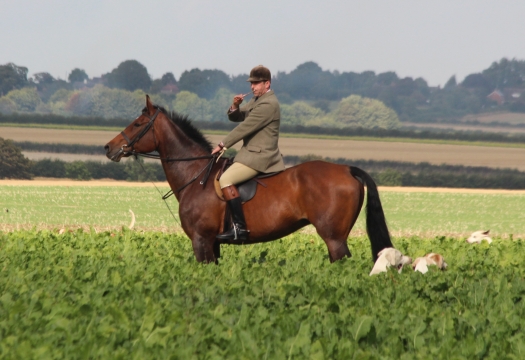
Master and huntsman Adam Esom and the South Wold Foxhounds midst the sugar beets in Lincolnshire. / James Barclay photo
Join James Barclay—an ex-Master of five English foxhunts—for a personal and revealing tour of elite hunting establishments through Middle and Eastern England. Part 2 to follow.
This last summer has been one of the busiest for a while with a fair share of weekends spent judging various Puppy Shows, which is always a pleasurable thing to do, but sadly does nothing beneficial for the waistline! It is always nice to look at hounds during their restful period, and we can soon start to gauge what there is coming on from behind the scenes and start to assess the breed’s general standard.
On that note, it is a great relief to see a lot of nice hounds about, as there was a time after that dreaded day in February 2005 when the Hunting Act became law that many packs cut right back to a minimum. However, to see that confidence returning is most reassuring to all of us who take the breeding of the Foxhound seriously.
Now the time had come to dust off the camera and get out there and firstly to take some early morning pictures of hounds on exercise. This is a wonderful time of year as, given the blessing of some good weather, harvest starts to move, and with those dewy late summer mornings and a hint of mist in the air, our countryside comes to life in a way any true hunting man knows. So visits to Badminton, Belvoir and the Bicester were a particular pleasure this year, as last summer, I had decided to cover most packs in the Eastern Counties as well as the Midlands.
Remembering the Curre on Boxing Day
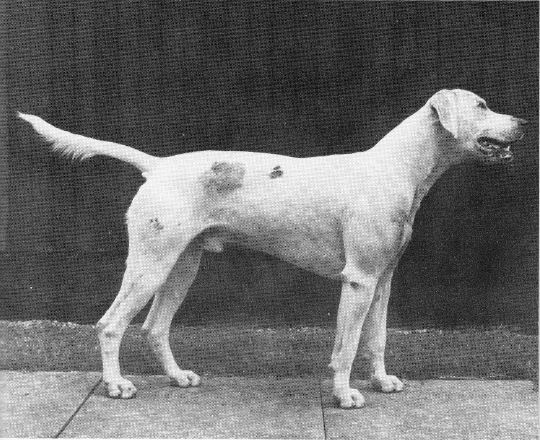
Modern English Foxhound: Duke of Beaufort’s Monmouth 1977 by New Forest Medyg 1969 Peterborough winner of the early 1900s — thick and ponderous — an example of the style of foxhound favored at the time.
Thousands of foxhunters and hunt supporters are expected to turn out in England and Wales on Boxing Day. Young and old, riders and spectators alike, entire families together for the holidays tumble out-of-doors the morning after Christmas for these traditionally celebrated meets.
“It’s the highlight of the season which starts in November,” said Peter Swann, MFH of the Curre and Llangibby Foxhounds in Wales. “This year we are expecting forty riders to take part and around five hundred spectators and supporters to join us on the green.
In Wales, the Curre and Llangibby and the Monmouthshire Foxhounds trace back to the 1600s and 1700s. The Curre remains of particular significance to foxhunters because we still see and enjoy the results of Sir Edward Curre’s bloodlines in our own Crossbreds and modern English foxhounds to this day.
It was Sir Edward Curre who provided Isaac “Ikey” Bell, father of the modern English foxhound, with the Welsh blood and the pale coloration of his breeding that has been preserved and carried on by forward-looking breeders in England ever since. Bell’s vision of the foxhound finally prevailed over the thick and ponderous, black-and-tan colored foxhounds that were fashionable early in the twentieth century. Bell’s efforts to breed lighter and more athletic foxhounds fell so afoul of the foxhunting establishment of the time that leading Masters would cross the street to avoid having to greet him.
Extend Your Weekend Sport with a Foot Pack
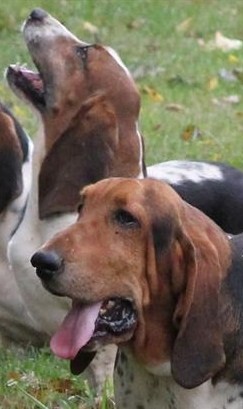
The Ashland Bassets / Susan Monticelli photoWhen not following foxhounds on horseback, many foxhunters and their like-minded friends can be found following their local basset or beagle pack on foot—a perfect way to continue enjoying sport and a country lifestyle. Any foxhunter who thrills to the cry of foxhounds and hasn’t yet heard a pack of bassets in full cry must try a day’s hunting behind these wonderful hounds!
Even after dismounting from the saddle on a Saturday, many still yearn to hunt on before returning to an office on Monday. There are others who have hung up their tack for various reasons, and some who have never hunted astride yet love being outdoors on fall and winter afternoons. For all these sportsmen and women, the Ashland Bassets—hunting the territories of the Casanova, Old Dominion, Orange County, and Warrenton foxhound packs in Virginia—have provided a welcome window through which to extend one’s weekend enjoyment of the countryside and venery.
How Domestication Has Changed the Horse’s Genes
The course of civilization was profoundly altered by the domestication of the horse on the steppes of Eurasia some 5,500 years ago. Merchants, soldiers, explorers, and adventurers of all stripes—newly empowered by the horse to gallop rather than walk—expanded trade, warfare, migration of populations, and the transmission of ideas. To understand the genetic changes wrought […]
Reflections on a Hunting Day

Photographer Cathy Summers positioned herself perfectly to capture this image of Farmington Hunt’s (VA) first flight moving off from the meet at Hidden Fox Farm. Fortunately it was a still day, rendering the reflections as clear as the subjects. More photos can be seen on Cathy’ website. Posted December 15, 2014
The Coyote: Thriving Through Persecution
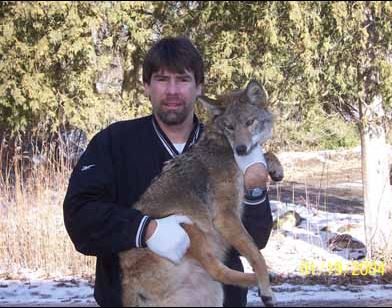
Dr. Stanley Gehrt and an anesthesized coyote in metropolitan ChicagoThe Belle Meade Hounds in Thomson, Georgia will once again stage their annual Hunt Week—Gone Away with the Wind—this season from January 18 to 24. As before, the week will be fun-filled with hunting, parties, a hunt ball, and the camaraderie of the field.
As a bonus, this year’s affair will feature a fascinating presentation by special guest Dr. Stanley Ghert, Associate Professor of Wildlife Ecology and a Wildlife Extension Specialist at Ohio State University.
Dr. Ghert, who has enthralled foxhunters at MFHA meetings over the years, will talk to Belle Meade Hunt Week attendees on Thursday morning, January 22, about his special subject of research—the coyote. This much-aligned animal has survived and even flourished over the past hundred years despite the best efforts of the federal government to eradicate it.
Early in the twentieth century, at the behest of western ranching and agricultural interests that were losing stock to predators, the U.S. Government instituted program after program designed to erase the wolf, grizzly bear, mountain lion, and coyote from the landscape. The programs were mostly successful in their purpose. The wolf, grizzly, and mountain lion were driven nearly to extinction. The coyote, however, was the one predator that not only survived the pressure, but increased its population and its range, slowly expanding eastward and covering now the entire country. How it did that is one of the mysteries of the animal world.
How I Came to go Foxhunting
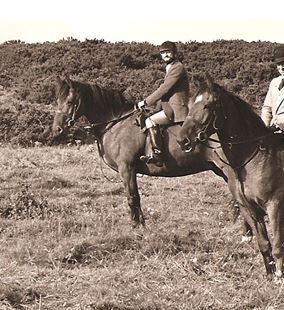
Steve Price on his first foxhuntSome time ago in Norm Fine’s Blog we asked the question, How to did you come to go foxhunting? Fine told his story and received some good Comments in response. Here’s Steve Price’s story. Use the Comments field to send us yours!
It happened nearly forty years ago. I was half of a two-person equestrian journalist junket to Ireland. Over lunch in his home at Scarteen, Master Thady Ryan invited us to join him the following day. My companion happily agreed, but I demurred. My jumping skills were limited to beginner courses—egg-rolls and twice-arounds—and I had seen the formidable banks and ditches separating the County Limerick fields.
“Aw, I’ll give you my best hunting horse,” Thady assured me, “you’ll be safe as houses.”
In for a penny… I shrugged, and went along.
The Galway Blazers at Craughwell
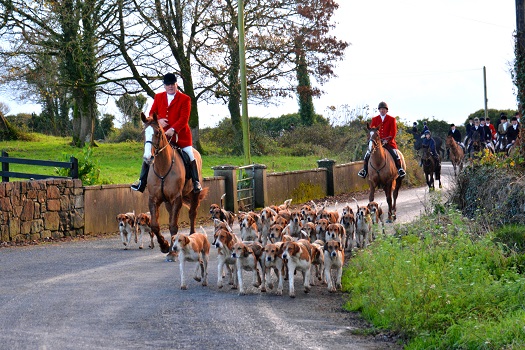
Galway Blazers huntsman Tom Dempsey and whipper-in Anthony Costello hack home after a cracking day’s hunting in Craughwell. / Noel Mullins photo
The County Galway Foxhounds (the Blazers), hunted by Tom Dempsey, had a brilliant day’s hunting at Craughwell, finding five foxes and running each one to ground.
The hunt was formed in the early nineteenth century and hunts about thirty square miles of unique limestone wall country. The first Master and huntsman was John Denis, an ancestor of the late Lady Molly Cusack-Smith, MFH, who, neé Molly O’Rourke, hunted the Blazers during World War II. There were many other well known Masters, including Isaac (Ikey) Bell, father of the modern English foxhound; American film director John Huston; and Captain Brian Fanshawe, one of England’s illustrious Masters (Warwickshire, North Cotswold, and Cottesmore) and renowned breeder of foxhounds. Two Field Masters that held office for long periods were Lady Anne Hemphill and Willie Leahy.
The Galway Blazers have some of the very best hunting country in the world. To say it is unique is an understatement, with miles of small enclosures, resulting in often fifty stone walls to the mile and uninterrupted views of hounds hunting. To hunt even once with the Galway Blazers is on most hunt followers’ bucket list.
Ten Years of the Hunting Ban in England
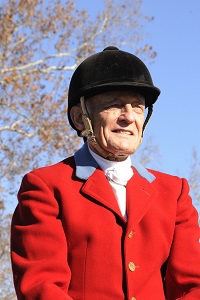
Liz Callar photoIt’s been ten years now since England’s Hunting Act of 2004 was enacted by the Labour government, and neither side is satisfied, says Stephen Moss in The Guardian.
To give the briefest of recaps, here’s what the law allows. Two hounds may be used to flush a fox to a gun; a pack of hounds may be used to flush a fox to a bird of prey; and/or a pack of hounds may follow a drag.
Most hunts in England and Wales opt for the drag. The problem comes when hounds find the line of a live fox and switch from the drag. At that point, huntsman and staff are supposed to stop hounds. The huntsman says, Easier said than done. The hunt monitor with his video cam rolling says, Not only did you fail to try to stop hounds, you even encouraged your hounds! There’s the rub, and there’s the basis of most of the prosecutions in court. In the end, it all depends on the persuasiveness of the evidence.
Tony Blair, prime minister at the time of the bill’s passage, later wrote that his support of the legislation was a mistake. When David Cameron, a foxhunter himself, became prime minister, he promised a free vote in Parliament aimed at reversing the ban. However, he has not been able to get enough support within his own government’s coalition to give him the confidence to push for such a vote.
Stu Grod Retires from the Field at Eighty-Four
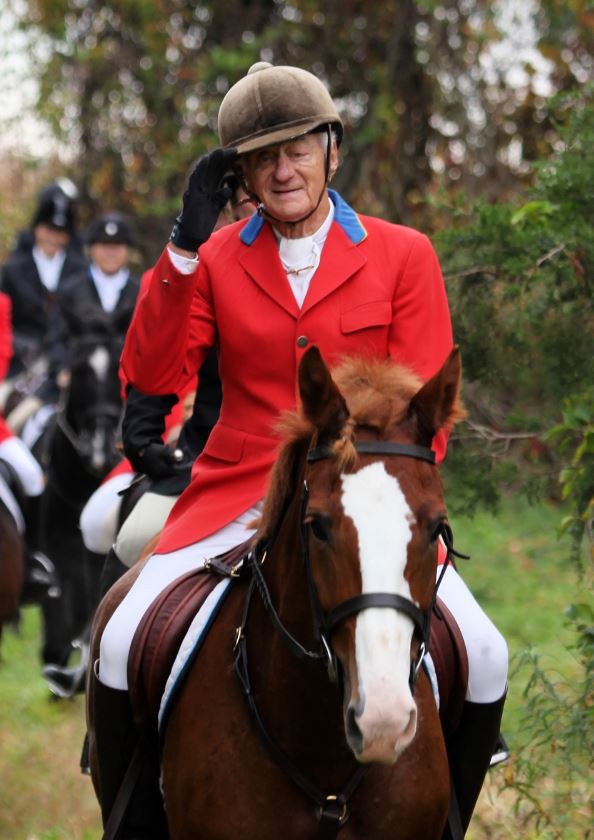
Julie Stuart Seger photoStuart Grod—popular field member of the Fairfield County Hounds (CT)—has retired after forty-three consecutive seasons hunting in the first flight. A retirement party was held in Stu’s honor at the hunt’s clubhouse on November 22, 2014, where well-known food and travel author Michael Stern read a poem he composed for the occasion.
“Build a bridge with your hands on the mane;”
“Trot smooth as you head for the jump;”
“Go light when your hands hold the reins;”
“And don’t crowd on the lead horse’s rump:”
Just some of Stu’s tips I’ve acquired
Since I started to ride with you folks.
I’ll miss you up there, you strange country squire
With your bright eyes, your wisdom, and jokes.