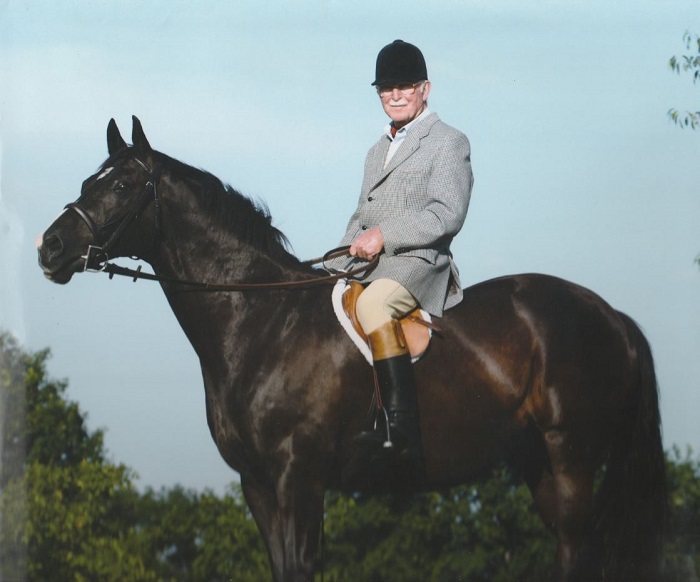
 Gus hunting Kronprinz, a Trakehner / Brendan Matthias photo
Gustav Schickedanz, ex-MFH, Eglinton and Caledon Hunt (ON), 2009 inductee into the Canadian Horse Racing Hall of Fame, emigré from war-ravaged Europe, died peacefully at his Schönberg Farm in Ontario on Monday, June 17, 2019. A horseman from his earliest days, Gus was a loveable, courtly, and fascinating man who had personally witnessed the best and the worst of life’s offerings during his ninety years on this planet.
Gus’s life trajectory included the pleasures of a childhood with horses on the three hundred acre family farm in East Prussia, the terror of his family’s flight from the Russians across Germany in World War II, the struggles of gaining entrance to Canada and a new life, achieving wealth through building a successful construction and development company from scratch, the breeding of stakes winners, and the satisfactions derived from devotion to family, horses, and foxhunting.
Building his new life in Canada, Gus was taken under the wing of mentors like the incomparable English-born Major Charles Kindersley, MFH of the Caledon (later Eglinton and Caledon) Hunt in Ontario. Recognizing the young man’s character, zeal, and joi-de-vivre when he saw it, the Major welcomed the newcomer to his hunting field. Gus absorbed foxhunting in the British tradition from the Major, was eventually invited to become a Joint-Master, and led the field. He became a member of the Toronto and North York Hunt (ON) as well, and, in the Canadian off-season, discovered the pleasures of foxhunting in Georgia and South Carolina. He became a member of the Belle Meade Hunt (GA), the Whiskey Road Foxhounds (SC), and the Flat Branch Hounds (SC). Gus struck up warm friendships with many foxhunters in this country. One was the late James Wilson, founder of the Belle Meade.
“When I hear Mr. Gus is coming to the meet,” said current Belle Meade MFH Epp Wilson, son of the late James Wilson, “it brightens my spirits. I know we are going to have a better day, a fun day, because Mr. Gus will be there. He gets there early, his horse is turned out beautifully, he is crisp and sharp and looks like something out of a magazine. He sits a horse like a cavalry officer.”
“Unforgettable” is the single word uttered by Gus’s biographer Karin Winegar in summing up this accomplished man.
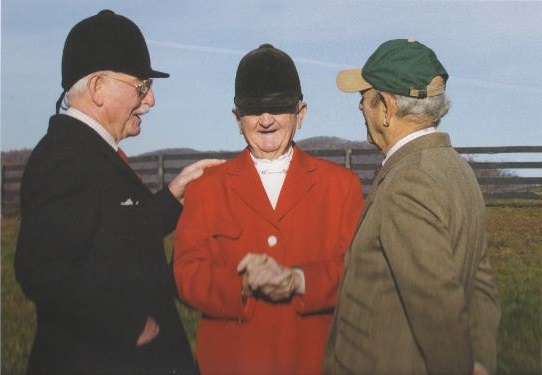 (l-r) Gus, Melvin Poe, Ray Moffet in Virginia in 2009
“I love peace and people who love peace.” –Gus Schickedanz
Gus’s Protestant ancestors were driven out of Salzburg—an independent state of the Holy Roman Empire in Austria—in the eighteenth century because they refused to convert to Catholicism. Yet, a couple of centuries later, Gus’s idyllic childhood with horses on the three hundred acre family farm in Memel, Lithuania (East Prussia) also came to an end as the Russians advanced toward Germany in 1944.
Fleeing westward with five wagons and twenty horses on the road, they found themselves caught between the advancing Russians and the defending German forces. Shelled by tanks and artillery from both sides, they lost most of the frightened horses. Gus’s sister suffered a serious head wound and a housemaid was killed. They were able to save only two horses and one wagon.
On the move once again—Gus’s mother holding her hand on her daughter’s head wound—they found a temporary first aid station where a single orderly had been left behind by the retreating German forces. Between Gus’s mother and the orderly, the hole in his sister’s skull was cleaned with alcohol and a gold coin was sterilized with the flame of a candle to place over the wound.
“It was chaos. It was hell. I cannot begin to describe it,” Gus said to Winegar.
The family crossed the Memel River by a bridge that was destroyed later the same night. They were on the western shore, but thousands were stranded behind. They struggled on westward through Germany, sold the horses and wagon, and proceeded by train, reaching the outskirts of Dresden in February of 1945 precisely in time to watch the city burn from the fire bombing inflicted in the final throes of the Nazi regime. The death toll from the bombing and fires exceeded that of the atomic blasts on Hiroshima and Nagasaki. Gus had just turned sixteen and, with his brother and many others, was ordered into the city’s smoldering rubble to retrieve corpses.
Arriving finally at a small village in Bavaria, Gus’s mother asked to be directed to the biggest farmer in the area. Once there, she told the owner that her son, Gus, would work for him, as would her other sons when they returned from service. They were fed and given two rooms with the farming family, who had lost four sons in the war.
Soon after, conscription papers arrived for Gus. His mother tore them up and promised, “I will hide you; they will not find you.” Gus’s biography, after the title page, is dedicated “To Maria, my beloved mother.”
The war ended in 1945, the family was reunited, but their farm and possessions were left behind in the hands of the Soviet Union. Gus’s father died of Parkinson’s Disease in 1950, and the decision was made to emigrate. Canada was the first nation to allow Germans to immigrate after the war, but it was exceedingly difficult. In the end it was an Irish-Catholic priest who was most instrumental in finally persuading Canadian officials to approve his application.
Gus arrived in Canada carrying only a briefcase. In it was a toothbrush, a work shirt, one set of underwear, and boots. He went to work as a bricklayer at an hourly rate of $1.95, and a year later his three brothers arrived. They started their own construction business, married, had children, and their fortunes multiplied.
Farms, Cattle, and Horses
Gus was, at heart, a farmer. He bought a cattle farm in Georgia, Longleaf Plantation, and later, a Thoroughbred training farm he named Schönberg Farm, located on a rise between Georgian Bay and Lake Ontario in Canada. With his brother, Gerhard, Gus also bought a horse farm in Markam, Ontario, which they named Galten Farm in memory of the old family farm in East Prussia.
They bought Canadian-bred saddle horses out of Trakehner dams, and began riding again as they had in earlier days. Gus loved the attributes of the breed, and, after discovering foxhunting, bred his own Trakehners as field hunters. He was one of a very few allowed to ride stallions in the hunting field. Gus also began building a stable of well-bred Thoroughbred fillies. One was Victorious Answer, a grand-daughter of Native Dancer. She was Gus’s first stakes winner, earning more than $57,000 before retiring to become the foundation broodmare at Schönberg Farm.
A Schönberg-bred filly, Sweet Briar Too—a descendant of unbeaten Nearco—was brought to Danzig. Gus named the foal Langfuhr, for a suburb of Danzig. During his racing career, both in Canada and the U.S., Langfuhr won important graded stakes races. He was retired to stud, undefeated at seven furlongs, after a minor leg injury.
Woodcarver, a homebred, won the first Queen’s Plate for Gus. Another homebred, Wando, son of Langfuhr, was the horse that put the icing on Gus’s cake.
In 2003, Wando won the Queen’s Plate by nine lengths, three ticks under the Plate record set thirteen years earlier. With Canada infected by Wando fever, the horse went on to win the second jewel in Canada’s Triple Crown of racing, the Prince of Wales Stakes, by four lengths. In the third and crucial race, The Breeders’ Stakes at one-and-one-half miles, it was Wando again after a brilliant move by his jockey to get him running space. He finished the year 2003 as Canadian Horse of the Year and Champion Three Year Old Colt, was retired to stud in Kentucky with his famous sire Langfuhr. As of 2010, Langfuhr had sired eight horses that had won over a million dollars.
Gus leaves Ann, his wife of sixty-five years, four daughters, ten grand-children, and two great grand-children. His remains were interred privately by the family on Thursday, June 20th, after a reception for friends. Donations may be made in his memory to a charity of your choice. Condolences for the family may be offered at Egan Funeral Home.
Posted June 22, 2019
The historical information above was taken with permission from Karin Winegar’s gorgeous biography, “Never Stop Dreaming: The Gus Schickedanz Story.” The book was privately published, and may be seen at the Canadian Horse Racing Hall of Fame library in Toronto, the National Sporting Library in Middleburg, VA, and the Aiken Thoroughbred Racing Hall of Fame in Aiken, SC.
The last time your editor rode with Gus was behind Melvin Poe’s foxhounds in Melvin’s home country in Hume, Virginia. Two “unforgettable” individuals from two different worlds who came together in peace, friendship, and respect through the sport of foxhunting.