In Ireland, the early 1950s through the 1960s was an era of amateur Master/huntsmen―young men of some means―who took on a pack of hounds more as an avocation than a job,” writes our correspondent, Dickie Power. He was fortunate to have hunted with many of them, such as Thady Ryan in Scarteen, Evan Williams in Tipperary, Lord Daresbury in Limerick, Capt. Harry Freeman-Jackson in Duhallow, Victor McCalmont in Kilkenny, Elsie Morgan in West Waterford, and PP Hogan in Avondhu. This centenary year of Hogan’s birth is an appropriate time to remember him―a legend of Irish foxhunting and point-to-point racing.
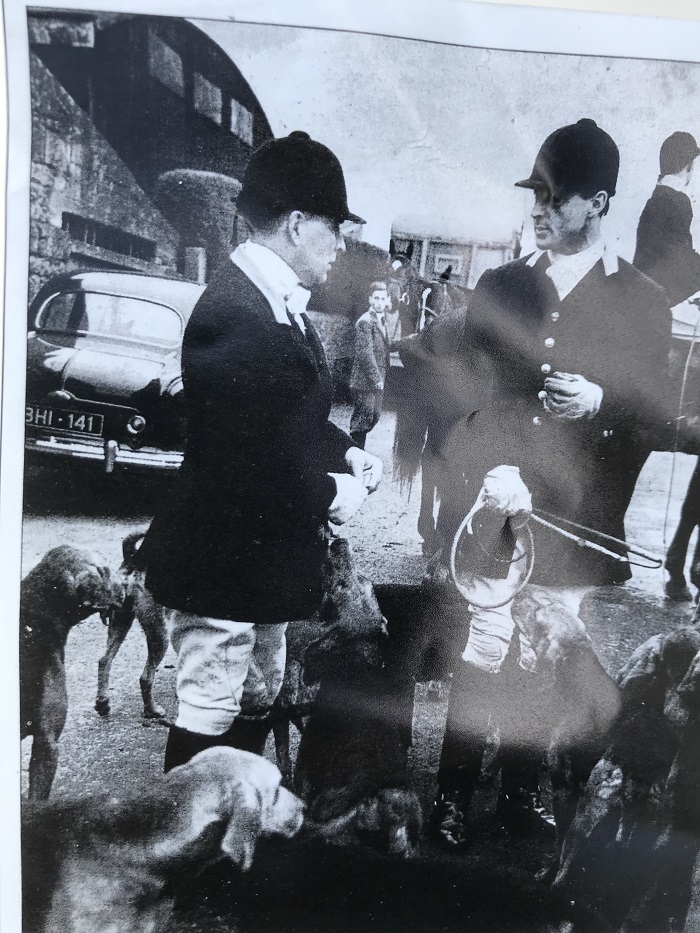 (L-R) PP Hogan with his friend Thady Ryan, Master and huntsman, Scarteeen Black and Tans (1956)
PP (Pat) Hogan was born in Ireland into a family of horse dealers, farmers, and huntsmen, with an odd Bishop thrown in. His great uncle was the sporting bishop of Limerick, who always encouraged his clergy to ride to hounds.
The Hogans were a well-to-do farming family, with farms dotted around east Limerick, then as now an area steeped in everything to do with the horse. PP rode almost before he could walk. He rode his first race at the age of twelve. In those days before health and safety reigned supreme, it was only a matter of months before he made the first of countless visits to the winner’s enclosure.
From the word go, his talent in the saddle shone like a sentinel while his academic achievements rarely got past the starting stalls. It was not long before he was much in demand, winning his first amateur rider championship in1942. It was just the start, and he was declared champion amateur no less than five times. In 1946, he won two bumpers on the great horse, Cottage Rake, for Vincent O’Brien, who was still training back home in Clashgannife in the heart of Duhallow country. Cottage Rake went on to win three consecutive Cheltenham Gold Cups with Aubrey Brabazon up.
While all this was happening, romance intervened, and PP married Maureen Gubbins of Kilfrush. She came from a family steeped in racing and hunting. Her great uncle had bred no less than two Derby winners, Galteemore and Ardpatrick, as well as hunting the County Limerick foxhounds. She was the only child and heiress to the rolling acres of Kilfrush and an inveterate foxhunter to boot. PP’s talent for training immediately shone, and Maureen was declared Leading Owner that year.
This was the start of an extraordinary odyssey of hunting, racing and particularly point-to-pointing.
Hunting was at least four or five days a week during the season. Monday and Thursday were reserved for Scarteen; Tuesday, Tipperary foxhounds with Evan Williams; Wednesday, Co Limerick in the wall country where horses were normally provide by Toby Daresbury from Clonshire; and Friday saw them in the cream of Co Limerick bank country around Athlacca/Bruree.
All the while, Kilfrush was run like a five-star hunting hotel for which there was no checkout. Sarah Hogan recalls people coming for dinner after hunting and leaving the following day while their hosts never quite discovered who they were. But along the way, they did have three daughters: Diana, Susan, and Sarah. The three girls, as you might expect, were never short of top-class ponies.
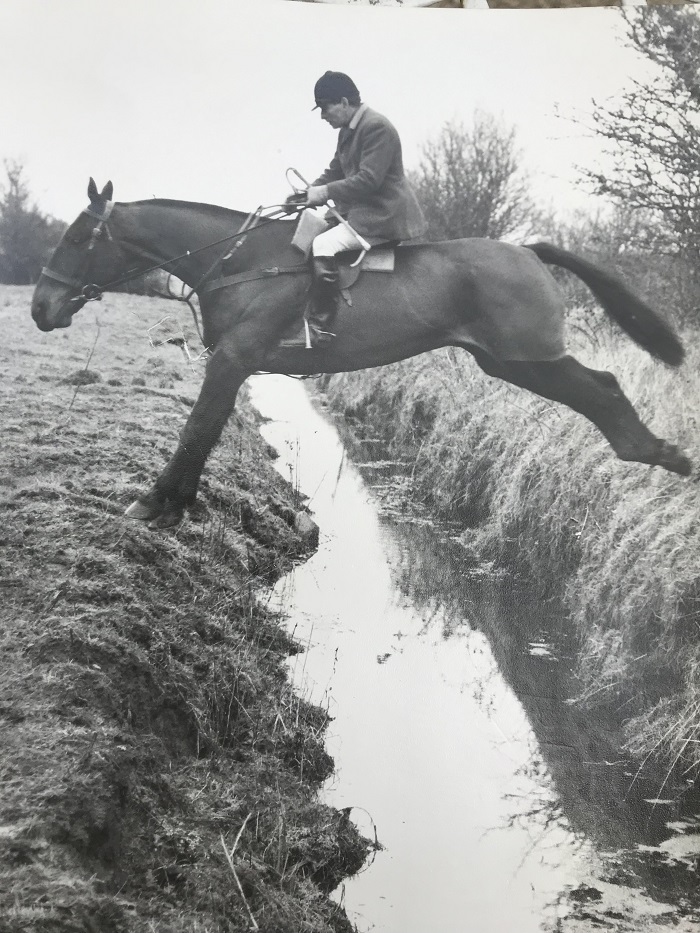 PP Hogan and his great hunter Half Moon / Frank Meads photon
Although they hunted with several packs, it was to Scarteen they bore allegiance. Thady Ryan said of PP, “No one could catch him across country. He and Half Moon would just disappear after hounds. What a horse Half Moon was. At one stage, the pressure on hounds was becoming too hard, and I took the bold step: I asked him to be Field Master!”
While Half Moon’s origins have been lost in the mist of time, his exploits jumping the black ditch in Dromin or wire palings have become the stuff of legend. PP himself recalled a day from Emly with hounds flying and he at least a field in front came to a pair of farm railway gates guarding the main Cork-to-Dublin line. He always carried keys, but before he could reach for them, Half Moon took off, landed, took two strides, and was gone over the second gate, leaving the field to get through as best they could.
All the visitors to Kilfrush weren’t anonymous freeloaders. Champion jockey Greville Starkey who rode two thousand winners and the Derby on the great Shirley Heights used to winter in Kilfrush with his two hunters, Thunder and Lightning. Barry Hill was a regular as was leading amateur and racing journalist Lord Oaksey. In later years in his autobiography, Lord Oaksey warmly remembered his days (and nights) in Kilfrush to be followed by exciting and sometimes disastrous days attempting to follow PP and the Tans over some of the best bank country God has created. For all that, PP, in retirement, speaking to this author was more than dismissive of the talents of the noble lord. While he was recalling those halcyon days, I asked PP how good was Oaksey.
“Well,” he replied after some thought, “he wasn’t much good when he came and little better when he left!” This didn’t stop Oaksey from being second on Carrickbeg (20/1) in the 1963 running of the Grand National!
Around this time, the Mastership of the Avondhu Foxhounds fell vacant upon the retirement of Rodney Mole. PP, who was hunting the Hospital Beagles, became Master and huntsman, setting an extraordinary three or four seasons in the history of the Avondhu in Fermoy. He augmented the pack with a good draft of Old English from his good friend Toby Daresbury in Co Limerick. With Johnny Rohan of Roh-Fab modular house-fame as his whipper-in, their opening meet in Fermoy was an uproarious success. He had all the young Turks out―his nephew Edward O’Grady (still a veterinary student), Mouse Morris, Greville Starkey, Barry Hills, Peter Magnier, and of course, his older brother John, riding the grey Stalbridge Colonist. Edward recalls the Magnier brothers as top-class men to cross the country always on the tail of hounds. At this stage, the future success of their now-international Coolmore Stud could only be looked on as the stuff of fantasy.
A remarkable run is still spoken of when hounds found a four o’clock fox near Glanworth, finishing in pitch dark on the edges of Kilfinane in far distant Scarteen country with just a handful of horses remaining. After three or four seasons, PP gave up the Avondhu Mastership but continued to hunt, particularly with the Tans.
During all this, PP had established himself as the uncrowned king of point-to-points and hunter chases. His first champion was Devon Breeze in 1965. He went on to have Fearless Fred―named with some irony after the Field Master of the Co Limerick (not noted as a thruster). Passed on to Fred Rimell, Fearless Fred won a Welsh Grand National.
With a new group of investors entering the bloodstock market, led by pools millionaire Robert Sangster and Coolmore, PP, who had an uncanny eye for what made a horse a champion, became their bloodstock adviser. This allowed PP a level of financial security. By then, he had moved back to Rathcannon, near Athlacca, which had been in the Hogan family for generations. Maureen had moved to an estate at Rathcormack near Fermoy.
It was in Rathcannon that his point-to-point career really took off. His horse, Any Crack, won five La Touche Cups at Punchestown and would have won more were he not so heavily penalised by the handicapper. His horse, Under Way, had a lifetime record of more than fifty race wins, and in 1985, the stable recorded forty-five wins. Over the 1980s, the stable recorded 265 point-to-point wins.
PP’s jockeys list looks like a Who’s Who, starting with Bill McLernon, Ted Walsh, Roger Hurley, Peter Greenall, Niall Madden, Tom Costello, Jr, and finishing with the peerless Enda Bolger. He arrived in 1981 from the Willie Mullins yard and completed a perfect round by marrying PP’s youngest daughter Sarah.
Enda now trains very successfully in nearby Howardstown, the first married home of a young JP and Noreen McManus. Enda recalls PP as a hard but fair taskmaster, not afraid to give candid comments on the young jockeys’ performances. On the schooling gallops in Rathcannon, after Enda would pull up on Ah Whist or Under Way, PP’s favoured comment to the young aspiring (and perspiring) future champion was, “Young fellow, if I had hands like that, I’d cut them off!” in these times it might sound harsh, but young Enda took the advice to heart and ended up as one of the great stylists in the saddle.
Speaking of JP McManus, there’s another racing fairy tale. JP is now the most prolific and successful owner that the world of national hunt racing has ever known. PP was his early mentor and supplied him with his early horses―Jack of Trumps and Bit of a Skit, both of which were trained by PP’s nephew Edward O’Grady, to name just a couple.
The list of stellar “apprentices” who passed through PP’s yard must also include Philip Purcell, Brendan Powell, Norman Williamson, and that inveterate hunting man, John Gleeson, now looked on as only second to Enda in producing cross-country horses.
But perhaps it was PP’s talents as a spotter for Vincent O’Brien and Robert Sangster that he will be best remembered in the world of the turf. It was PP who bought Arc winners Rheingold and Detroit. It was said the great Vincent O’Brien never made any major purchase without consulting PP for confirmation of his proposed purchase.
It could also be argued that it was Assert (by Be My Guest) that really set PP up. Asset was bought for Robert Sangster by PP in 1980 and went on to win the Prix du Jockey Club (the French Derby) before being syndicated for a rumoured $26 million.
PP’s share allowed him to keep and run these great horses right through their racing careers. Like Under Way, which in a commercial yard, would have had to be passed on.
Reaching the biblical age of three score and ten, PP began to wind down his training by degrees, which Enda took over. PP continued to hunt, but Thady Ryan, in his memoir, recalls taking a shortcut across country after a good day when PP jumped into a bottomless bog. When the horse was eventually retrieved, Thady asked his oldest hunting friend why he had jumped into the morass. “Thady, I just didn’t see it,” he said. Thady recalled with sadness that PP’s eyesight was failing.
I knew PP as a good friend and mentor, and while I was never of the calibre of his great jockeys, most of what I learned was on the gallops in Kilfrush. I was his last “apprentice” before his move to Rathcannon.
In his later years, I continued to visit him at Rathcannon. He was brilliantly looked after by Susan, who was unfailingly a generous host.
We would sit and reminisce on the great hunting days when the country was open, and long hunts were the order of the day. Inevitably the question had to be asked. “What was your best day in the field?”
He recalled a day from a Limerick meet in Athlacca with hounds being hunted by Hugh Robards. First draw was Howardstown, where hounds found and crossed the Morning Star seriously in flood after overnight rain. PP and the young whipper-in Martin Hurley from the Conna Harriers, without hesitation, swam the river. Hugh, sensing a split, took the field to the nearby bridge to stay with the main lot. PP and young Martin had their hounds to themselves for an epic hunt running from the covert in Dromin almost to Fedamore and back without a check.
“I was on Half Moon,” said PP, “and young Martin was riding at no weight at all, so we stayed with hounds, and the country was so open we only had to dismount once for a roadside gate.”
Alas, that was then, and this is now. If there is hunting in Elysian fields, I’ve no doubt PP is leading the field over a cracking bit of country and showing that the impossible looks easy in the hands of a master.
Posted June 19, 2022
Published with permission. This article was first published in The Irish Field June 3, 2022.
Afterword:
For your editor, reading these reminiscences by Dickie Power is a poignant trip back in time. He and his wife were there with these same legends in the late 1960s and early 1970s, and, good grief, but that was half a century ago.
Joan and I stayed with Thady and Anne Ryan in Co Limerick and hunted behind Thady and his hounds, PP Hogan, and Co Limerick huntsman Hugh Robards, all hunting figures in this story. In those years, the countryside was wide open to hunting, the hunting days were long, and Americans were loved. And all the wild tales told about these larger-than-life legends are true. Aboard the Irish horse, one embarks on adventures that would be considered impossible back home. Not to be believed. Once home, we could scarcely believe the things we saw and did on horseback ourselves.
To those who hang back from Irish hunting out of caution, I would sooner have twice the falls from a horse onto the soft Irish turf than a single fall onto our own unforgiving ground in North America. In fact, I tested that theory. And though Joan was usually in front of me, I never once saw her fall off. So, falls are not preordained. And you will meet plenty of your fellow Americans hunting there. ―Ed