
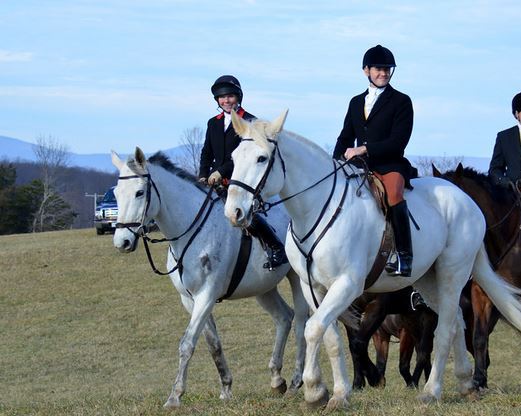
 Joe Whited (right) and the author in the Old Dominion field / Michelle OHanlon Arnold photo
A foxhunter and conservationist with an impressive background in foreign affairs is seeking the Republican nomination for Virginia’s Fifth Congressional District seat in the U.S. House of Representatives.
Joe Whited, thirty-six, has mounted a campaign for the Republican nomination, one of four vying for the seat being vacated by Representative Robert Hurt (R). Whited wears the colors of the Old Dominion Hounds (VA) and helps run the club’s annual point-to-point. His first race, however, will be purely political—the Republican primary in April.
Virginia’s Fifth District is the Commonwealth’s largest. The pie-shaped wedge includes much of Virginia hunt country, including territory of Piedmont, Orange County, Warrenton, Casanova, Old Dominion, Rappahannock, Thornton Hill-Fort Valley, Bull Run, Keswick, Farmington, Deep Run, Oak Ridge, Stonewall, Bedford, and Red Oak in Virginia, just north of Sedgefield and Red Mountain in North Carolina.
A Rappahannock County resident and avid outdoorsman, Whited is a Navy veteran with a decade of experience for the Defense Intelligence Agency and House Armed Services Committee. He believes his unique experience “from both sides of the table” sets him up for elected office.
“When it comes to the size and effectiveness of government,” Whited says, “we must not only check the growth of government and roll back the endless regulations, but we must also ensure government is doing the things we actually want it to do—effectively and efficiently.
“The recent capture and release of American sailors by Iran is emblematic of the low esteem in which the United States is currently held,” he maintains. “While I am not aware of the specific details of this event, outside of what’s been briefed to the press, it is hard to fathom a foreign power thinking it could get away with seizing a U.S. Navy vessel in distress and holding our sailors at gunpoint. There should be no doubt in the minds of our potential adversaries that this sort of behavior is unacceptable.”
Whited was raised on a family cattle farm near Spencer, West Virginia. Recalling the long days of hard work alongside his grandfather, and countless evenings spent with a fishing pole at the farm pond, Whited’s ardor for open space, hunting, and fishing come as no surprise. He continues to find solace in the countryside he vows to protect if elected.
“When I returned from deployments in the Navy I looked forward to long walks through the hayfields, or just sitting with a line in the water, totally at peace,” Whited recalls. “These days I get that same joy when I can escape the office and get on a horse.”
He loves the many foxhunting references in politics, and makes a few of his own. “I always enjoy telling people where the terms ‘House Whip’ and ‘Senate Whip’ come from,” Whited says of his unique insider knowledge. “Most folks are unaware of the connection to foxhunting, and they always enjoy the story” of a whipper-in helping to keep hounds in touch with the huntsman, much as a Congressional Whip keeps party members apprised of House and Senate leadership movements.
“Trying to whip a pack of young hounds, new entry, together during cubbing season pales in comparison to trying to whip the pack on the Hill,” Whited adds with a shrug. “I suspect even some of the best huntsmen and whips in horse country would give up.”
Expanding on the hunt terminology, calling that most important gait of the foxhunter—the halt—critical to government, Whited adds, “Not unlike foxhunting, in Congress the standstill, a full pause, is often the best position to take. Quietly observing the different views of hounds, or members of Congress, before committing to a particular position is key.
“And like the hunt field, knowing your territory is vital. What are you going to find when the hounds—or your campaign—go over that next hill? A cliff? Or maybe a wide-open field and a good covert.”
Whited hopes to find time to hunt as his campaign ramps up over the next couple months to and through the April Republican primary. “I hired my campaign manager with the stipulation that he lets me take time to foxhunt,” Whited says with a chuckle. “I assured him I’ll be a lot easier to deal with if I get to ride [to hounds] once a week.”
“We’re very proud of Joe,” said long-time Old Dominion Joint-Master Gus Forbush. “I think having a foxhunter in Congress would make history. Senator Warner was a hunter, but I’m not aware of any others in modern times.”
Whited has decades of experience in foreign affairs. He enlisted in the U.S. Navy at seventeen, serving three tours from 1998 to 2006. He was intelligence adviser to the Assistant Secretary of Defense for International Security Affairs, Naval Intelligence Watch Stander for the Chief of Naval Operations Staff, and adviser to the Iraqi national police.
Whited then worked as senior foreign military analyst for DIA, most recently serving as professional staff for the House Armed Services Committee, principal defense intelligence adviser to Chairman Mac Thornberry.
Also seeking the Republican nomination are state Senator Thomas Garrett, Jr. of Buckingham County, Michael Del Rosso of Albemarle County, and James McKelvey of Franklin County. Virginia’s Republican Party has yet to decide if its congressional candidate will be chosen at a party convention or by primary. A decision will be made at a party caucus in February.
The seat Whited seeks was first held by James Madison, 1789-1797. Fourth U.S. President Madison started as a Virginia state rep, then sat on the Continental Congress before serving as Jefferson’s Secretary of State. He was President from 1809 to 1818. Find out more about Whited’s campaign on his website.
There are strong precedents for the foxhunting-political link in the U.S. since Colonial days. The diaries of George Washington show an ardent hunter who kept hounds kenneled at Mount Vernon. On one occasion, Congress was in session as hounds ran near the Capitol building. Washington noted in his diary that congressmen ran outside to watch, some jumping on their horses and joining the chase. At least four U.S. Presidents were foxhunters: Washington, Thomas Jefferson, Teddy Roosevelt, and Ronald Reagan. Reagan hunted with the West Hills Hounds near Los Angeles.
Though there is no reference to John Kennedy foxhunting, his wife Jackie was a regular with Virginia’s Piedmont Fox Hounds and the Orange County Hounds. Senator John Warner had his colors with Piedmont and also hunted with Orange County. Massachusetts Senator Leverett Saltonstall and his entire family hunted with the Norfolk Hunt (MA).
In Congress the late Mike Strang, co-founder of the Roaring Fork Hounds (CO) and MFH from 1967–2006 represented Western Colorado in the U.S. House of Representatives for a single term starting in 1984. Kate Byron, MFH of the New Market-Middleton Valley Hounds (MD), counts three foxhunting members of her family who represented their Maryland districts in the U.S. House of Representatrives: her grandfather William Devereaux Byron with the old Antietam Hunt and her father James Edgar Byron and uncle Goodloe Edgar Byron who hunted with Newmarket and Antietam.
Whited thinks field sports provide a much-needed outlet from the pressure-cooker of U.S. politics. He quotes from Winston Churchill: “the outside of a horse is good for the inside of a man.”
Posted February 3, 2016