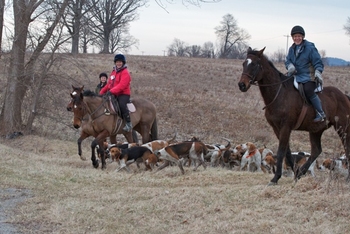
 Genesee Valley hounds going home from their one hundredth hunt of the season after running their fox in and out of a swamp for nearly two hours. (l-r) whipper-in Erica Hutten, Master and huntsman Marion Thorne, and whipper-in and hunt secretary Janice Barrett. / Bill Gamble photoThe Genesee Valley Hunt (NY) celebrated a new record for their hunt on Wednesday, February 8, 2012, when they completed their one hundredth hunt of the season. True, the eastern part of the country has been blessed with an easy winter, but equally true is that their hunting country sits astride the same latitude as Buffalo, New York!
Located in a northern clime, the Genesee Valley Hunt decided long ago to simply ignore the weather. The only generally acceptable causes for cancellation are lightning—you never want to be sitting on a horse shod with steel shoes in a lightning storm—or when the Genesee River freezes over. Of course, the hunt’s geographic location is advantageous in the summer where they are able to start cubhunting in mid-July.
A Distinguished History
There is no other hunt in North America with a more distinguished foxhunting history than the Genesee Valley Hunt: four generations of Masters and huntsmen from a single family, a founder of the Masters of Foxhounds Association, two presidents of that Association, and an enviable record of conservation. With such familial continuity, the hunt more nearly resembles Ireland’s famed Scarteen, where hounds have been owned and bred by the Ryan family for over three hundred years, than it does any other hunt on this continent.
When, in February of 1907, Major W. Austin Wadsworth met with Harry Worcester-Smith and four other Masters at the Waldorf-Astoria in New York to discuss the creation of the Masters of Foxhounds Association, the Genesee Valley (of which he owned forty-thousand acres) had long been the center of organized foxhunting in North America. At the Association’s first official meeting later that year, Major Wadsworth was elected president.
From earliest times, Major Wadsworth was sculpting a uniquely American twist on the sport of foxhunting. Though he ran his hunt and managed the country as befits a benevolent dictator, he fostered a culture of democratic inclusiveness which has remained a core tenet of the hunt’s philosophy to this day.
“I would rather see a farmer’s boy on a mule at a meet,” he said, “than the most elaborate creation of a London tailor.”
The 1881 membership role lists thirteen male and fifteen female honorary members. Over the next thirty years, according to the hunt’s website, over 150 people of all ethnic, religious, and economic backgrounds were invited by the Master to become members of the hunt.
The Major also possessed a well-developed sense of humor which he employed to great success in his writings. To him we credit the well-known “Foxhunter’s Bible,” many lines of which are treasured by the literate foxhunter. Here are just a few:
Of the Farmer:
You may think that the honest farmer deems it a privilege to leave his life of luxurious idleness and travel around half the night in the mud for horses that have got out… by your leaving his gates open…. You are mistaken. He doesn’t.
Of the Master:
The MFH is a great and mystic personage to be lowly, meekly and reverently looked up to…. His ways are not as other men’s ways, and his language and actions are not to be judged by their standards.
Of the Fox:
Don’t “give tongue” on a woodchuck. It will cause you humiliation. There is a difference in the tails.
Of the Hounds:
Keep away from them at all times and at every time. Even if you consider them worthless, the Master may be quaintly indifferent to your opinions….
(The entire text of Major Wadsworth’s “Bible” has been published in many books on foxhunting and also may be found on the hunt’s website.)
Recognizing that many of the young bloods in his field wanted nothing more than the opportunity to run and jump, the Major organized the occasional drag hunt for their satisfaction. In the final paragraph of the proposed notice of the drag hunt to his followers we find yet another example of his understanding wit:
Some very swift hounds have been secured, and this drag will be laid as strong as possible, so that it is sincerely hoped the gentlemen racing with each other will not be annoyed by these stupid animals. Should they prove to be a nuisance, however, the stupid brutes will be dispensed with altogether and the line flagged.
David Gray, the first author to popularize American foxhunting stories, was a regular follower of Major Wadsworth’s hounds, and many of the stories published in his acclaimed Gallops I and Gallops II volumes were based on actual events that occurred in the Genesee Valley field.
Major Wadsworth’s son William P. Wadsworth took over the Mastership and the horn in 1933. He was elected president of the MFHA in 1970. He had a way with words as well and is the author of the classic booklet, Riding to Hounds in North America, which has provided advice and instruction on attire, etiquette, as well as sound hunting information to countless newcomers to the sport. The booklet is still in print and is available from the MFHA.
William P.’s son W. Austin and daughter Martha preserved the family continuity by whipping-in and by, each in their turn, taking the Mastership and the horn. W. Austin’s step-daughter Marion Thorne, who in her turn whipped-in to both Austin and Martha, represents the fourth generation to have accepted the Mastership and carried the horn. Marion’s husband Travis Thorne whips-in to Marion.
Posted February 17, 2012
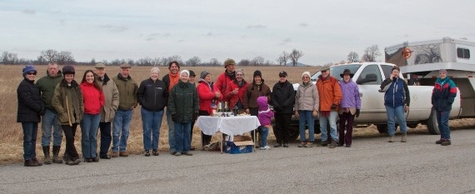 Genesee Valley Hunt members enjoy a pre-hunt stirrup cup to toast their new record. / Bill Gamble photo