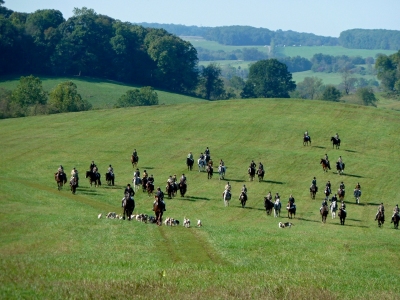
If you want to see stunning hunting country, I commend you to FHL’s latest Photo Gallery slide show. We feature Elisabeth Harpham’s lovely photos of Mr. Stewart’s Cheshire Foxhounds in Unionville, Pennsylvania.
The Cheshire hunting country is an oasis between the developed suburbs of Philadelphia, Pennsylvania and Wilmington, Delaware. This is hunting country for any foxhunter to drool over. But you have to know that country like that just doesn’t happen by a stroke of luck. It’s the product of years of commitment by strong-willed individuals determined to protect what they have.
The late Mrs. John Hannum served as Master of the Cheshire for over fifty years, and as huntsman for much of that time. Through those years she zealously guarded the open space of Chester County. She “advised” property owners how (and how not) to fence their land; she “convinced” them where to site their houses and improvements; she purchased countless properties and resold them at cost to sympathetic buyers; and she battled developers by every possible means from persuasion to bureaucratic delay. Moreover, she recruited the residents of her hunting community to follow her lead. From her unrelenting crusade bloomed the famed Brandywine Conservancy, a national model for open space conservancy. Born of a bygone era, Nancy Hannum was one of the great heroines of North American foxhunting.
Though Mrs. Hannum adored the traditionally bred English foxhound, the Masters embarked some years ago on a bold breeding experiment. By crossing Penn-Marydels with English hounds, the Cheshire Masters and huntsman are striving to produce a Crossbred hound that combines the voice and low scenting attributes of the Penn-Marydel with the drive of the English foxhound.
“We are developing a new type of hound, and it’s a long-term process,” said Russell Jones, MFH. “Since we are only hunting bitches, we have forced ourselves to go outside for semen. We are maintaining both our purebred lines of Penn-Marydel and English for future brood bitches. The real question becomes who to breed the Crossbred daughters to.”
As examples, Jones explained that a Crossbred bitch needing more voice might be bred to a Penn-Marydel dog, or a Crossbred bitch that tends to be shy might be bred to an English dog.
“Our challenge is to correctly identify the aptitudes of the Crossbred daughters so we can breed them right,” Jones said.
One might well wonder how three disparate hound types work together in the pack.
“They hunt great together,” said Jones, “and they respect each other.” Jones and his hunt staff are convinced that the hounds of each breed value the attributes brought to the pack by the other.
Although the drastic change in the breeding program was wrenching for many members of this venerable hunt, there is little disagreement that the newly developed hound pack delivers excellent hunting for a discerning and hard-riding membership.
October 25, 2010
{pgslideshow id=38|width=540|height=405|delay=3000|image=L|pgslink=1}