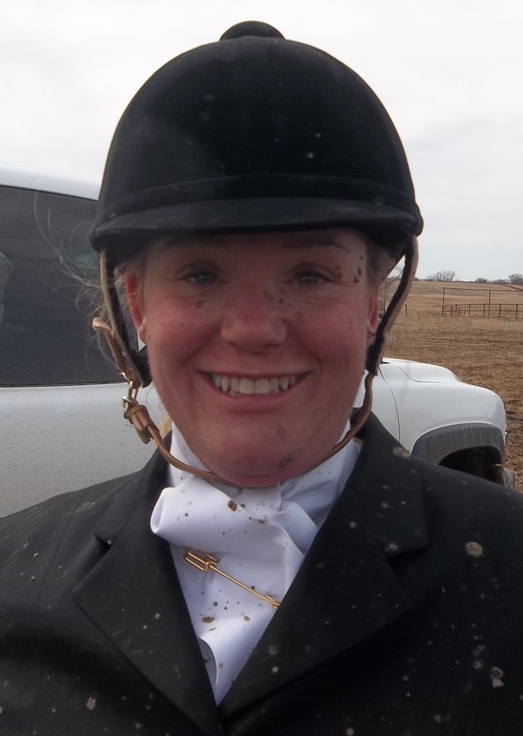
 The authorPicture this: four hunts—Bridlespur Hunt (MO), Full Cry Hounds (AL), Grand Canyon Hounds (AZ),and Mill Creek Hunt (IL)—bringing their best three couple of hounds to the field; thirty-five enthusiastic mounted riders; and sweeping vistas of open hunting country loaded with coyotes. This made for an action-packed five days of foxhunting activities consisting of a three-day Foxhound Performance Trial, foot hunting with the bassets, and a joint meet of foxhounds. It all took place at the Flint Hills Invitational Performance Trial, held on March 7-9, 2012, generously hosted by the Moingona Hunt staff and members. The Flint Hills area of Kansas is an immense rolling prairie of tallgrass and recognized as one of America’s unique treasures.
I write this report as a fourth-year General Member of Mill Creek Hunt in Old Mill Creek, Illinois. I feel I’m still getting my “feet wet” with my own short list of foxhunting adventures, happily riding in the back of the second field with my eleven-year-old son Anthony behind our dedicated Mill Creek staff and professional huntsman, Brenda Yost.
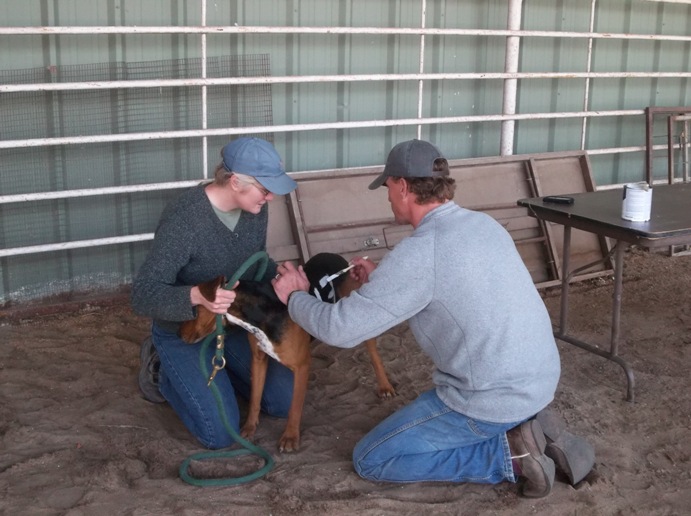 Mill Creek huntsman Brenda Yost and Moingona huntsman Ken George painting the numbers / Heather Kuenzi photoWe set off early on a Monday morning at five-dark-thirty with six hounds and six horses ready for the twelve-hour drive ahead of us. Many quality road-trip conversations and tanks of gas later, we realized we had arrived as we drove right past the small Morris County fairgrounds. Somewhere in the small town of Council Grove, Kansas we found space to turn our lengthy trailer around and quickly headed back in the right direction to get horses and hounds unloaded and settled into their new abode for the night. The horses were happy in their large stalls, and the hounds had the whole trailer to move around in and the choice to sleep in the comfy warm straw in their trailer box.
Huntsman Brenda, Mill Creek member Alison Volpentesta, and I were looking forward to the adventures of the week. Huntsman Brenda already had the experience of one Performance Trial under her belt while Alison and I were trial rookies—happy to be along for the ride! While I had volunteered my time to help with horses and hounds for the week, Brenda, Alison, and Mill Creek Hunt member Alex Kaplan (who wisely chose to fly in for the event) had signed up for all three days of the performance trial. Mill Creek Master Roger Lane and his whipper-In wife Chris Lane also made the trip with their own trailer for all three days as well.
Our first full day in the warm Kansas climate brought seventy-degree weather, sunshine, and gale force winds gusting to forty mph! The horses were happy to have their blankets off while stabled in a sturdy steel building out of the strong Kansas winds. After a morning walk to explore the fairgrounds, hounds came off the trailer in their turns to have performance trial entry numbers painted on each side of their ribs. Moingona Huntsman Ken George showed up with his paint brush and two cans of paint: white for dark hounds and black for light hounds. While we used paint to mark our hounds, some hunts had used bleach on their dark coated hounds to mark their numbers—a creative way to assure that the paint didn’t rub off during their three days of exploring the countryside. If the judges can’t read their number the hound can’t get judged.
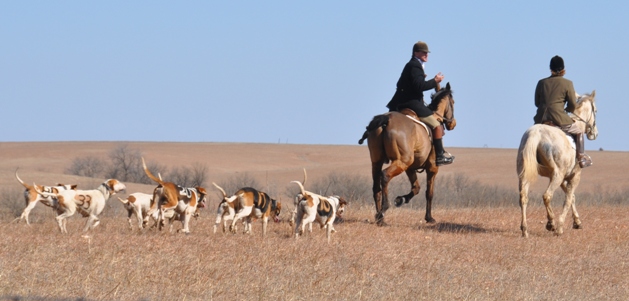 Hunting coyotes in the Flint Hills / Jon Webber photo
How Hounds Are Judged
That night in the back room of a local pub, the judges and officials met for a briefing to discuss the flow of the three days to come, what the judges are to be scoring, and how the judges will track their scores. Alison and I sat as close to the discussion as we could listening to the exciting details. We were joined at our table by foxhunting enthusiast Art Richardson, ex-MFH of the Wayne-DuPage Hunt (IL), who patiently answered our many questions and told us a few foxhunting stories of his own!
Alison and I were excited for Huntsman Brenda, who this whole time had thought she would be simply entering her hounds and then riding in the field like everyone else. However, upon arriving, she found out she would be one of the seven judges for the competition.
The mixed pack of twelve couple—three couple from each of the four hunts—marked with painted or bleached numbers would hunt alongside three couple of the non-marked Moingona hounds to make a complete pack of fifteen couple for each day. Moingona Huntsman Ken George would serve as the trial huntsman, and the seven judges would be keeping a close eye on the pack, eliminating the need for whippers-in. There was to be one field of approximately thirty-five riders each day. This well mounted field was led by Moingona members Angela Sommers and Ann Webber who bravely took turns leading the field every other day through the open and sometimes challenging country.
Each judge was given a small voice recorder to carry during the trial on a lanyard string around the neck upon which to record each hound’s scores as the day progressed, listing the number of the hound they were scoring, the time of the scoring, and noting the details of that hound’s actions. Hounds were to be judged on four criteria: Hunting, Trailing, Full Cry, and Marking. While we had some amazing runs with many judging opportunities, we didn’t experience any marking (gone to ground) opportunities, so that score wasn’t factored in. The one overall score that’s not actively judged—Speed & Endurance—is factored in by the computerized judging program based on the other three scores of hunting, trailing and full cry.
Judges must ride rather aggressively to keep up with hounds as they work. The judges are only to judge the lead hounds, listing the hound in the front of the pack first. A typical judge’s score might sound like, “27, 15 then 46 trailing.” Listening to bits and pieces of huntsman Brenda’s recordings were insightful and sometimes humorous as she learned the true meaning of judging—multi-tasking. On her voice recorder that day we heard words come out of Brenda’s mouth that any good country boy would be proud of! This proved to be one of my favorite moments of getting to know huntsman Brenda, whom we usually only get to see as calm, cool, and collected during our hunts at Mill Creek!
While briskly galloping along the open grassland with one hand holding her reins and hunt whip, the other hand operating the recorder close to her mouth, not looking where she was going, and taking deep breaths to list the eagerly hunting hounds, Brenda’s horse almost ran into a tree! We learned that huntsman Brenda, from whose mouth I’ve never heard even a peep of profanity, knows a few choice words! Multi-tasking proved to be a challenge when in the heat of that judging moment!
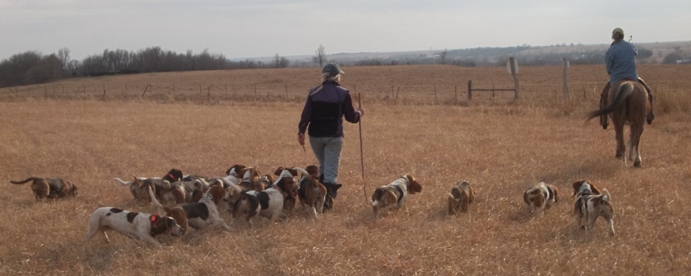 Betsy Parke and her bassets in search of the hare. / Heather Kuenzi photo
My Adventures
As I mentioned before, I volunteered to come on the trip to help with daily care of hounds and horses, happy to ride in the SUV vehicles of Moingona Master Diane Hickman and Moingona member Ann Webber’s husband John with the road followers serving as paparazzi taking countless photos! I did bring my formal hunt attire—just in case a horse needed to be ridden. After my first day of seeing how everything transpired, I did take huntsman Brenda up on her offer to ride her horse on the second day. I was very excited to get to ride among so many talented riders across open grassland cattle-country so much unlike our woods/cropland country at Mill Creek.
We had unexpected snow flurries the night before which left the ground with countless puddles and at times muddy conditions with a large field riding over it. Riding in cattle-country on ranches with 30,000-plus acres you’d think you could ride forever without getting off your horse. However, most of the land is fenced off into pastures ranging from 200 to 2,000 acres. It was common to see someone dismounting quickly to hold the wire fence gate open while the hunt proceeded through the opening many times using this break to check hounds before moving off to the next draw.
On this second day of the trial, according to the GPS tracker on my phone (that I kept on silent mode in the pocket of my hunt coat) we logged a swift distance of 15.44 miles over two hours and twenty-three minutes. With sights of the open country for miles and sometimes riding through pastures stocked with herds of Black Angus cattle, it truly was an adventure to ride through this meandering creek country. The country is “blessed” with the occasional Osage Orange tree. I believe this is just another way to keep the riders at full alert of their surroundings! The Osage Orange tree’s name sounds nice, but it’s actually covered in sturdy two-inch long thorns. After riding in open country, and galloping up to ride through a tree line and you have to look twice and come up with a quick plan to twist, duck or swerve out of the way of the impeding thorns. I’m pretty sure the hairnet that got ripped right out from under my helmet while galloping under a low hanging branch will be hanging there for many years to come.
I’m happy to say that all of the riders stayed mounted through all three days and it was a pleasure to witness so many talented riders and horses in action, taking the new terrain in stride. The area is called the Flint Hills for a reason. There are random sections of the grassy fields littered with shoe-box-sized flat flint rocks that make for challenging sections of footing for the horses. Having good brakes on your horse was definitely a requirement as sometimes sections of rock come up very quickly while galloping.
We had one final day of the performance trial, making this one of the first three-day performance trials ever held. The last run of the final third day was lead by a generous coyote who ran the pack straight back to the trailers making for a short ride back home.
Each night the group met for an awards dinner to enjoy homemade cuisine hosted by local caterers. Impressive ribbons were awarded for the top three hounds, and scores were called for the top ten hounds in each division. It was interesting to follow which hounds were placing each day and note that each day of hunting brought many different hounds to the top of the list. I was happy to learn more about our hounds, their hunting skills, and pedigrees. Thanks to a discussion with huntsman Charles Montgomery, we learned that our top performing Mill Creek hound, “Golding,” was a close descendant to a superior English hound sire, “Robot.”
To top off our week, we stayed for the eventful joint-meet on Saturday before heading home. I enjoyed the views from the backseat of Diane’s SUV as we quickly drove along the gravel roads and bounced our way through the winding dirt paths in the pastures behind the hunt. This day was special as the full pack of Grand Canyon Hounds had the glory of the chase all to themselves.
At home with Mill Creek, when I’m not able to hunt on horseback, I enjoy riding in the road whip truck listening to the walkie-talkie radios. You learn a lot about the country, how the staff communicates, which hounds are working well and so on. During the quick Joint Meet hunt, it was a fun experience on the radio different dynamics of Moingona Huntsman Ken working alongside Grand Canyon Huntsman Peter Wilson working his hounds while listening to the whipper-ins and drivers of the greyhound trucks patiently perched on the tops of the surrounding hills.
I’m so grateful for the many wonderful friendships that have developed out of our common love of foxhunting. Getting to spend a week focused on nothing but the sport of foxhunting was surreal for someone like me who has spent most of my life only reading about it in books. The staff and members of Moingona Hunt are to be commended for their fellowship and generosity to share their hunting country with others. It was special to see what a true appreciation they have for their landowners, and it was great to see some of the landowners riding along with the hunt. We are already planning to join in on the fun again.
Posted April 4, 2012
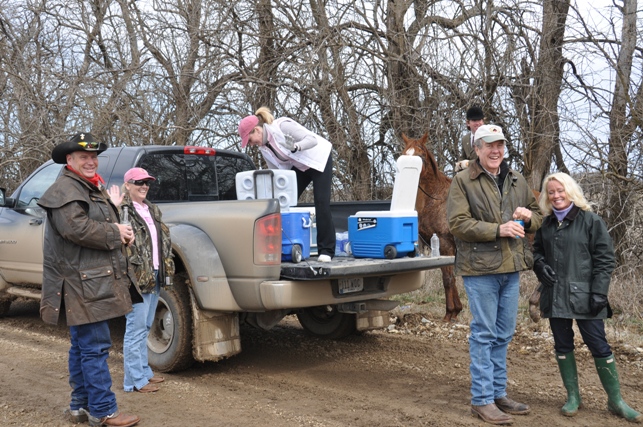 The Support and Sustenance crew / Jon Webber photo