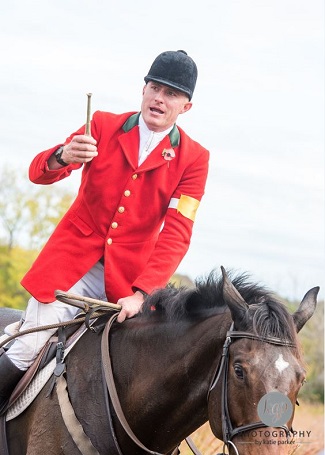
 Trial Huntsman Ashley Hubbard / Kgp PhotographyTwo days of hard hunting on November 6 and 7, 2018 behind a pack of fifty-four foxhounds—each of which qualified for this championship event by placing among the top ten of one or more of the performance trials over the past year—concluded the MFHA Hark Forward! Performance Trial Season. The season of performance trials, field hunter trials, and joint meets which began last year were conceived by MFHA president Tony Leahy and Master Epp Wilson, Belle Meade Hunt (GA), to reprise, during Leahy’s tenure as president, the spirit of the MFHA Centennial celebrations ten years earlier.
The Performance Trial Championship event was matured, expanded, organized, and staged to perfection by the Masters of the Midland Fox Hounds (GA) in their Fitzpatrick, Alabama hunting country. More than two hundred people representing more than forty hunts participated. Foxhounds from twenty-four hunts competed. Ashley Hubbard, professional huntsman at the Green Spring Valley Hounds (MD), served as trial huntsman for this all-star pack.
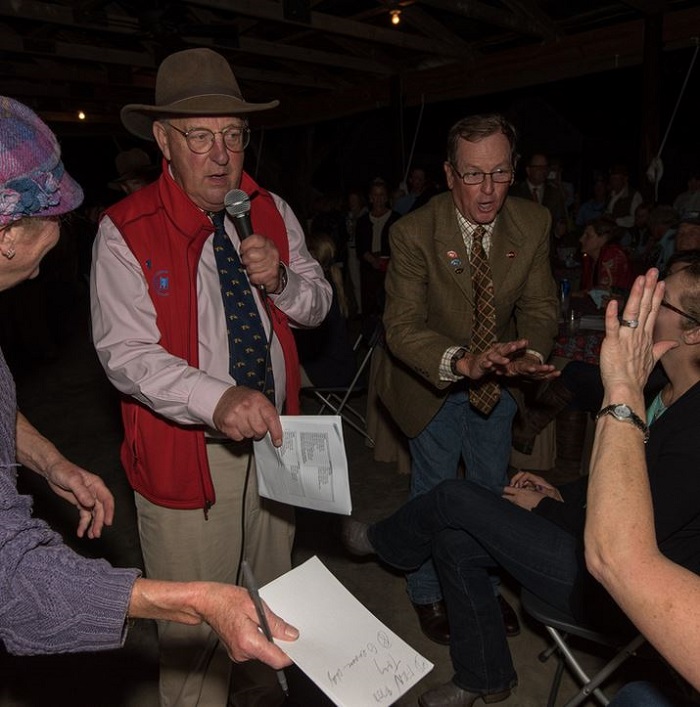 Mason Lampton and Epp Wilson raise funds during the Calcutta / Kgp Photography
What with proceeds from entries, caps, the Calcutta, and the sale of a thousand meals in five venues, the Midland event raised more than $100,000 thousand dollars for the MFHA. The funds will be used in the ongoing refurbishment of and improvements to the new MFHA headquarters in Middleburg, Virginia.
Mason H. Lampton, MFH, Midland, enticed a number of notable figures from the English foxhunting world to attend: Charmian Green, recently retired after thirty-five years as MFH of the Warwickshire (UK) and a former Master of the Fox River Valley Hunt (IL) in the early 1970s (and having recognized the talent of a young Irishman named Anthony Leahy, encouraged him to immigrate to the US as a huntsman); Tim Easby, who serves as director of the Masters of Foxhounds Association in the UK and his charming wife Hebie; and Frank Houghton Brown, a journalist with Horse and Hound magazine and formerly MFH of the Middleton Foxhounds (UK).
Cameron Sadler, MFH, Moore County Hounds (NC), was trial president. She also chairs the Hound Show and Foxhound Performance Trial Subcommittee of the MFHA. American judges were MFHA First-Vice President Leslie Crosby, Mooreland Hunt (AL); Dennis Foster, former executive director of MFHA; Dinwiddie Lampton, III, MFH, Long Run Woodford Hounds (KY); and Lincoln Sadler, huntsman, Moore County Hounds. Road judges were Steve Clifton, huntsman, Bear Creek Hounds (GA), and landowners Toddy Smith and Rick Congers.
The day before hunting, a conformation show was judged by Brown, Crosby, Easby, Foster, and Green, yielding the following results:
Crossbred
Champion: Midland Saber
Reserve: Midland Shiloh
American
Champion: Aiken Vampire
Reserve: Essex Oatlands
Penn-Marydel
Champion: Longreen Future
Reserve: Rose Tree Kudos
English
Champion: Mill Creek Dallas
Reserve: Mill Creek Dakota
Grand Champion Class:
Champion: Midland Saber
Reserve: Aiken Vampire
Mason H. Lampton then ran a Calcutta, selling the entries (as a pack) from each of the twenty-four hunts. The bidding grossed $22,000 to be divided between the Fitzpatrick Fire Department, the MFHA Foundation, and the winning bidder. The latter was Dathel Coleman, wife of Midland MFH Thomas Coleman, who donated her winnings to the MFHA, so all the proceeds went to good causes.
Each day, Midland huntsman Ken George cleverly stationed “the three hardest ridin’ SOBs I know!” as whippers-ins toward the front of the pack. They were Darren Haeusler, former huntsman, Whiskey Road Hounds (SC); Sam Clifton, huntsman, Rolling Rock Hunt (PA), and Rhodri Jones-Evans, huntsman, Mooreland Hunt. These were wise choices, as you will see.
The first day of hunting was decisively warm and coats were excused. An impressive field of about one hundred riders met at Rutlands, a magnificent grassy and open site owned by Frank Rutland. Mr. Rutland has earned nineteen world titles with his bird dogs, and he was proud to have the fox hunters come in to take some coyotes out of his preserve, or at least run them around. Mr. Rutland’s cousin owns the estate next door, and together this fixture offered a core of 2,400 acres.
Bullock County, Alabama is part of the Black Belt, famous for its rich, non-permeable soil. The soil doesn’t drain well enough to be suitable for arable crops, but is ideal for cattle grasslands. And it’s wonderful footing for field hunters.
Furthermore, decades ago, the Bullock County Court was a favorite venue for trial lawyers to sue the railroad, because Bullock County juries normally returned famously large verdicts. The railroad, in a fit of pique, pulled up all of its tracks in Bullock County, so it couldn’t be sued there anymore, thereby leaving vast amounts of open land which has remained rural.
Most importantly, this is where Ben Hardaway, MFH, founder of the Midland and John Peel of the Twentieth Century, held the very first mounted Foxhound Performance Trial in 1996.
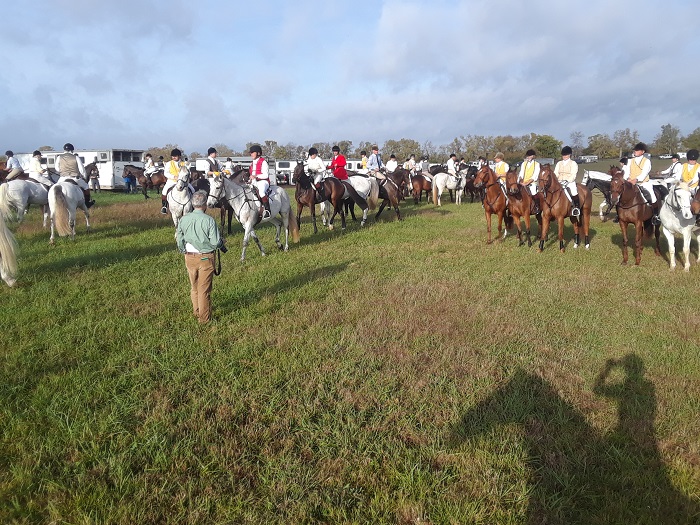 A portion of the hunting field of 100 riders / Rosie Campbell photo
Day 1
The pack moved off to the west promptly at 8:00 am, close to a cattle farm owned by the McClurklin brothers. There was an immediate strike on two coyotes, which went away to the west.
The site of the strike was about a quarter mile from the meet, after two coops. Midland huntsman Ken George reports the “hounds struck so quickly that some of the large field were still negotiating the first coop. I heard Ashley Hubbard whooping and hollering, saw him waving his cap, and away we went!”
An alert whipper-in out front stopped a possible incipient split of the pack, and settled hounds on one coyote. Screaming, the whole pack of championship hounds ran south, then hooked a hard left to the east and ran to Panther Creek, the field following and jumping coops at speed. Then right to Smith Road at the creek. Hounds began to suffer from the heat, and slowed down to take advantage of the cooling waters of Panther Creek. However, two hounds, numbers 72 and 40 (Midland Bliss and Hillsborough Dagwood) went on. Judges Frank Houghton Brown and Tim Easby viewed these two hounds on the quarry running hard to the west, but then circling back and gaining purchase on the coyote in the creek. Both hounds had a hold of the coyote. Then (still a matter of dispute between Midland and Hillsborough camps as to which hound let go first), the coyote slipped the grip of one hound, and also broke free from the remaining hound.
“I was close by the creek, watching, sitting on my horse,” said Mason Lampton. “The coyote ran straight at me, and swerved at the last moment. It was quite a view. I thought he was going to run into me.”
The chase continued, and the refreshed pack was harked on. The coyote cut back toward the side of the creek and was shortly lost in the tall grass.
At this check, English judge Tim Easby, amazed and impressed by this American sport of coyote chasing he’d observed, asked, “Why am I sitting behind a desk when I could do this?”
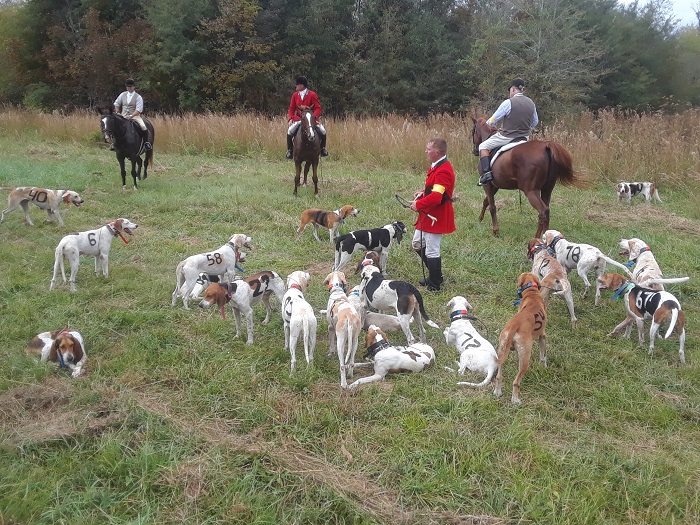 Pausing after a fast three miles in eight minutes / Rosie Campbell photo
Huntsman Hubbard then cast back to the west, found another coyote, and had a grand circular fast run toward the McGough and Brown farms. The first flight, led by Midland Master Mason Hardaway Lampton followed along, galloping and jumping, covering three miles in eight minutes. The quarry turned east and was lost, but not before Field Master Lampton led the first flight over a four-and-a-half-foot coop normally reserved for staff. Hounds checked shortly after this memorable obstacle, and the remaining members of the first flight enjoyed their flasks and congratulated each other on being there at the end. We headed in to enjoy a delicious buffet breakfast served al fresco at Rutlands. The field covered more than eleven miles with top speeds of over twenty mph on this first day.
Winning packs that day were Midland first, Hillsboro second, and Fox River Valley, third.
Looking back, probably the most decisive move of the day was that whipper-in out front who quickly stopped the split on the two coyotes at the initial strike. The pack, thus united, was able to make this a grand, exceptional day of sport.
Day 2
The second day’s hunting was even more exciting. The temperature was a little cooler, so we kept our coats on. We met on the grassy field at the giant tent barn erected for stabling. Set on the outskirts of the village of Fitzpatrick, this temporary barn had stalls for over sixty horses and was surrounded by a number of pump and hose stations convenient for watering and washing.
The huntsman hacked the pack away, through a large wooded creek and toward more open country to the west. Second days are usually memorable at a performance trial; by then, the individual hounds have melded into a pack. With one hunt under their belts, hounds have gained confidence in one another and their huntsmen. The pack was sent in at a creek bank, and Midland huntsman Ken George had a bird’s-eye view of how it all started.
“This was as good a race as you’ll ever get in any performance trial,” said George. “There were a few hounds who were just a little too busy. Ashley asked me was it right, and I said, ‘Yes, I think so,’ but this can drag out and go on and on.”
Then, Glen Westmoreland, professional whipper-in to the Fox River Valley, announced he was going ahead, turning toward the north. “There will be a coyote,” he predicted. Westmoreland, who formerly whipped-in to the Midland, knows where the honey holes are at Fitzpatrick.
Ken George and huntsman Ashley Hubbard turned their attention back to the pack. Number 6, Midland Caper, had had enough of the booing around, and spoke three times. Hubbard turned to George: “She’s drawing on, she’s getting it.” George responded, “Yes, but let’s hold her up.” Acting whipper-in Tony Leahy gently checked Caper, and right then, there was a “tallyho” on the radio and a large, loud holler from Glen Westmoreland. Ashley Hubbard laid the pack on the line, and as one, hounds moved forward with a swelling chorus.
This coyote ran a large loop, swinging to the south and west. The pack’s voice was tremendous, and there were repeated views of the hunted black coyote.
“At one point, I saw hound number 56 (Genesee Tempo) three feet behind him. The coyote literally dove underneath a coop to temporarily escape him. The rest of the pack was five to seven yards behind, spread out,” says George.
The coyote headed north to Smith Road with the pack still in full cry. Staff followed over Smith Road, then nothing. The whole pack had stopped in a low-lying swale in a large field bordering the road. In the sudden stillness, humans had overshot the pack.
“Go back, go back; the coyote never crossed!” shouted Boo Montgomery, road whipper-in.
Judges Cameron and Lincoln Saddler, who had been there at the beginning of the run, were there at the end to view the marking event.
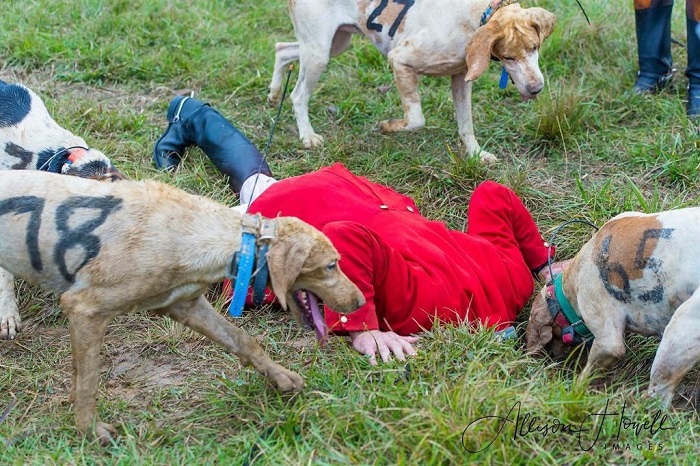 Fox River Valley Bracket (78), Aiken Euro (65), and Essex Oatlands (27) listen in as huntsman Ashley Hubbard negotiates with the coyote. / Allison Howell photo
The coyote had gone to ground in a large series of earthen dens. After a momentary silence, staff could hear underground sounds of hounds working, out of sight in the earth. Ken George recognized the voices of Midland Bliss and Shiloh. Also underground was Belle Meade Dahlia. Genesee Tempo was pulled out of the hole. There was then a huge roar from the pack, which seemed to last forever.
Trial president Cameron Sadler called it a day, given the spectacular chase. “The whole pack deserved this coyote; he ran with strength, speed, stamina and he had a strategy,” Ken George said.
Again, on the second day, it was the small but crucial checking of hound Number 6, Midland Caper, by whipper-in Leahy, which allowed the strike hound to stay with the whole pack and ignited that fantastic run. A huntsman’s work is truly a form of art.
Hubbard hacked the pack home six miles. All hounds were on at the end, and all came in together. “Everyone who had a hound there this day should be damn proud,” George observed. I swear, it looked like to me these dogs were swaggering!
“The English judges, as well as our home folk judges, did a superb job. The hounds both days looked very happy to be with their huntsman,” observed Mason Lampton.
Overall, Hillsboro Salty was the winning hound of the trial. Midland was the winning hunt with their Bliss and Caper placing second and third respectively. In the hunt scoring, Hillsboro and Shawnee placed second and third.
There were contacts between quarry and hounds on both days, scored as marking events, making this Performance Trial unique among all those ever held east of the Mississippi. But who cares who wins and who loses, in the end? The camaraderie at this event far exceeded any competitiveness. It was thrilling to see how some of the smaller hunts performed.
Dr. Mark Smith brought one good bitch named Zin to this event, and she did well enough over the two days to place Shawnee Hounds third in the pack rankings. He had tears in his eyes when he accepted his ribbon. Other smaller hunts such as Camden Hunt (SC) and Essex Fox Hounds from far away New Jersey did well with their entries. North Hills Hunt (NE), the hunt that traveled the furthest, placed fourth in the pack scoring after the first day, and, with their three entries, won the Trailing category at the end of the Trial. Click to view placings in all categories and overall.
Mason Hardaway Lampton, MFH looks at the big picture. “These Performance Trials showcase the evolution of foxhunting culture in America. At this trial we had proper foxhounds of four different types entered, American, English, Crossbred, and Penn-Marydel. All these hounds did their job. They gave us a great example of what foxhunting in America is becoming, evolving from our immature imitation of Elizabethan sport, and now developing its own tradition. We have radios, we have close landowner relationships, we have hounds bred for the territory, we certainly have different quarries, and we have hounds bred for these quarries, all of which differ from the English experience, and it’s all one big American amalgamation and adventure!”
Ken George was even more direct in his summary: “This pack did a truly great job of coming together. If foxhunters will do as well, the future looks bright.”
Posted November 23, 2018
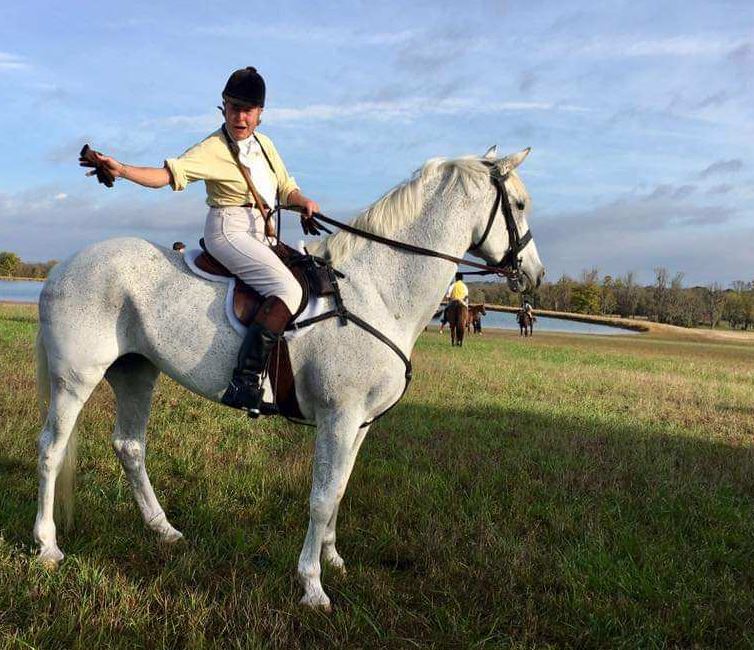 Author Jean Derrick, Fied Master at the Belle Meade, served as honorary performance trial secretary. / Allison Howell photo