In late February of 2024, the Foxfield Races Office in Charlottesville, Virginia held a seminar for the outriders of the local steeplechases and point-to-points.
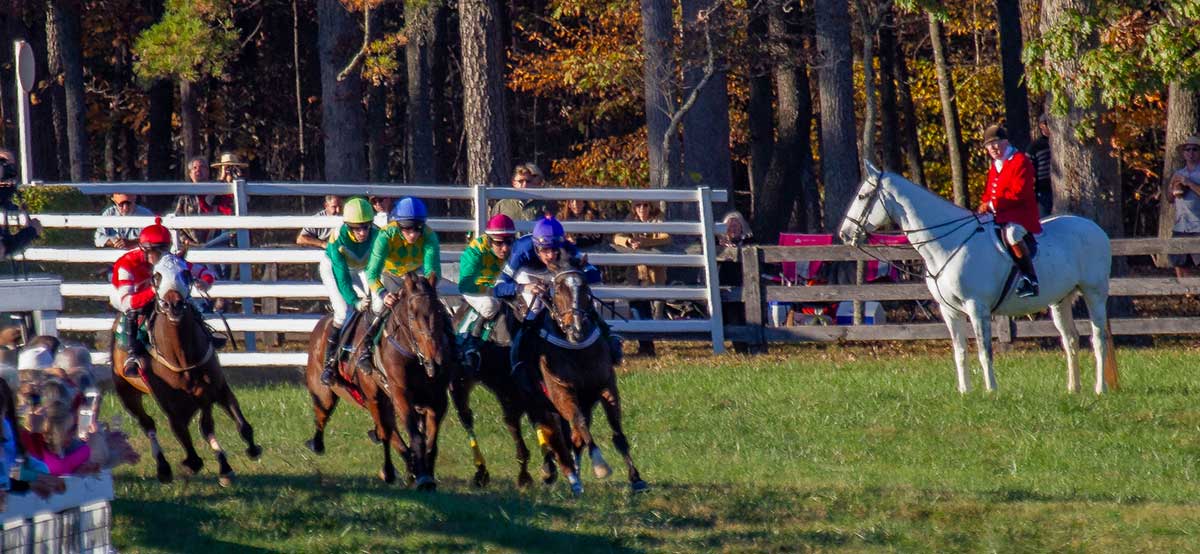
Don Yovanovich, former race director of the Virginia Gold Cup for 31 years and President of Virginia Point To Point Association, led a discussion last week for outriders for the Foxfield and Montpelier Races.
The seminar was held before hunt season ends to help recruit more outriders from the hunt field. The twenty-two participants were almost all foxhunters. Some were experienced outriders while others were about to help with their first racing meet.
Jack Sanford Jr., a current board member of the National Steeplechase Association (NSA), and Dr. Reynolds Cowles, the NSA’s Safety Committee Chairman and Equine Medical Director, organized the seminar and both emphasized that the outriders are an integral part of the race day. Don Yovanovich took over the talk and gave points on how to be an effective outrider.
Outrider’s Mounts:
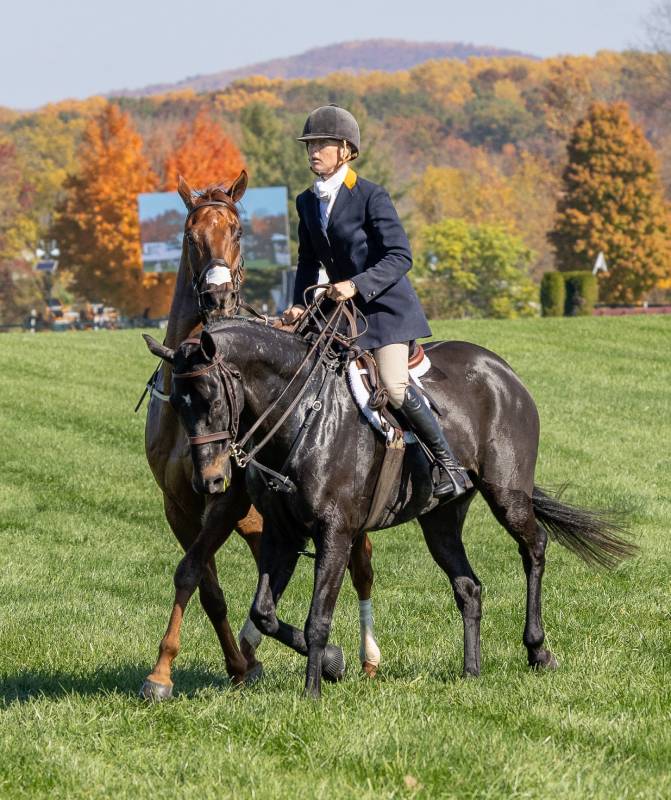
Outriders should mount themselves with quiet and calm horses that don’t react to hot horses. Their horses should be proven to not bite, jig, or kick other horses as these habits can make a hot racehorse go over the edge. The race meet is no place for a green horse or a green rider. Horses new to outriding should already be well-trained.
Consider the sights and sounds of a race meet. Can the horse handle hearing the announcer over the speakers? Stand quietly as other horses gallop past? Off-the-track Thoroughbreds have unique experiences with these stimuli and may not react well to the reminders of their old life.
Can the horse tolerate clapping or cheering crowds? If the horse new to outriding is balking at the crowds, then carrots can be offered to the horse from crowd members to encourage relaxation around all the noise and movement.
What about the ticking sound of the plastic filler inside the fences getting hit by jumping hooves? If an outrider’s horse is spooking at this unique sound, the horse should be faced towards the jump to allow them to associate the sound with racehorses jumping.
Outrider Kits:
Outriders are encouraged not to carry whips or crops so both hands can be as free as possible when handling potentially two horses. Shadbellys are also discouraged as the flapping tails may spook a racehorse. Radios should be clip-ons or carried in a pocket.
Radios:
Don advised to limit talking on the radio and to use hand signals when radios fail. If a fallen rider is injured then be calm and concise on the radio. Don’t add the panic of a fall.
Escorts to the Starting Box:
Outriders usually escort the field of racehorses to the starting box, with an outrider at the beginning and at the end of the group of starters. This helps the announcer, the scorer, and the starter know that the entire field of racehorses has arrived at the start.
When leaving the paddock, most jockeys just gallop off. But an observant outrider will keep an eye on the racehorses in case one of them is about to ditch their jockey. Signs that a racehorse is about to blow are jerking the reins, throwing their head, or balking to go forward. Outriders should ask the jockeys of these horses if they would like help. However, outriders should make sure they and their horse can deal with a jockey’s or horse’s problem before offering to help.
The starting box is no place for an outrider. Escorted racehorses should be let go by their outrider before the starting box is reached.
Crowd Control:
Races with larger crowds, like the Gold Cup and Montpelier Races, can have additional outriders to help with crowd control and traffic crossings. Crowd control is easier from the saddle as crowds usually don’t listen well to people on the ground. But crowds will listen to mounted riders. Having an elevated position can also be helpful to spot crowd situations that require police intervention.
Holding onto Racehorses:
Don advised that the best way to grab a racehorse is by the check piece if one doesn’t have a pony strap. Only the jockey should have control of the reins because it can confuse the racehorse if two sets of hands are on one pair of reins. Don advocated the use of pony straps when ponying the racehorse. Pony straps are long pieces of leather, without a snap, that are fed around a check piece. The outrider holds both ends of the leather strap looped around the check piece. This enables a quick release when necessary.
Never Chase a Loose Racehorse:
Don could not emphasize this enough: Rule Number One for every outrider is to never chase a loose racehorse. He said, “Even Secretariat cannot catch that loose horse. Let him run on with the field until he tires himself out.” Herd mentality will take over, and the loose racehorse will keep up with the field until the finish line. It’s easier to catch a loose racehorse when it’s tired and slowing down with the rest of the field after the finish line.
Don continued, “Too many outriders insist on chasing, and they get hurt. Horses and riders can get hurt in these situations. Don’t do it. The horse will be fine to run until it tires out.”
The danger of chasing a loose racehorse is that it encourages them to jump out of the racecourse to run too far and too fast. To risk injury to pedestrians and drivers as the racehorse runs loose through a town. This usually results in soft tissue injuries to both the racehorse and the outrider’s horse. Don said, “Best not to do anything until the horse slows down and gives a hint of what he’s going to do.”
Catching the Loose Racehorse At the Finish Line:
After the loose racehorse has slowed down, an outrider, staying calm while talking to them, should approach from behind on the near side. Racehorses are used to being ponied from the near side. Using a pony strap is preferable to grabbing a rein, and outriders should be ready for the racehorse to act up again after being caught. After the race is done, jockeys will usually try to help catch a loose racehorse.
Racehorses Who Leave The Course:
Outriders should try to minimize the chaos when a loose racehorse leaves the course. Usually, loose racehorses only jump out over a corner of the track fence if they are being chased. Most of the time loose racehorses will go back to the barn or paddock if they get separated from the field.
However, if the racehorse leaves the race area completely then reinforcements should be called in by racing officials. Four-wheelers and the vet trailer should be activated to follow the loose horse. Outriders who have studs on their horses’ shoes can track the loose racehorse at a distance to access areas that the vehicles cannot. Police can be advised to make a barricade to direct the loose racehorse into a convenient field.
Horse or Rider Injured:
When a fallen horse or rider appears injured, then the outrider should follow the patrol judge’s lead. Each fence has a patrol judge, and they will call the physician and veterinarian to the scene. The outrider should stand back and position their horse to give a visual barrier from unwanted cell phone videos from the crowd unless asked by the patrol judge to help.
The outrider may be asked to help wave around the oncoming field of racehorses to avoid the area. Knowing the beacon layout will help the outrider to know how far back down the course they will need to go to give the wave around to the race field. Usually, twenty-five yards up the track will be enough. Outriders should stand sideways, and the jockeys should notice in time to avoid the fence. Jockeys talk to each other during the race, so most likely they will know that a fall occurred there.
Strategic Positioning:
Outriders should be told the plan of where they need to be at the beginning of the race day. Normally outriders are posted to work alone, but newbies (rider and horse) should be paired up. An outrider may position themselves in the area after the finish line to prevent runouts into the crowd. This is a good place to catch a loose horse, as they are slowing down approaching the outrider that is already positioned after the finish line.
Don also mentioned that the outrider needs situational awareness. The ability to recognize once a loose racehorse has left the area, it’s the next person’s problem. It was another way for Don to discourage chasing the loose racehorse.
Most Common Mistakes An Outrider Can Make:
The biggest mistake an outrider can make is to chase a loose horse. The other common mistake is getting too close to the starting box, making it too congested. No snaps should be used when ponying racehorses. Good outriders should not be noticed during the races.
Other Tips:
Don had a few other tips for outrides. Outriders are there to do a job, not to enjoy the tailgate. The emergency protocols from race organizers are usually sent ahead of time to outriders so they can familiarize what they need to do if an injury occurs. This reduces any unnecessary chaos. Finally, Outriders can be ambassadors for all equine sports during the downtime between races by hanging out at the rail and letting the crowd pet their horses. Good PR should never be avoided.