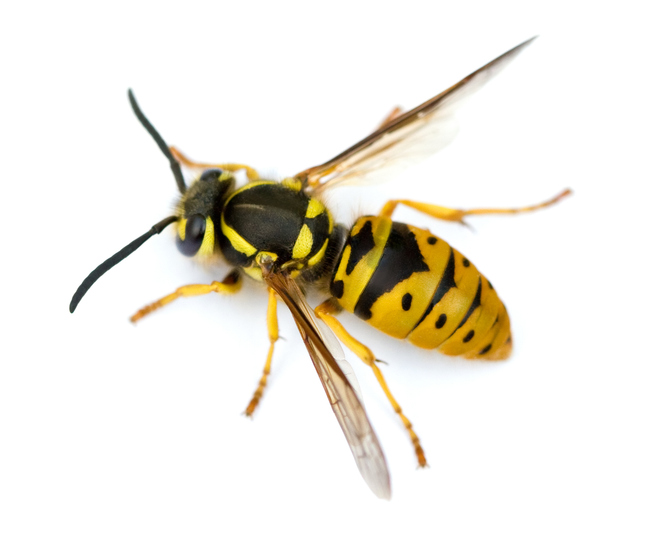
Nothing is more terrifying during early Autumn Hunting in the East than when a member of field yells “BEES!”. Yellow jackets are a dangerous surprise that can cause complete chaos in late summer (Yellow jackets are wasps, not bees, but when in the moment the fewer syllables required to scream a warning is best). There are some precautions everyone should take when riding out in the country in late summer to prevent injury from falling off a panicked horse, anaphylactic shock from a venom allergy (for both horse and rider), and permanently terrifying new riders to never ride out of the ring again. And please, don’t make the mistakes I did one trail ride.
I have a serious phobia of yellow jackets and other wasps. I used to work as a zoo keeper, so I can handle snakes, rodents, bats, etc. Nothing else gives me the willies, but a wasp buzzing my face? Oh hell no, I’m leaving the state. My phobia has been well established from childhood, ever since yellow jackets would routinely track and attack me around my grandparents’ barn yard down in Louisiana. Multiple stories abound in my family of my 5-year-old screaming being mistaken for my grandmother’s peacock sounding like it was being murdered.
Here is a story of how NOT to handle an attack of Satan’s Envoy. Several years ago, I was leading a trail ride in our hunt country with the purpose to school hunt coops. I had a junior out for her first trail ride with me and several hunt members with various levels of skill. There was one coop set on the edge of the woods, and as we all stood around on the wooded side to watch several people school the coop back and forth, all the horses started to stomp.
And anyone who knows, knows that multiple horses stomping for no reason in late summer means that evil has been released from the earth in the form of a tiny wasp with the determination of a Viking berserker. And your world is about to become complete chaos.
My horse at the time was new to me, and I found out that he was just as terrified of yellow jackets as I am. Unknown to us, we were standing on top of a rotten log where the ground nest was located, and the yellow jackets started to just boil out of the ground. Someone yelled the universal warning, “BEES!”
I panicked. My horse panicked. Then he started to spin franticly as he was stung over and over. And I just fell off. Not because I was thrown, oh no, I just simply bailed. What a terrible decision.
My horse bolted, taking most of the wasps with him. My horse is black, and yellow jackets will absolutely go after dark colors before other colors. Then all the other horses bolted around me. Including my brand-new junior. Oh vey.
As I sat up from the ground, I saw about twenty yellow jackets so close to me that I could see their little dangly legs. Then, all together, they turned toward me as they hovered and charged as one. I could see the facets of all their eyes getting closer and closer like a bad horror film. It was the stuff of nightmares. I’m not ashamed to say that I just screamed like a little girl and ran for my life.
I was wearing light colored clothing except for black half chaps and a black schooling helmet that had open vents. The wasps went for my head, attracted to the black color, so I flung my helmet, taking my glasses as well, to the side of the trail as I ran. Then I started to hop and run while I tried to rip off my half chaps. The chaps were covered in wasps with their stingers stuck in the leather.
All total, I was stung 18 times in my face and head around the helmet’s edge and through the open vents. But my poor horse, after he was caught over a mile down the trail, was literally covered in live wasps stuck in his tail and saddle pad with so many stings. I counted the welts all over his body to be 36, but several of the welts were obviously several stings swelled into one. So, I really have no idea how many times he was stung. Back at the trailer, he started to have labored breathing and was lethargic, so cue a trip to the vet on the way home. I had no Benadryl on hand to give him.
Also, one of the members was stung 12 times on her grey breeches (everything else she wore was light colored). As she stood at her trailer, I could watch the stings swell up under her pants. As many times as I was stung, none of mine swelled. So, this member was slightly allergic, which was a revelation to her, and no one had an epi pen for her. She ended up being fine, but it was scary to think about the possibility.
My Junior was on a fantastic horse who ran off with the others and fortunately didn’t dump her. She was completely unhurt but scared to death. Noone else fell off or was hurt.
We made so many mistakes that trip with not being prepared for an attack of the evil bee, even though we knew that late summer is yellow jacket season.
Here are some suggested tactics for surviving yellow jackets:
*Once everyone is mounted, review the plan that if anyone yells “BEES!” everyone should be ready to gallop off together. Don’t hang around in confusion.
*Anyone not familiar with the territory should be paired with someone who does, and have those riders stick together so no one gets lost after a mad bolt.
*Try to stack your group with strategically placed competent rides who can control the gallop off, so it won’t be a “mad bolt”.
*Eastern Yellow Jackets build nests in the ground along banks, under logs, and other protected places where rainwater won’t run straight down into their nest. Be very careful in late summer when riding around areas that hold this potential for ground nests. Riding on wide roads may be a safe option.
*Yellow Jackets can sting multiple times, unlike the honeybee. Yeah.
*Each spring the nest is built from scratch, so by the time the weather turns hot in late summer the nest has reached capacity with a high population. Eastern Yellow Jackets are very aggressive when protecting their nest, and any ground disturbance from horses’ hooves will set them off to wage a world war on anything moving.
*Since it takes the wasps a bit of time to boil out of the ground, it won’t be the first few horses that will get attacked, it will be the third or fourth horse (and those following) that will get the brunt of the stings.
*Yellow Jackets are very attracted to dark colors, so advise everyone to wear light colored clothing where possible. Maybe put the dark colored horses up front and at the rear.
*Even if you don’t see the wasps, if a horse is stomping, rubbing their face, switching their tails, or smelling the ground, don’t wait to confirm. Yell the universal warning, “BEES!” and have the entire field start running off. The only way to get away from the wasps is to outrun them.
*Yellow Jackets will mark who they sting with a pheromone that will attract any yellow jacket within reach to track you down, chase, and then sting you as well. Even if that yellow jacket is from another nest, they will be relentless in their pursuit.
*Some horses are fine with being stung and just stomp. Others will bolt, buck, and simply go hysterical since they can’t see where the pain is coming from. I knew one trail horse who, after hitting a nest, dumped her rider while on the Appalachian Trail. Then the mare simply turned perpendicular on the mountain trail and jumped OFF THE MOUNTAIN to land over a hundred feet down. She was eventually recovered safely, but it was an epic miss-calculation.
*Carry Benadryl on your person and not on the saddle in case you get separated from your mount. You can tape a packet of pills to the inside of your helmet.
*If you have been stung and are not allergic, then take a shower as soon as possible to remove any venom from your skin. Use a hydrocortisone cream on the stings, and Tylenol will help with the throbbing.
*Allison Grogan Crews with Chula Homa Hunt in Mississippi has this strategy to control the field with young or green juniors for late summer rides:
- White or light-colored clothes for juniors.
- Put in charge adults or super competent teens at the front, center, and rear of the group.
- Place the juniors in between the riders in charge.
- Place the weakest riders in front.
- At any sign of yellow jackets, the front kicks on forward, the rear reverses, and the center rider in charge will decide whichever end to follow.
- If there is a horse in the group that overreacts to the stings, get control of that horse for the kid if needed, and then get them away from the nest.
*The Eastern Yellow Jacket (Vespula maculifrons) is very different from the Western Yellow Jacket (Vespula pensylvanica). The wild west version of the wasp is bigger but slower. The western kind also do not seem to be as aggressive either. They are the overweight cousin who happens to be a pacifist. Those lucky riders out west.
Originally published on September 5, 2024.