
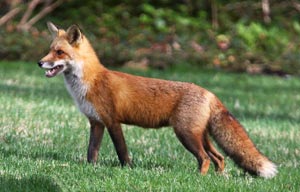
 The first time I saw Redmond was on a snowy afternoon in February, 2005. It was the closest thing to love at first sight that I’ve ever experienced.
Redmond, a stunning red fox, strolled up to my patio with great aplomb, glanced around a bit and then sat himself down as speckles of snow flakes fell from his spectacular coat.
I had lived in Ruxton, Maryland all my life and had never before seen a fox anywhere close to this Baltimore suburb. I had always heard that the appearance of such creatures in broad daylight was a red flag signaling the animal was rabid. As I stared at this magnificent fox sitting on my patio and acting for all the world like he owned the place, I concluded that the story I had been told had to be a myth.
Redmond looked healthy enough to me and by no means emaciated. I remembered reading somewhere that, despite their often robust appearances, adult foxes rarely weigh more than ten pounds. I decided to offer him a plate of food, but I had no idea what his preferences were. I knew that foxes were in the canine family so I put together a combination of canned dog food, dog biscuits, and threw in some cooked hot dogs leftover from lunch just for good measure.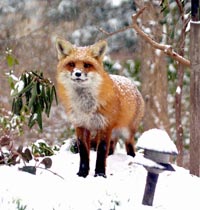
As I opened the sliding glass patio door he retreated quickly to the edge of the property and watched as I placed the aluminum foil container on the bricks and went back inside. I sat down and waited for him to return, which he did as soon as I had closed the door behind me. He consumed everything on the plate in short order so I refilled it, this time adding a few morsels of a cooked chicken I had on hand. Once again he retreated briefly and then returned for second helpings.
That event took place over four years ago, and I have been feeding Redmond, his children, and possibly his grandchildren ever since. Over that span of time I have incurred the wrath of neighbors who refuse to believe that these gentle creatures will not eat house pets, ravish the rabbit population, or kill squirrels merely for sport. When I inform them that foxes hunt and kill simply for survival and that the primary staple of their diet in the wild is mice, they refuse to believe me. They are stunned when I tell them that my nine-year-old Basset hound, Gibson, plays a game of “cat-and-mouse” with one of them in the yard. They stare at me in horror. One neighbor recently stopped by unexpectedly and saw this phenomenon first-hand for herself.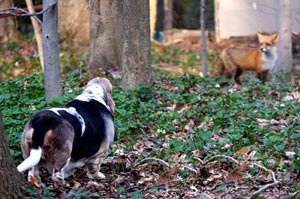
Last January I noticed that Redmond didn’t seem like his old self. He was listless, his coat looked scruffy, and he had a general unkempt appearance about him that wasn’t in keeping with his usual fastidious nature. Upon closer inspection I saw the reason for his discontent. He had mange, the dreaded skin plague that left untreated will destroy the fox’s vital organs resulting in death.
The lesions appeared on the left side of his face running from above the eye to the base of the ear. The area was raw and bloody, and I couldn’t just sit by and watch him suffer and wither away. I called my Basset hound’s vet and told him that I knew that fox mange could be treated by an injection of medicine and, while that might work for a domesticated fox, it obviously wouldn’t work for one living in the wild. However, I also recalled reading somewhere that the same medicine, a drug called Ivermectin, could be placed on a fox’s food and in the proper small dosage could effect a cure. I asked him to fix me up a “cocktail” that I could administer to Redmond’s chicken and hot dog dinner.
At first he was skeptical and lectured me on the various reasons I shouldn’t be feeding wild animals in the first place. I assured him, respectfully, that while I understood all of the reasons for not feeding them, I had been doing it for many years and had no plans to discontinue the practice. I told the vet that since I already had access to the fox on a regular basis, I was in a position to save him from suffering a long and agonizing death and that treating him was the only humane thing to do. I was practically in tears on the phone. He agreed to provide me with the drug and instructed me on the proper dosage.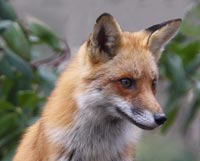
Over the next six weeks I watched as Redmond showed rapid and dramatic improvement. His coat quickly regained its previous luster, and I no longer observed him lolling around in the yard or sleeping under trees. His energy level seemed to pick up dramatically, and before long he was dashing through the yard with the rest of his family. I was further rewarded for my efforts not long ago when Redmond showed up looking proud and happy as he stood behind two of his new kits, Ben and Jerry.
The presence of the foxes in my neighborhood has afforded me many opportunities to observe how wild animals behave and adapt when ecological boundaries are altered. Nature forced these creatures into our world and, in my opinion, they have not only adapted beautifully to their new environment but have presented us with a unique visual opportunity to learn by observing how they make this transition.