Lonesome Palm Hounds Dissolved
The Lonesome Palm Hounds (FL) has dissolved as of May 1, 2013. Established by the Kerry Kornacki Family in 1991, the hunt was Registered with the MFHA in 1994 and Recognized in 1996. The mixed pack of Crossbred, English, and Penn-Marydel hounds hunted red fox, gray fox, coyote, bobcat, and the drag in northeastern Florida […]
Patrick Smithwick Wins the 2013 Dr. Tony Ryan Book Award
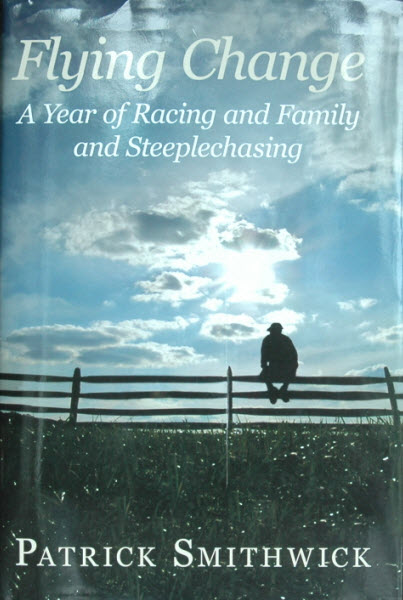
Flying Change: A Year of Racing and Family and Steeplechasing by Patrick Smithwick, Chesapeake Book Company, 2012, 360 pages, $30.00Writer/horseman Patrick Smithwick has been awarded the seventh annual Dr. Tony Ryan Book Award, for his 2012 autobiographical work Flying Change: A Year of Racing and Family and Steeplechasing. The work which was reviewed enthusiastically by […]
Radnor Hunts the Big Bend

Radnor huntsman Joe Cassidy and hounds at Big Bend / Diana Rowland photoThe gray uncertain sky and falling barometer suggested that winter was not yet finished with us. Nevertheless, I had rearranged my previously planned trip to Aiken after Joe Cassidy called. Joe hunted Mr. Stewart’s Cheshire Foxhounds (PA) for eighteen years and is currently huntsman for the Radnor Hunt (PA). This was an opportunity for me to hunt in his back pocket.
Joe had taught me to hunt hounds while I was MFH at Loudoun Hunt (VA), and he hunted with me when I carried the horn for a couple of years, making the drive with his wife Leslie and their very large dog Luca each weekend.
The meet was at Big Bend, the long-time residence of Frolic Weymouth, well-known for his immense contributions to open space conservancy. It was a Saturday meet, March 16, 2013, and as we sat waiting for the last of the field to mount and the clock to strike 11:00, Joe turned in his saddle, handed me his horn, and quietly told me that I was hunting the pack that day. I confess to a moment of stage fright, made some knuckle-head comment about strike hounds to which he replied, “Really,” and then we headed off to the first covert—a thick patch of brambles, ground cover, and trees about the size of a football field.
Morris/Roberts Team Dominates Loudoun Races
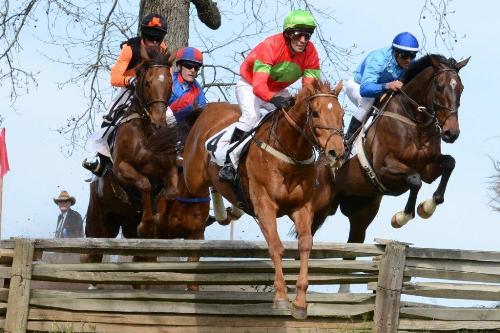
Magalen Bryant’s Triplekin (Jacob Roberts up) wins the second division of the Novice Timber for trainer Neil Morris. The Bryant/Roberts/Morris team won the first division Novice Timber as well with Classic Bridges ./ Liz Callar photo
Trainer Neil Morris and jockey Jacob Roberts teamed up at the Loudoun Hunt Point-to-Point to win four of their five races over fences at Oatlands in Leesburg, Virginia, Sunday, April 14, 2013.
After a fifth place showing in the first division of the first race (Maiden Hurdle)—won by Silverado Beach, rider Jeff Murphy, trainer Doug Fout—Morris-trained horses with Roberts in the irons swept the four remaining brush and timber races on the card.
Big Crossbred Turnout at Southern Hound Show
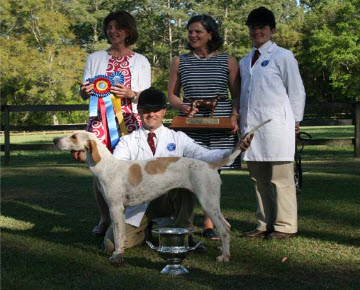
Mooreland Wary ’12, Grand Champion, Southern Hound Show / Wendy Butler photoThe seventh annual Southern Hound Show, held on April 6, 2013 at Live Oak Plantation Monticello, Florida, produced a perfect day for showing hounds—chilly in the morning and low seventies in the afternoon.
This year’s judges were Mr. Richard Tyacke, MFH and huntsman of Sir Watkin Williams-Wynn’s Wynnstay Hounds (UK), and Mrs. Tyacke who substituted for Dr. John W. D. McDonald, MFH, London Hunt (ON), who took ill the night before the show. Dr. Charlotte McDonald, MFH, London Hunt, was the apprentice judge.
Mr. Tyacke said that he was thrilled by the amount of quality he saw in every class. He was very impressed with the levelness shown, particularly in the Two Couple Classes where some hunts produced more than one entry.
As is the custom at the show, all hound types are judged together in one ring, as also happens at the Canadian Hound Show. Eight packs showed, which is one more than showed in the 35-couple-or-more in the Crossbred ring at Virginia in 2012.
Martyn Blackmore Is New Huntsman at Loudoun Hunt
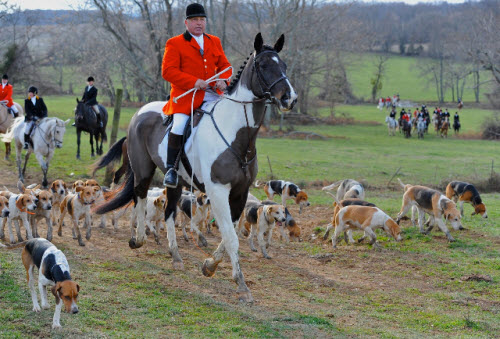
Completing the recent round-robin of “Huntsmen on the Move,” Martyn Blackmore will be the new huntsman at the Loudoun Hunt (VA) come the month of May, the traditional month for hunt staff to move to their new posts. Blackmore is the departing huntsman at the Loudoun West Hunt, just across town. With this announcement, a […]
Foxhounds With a Difference
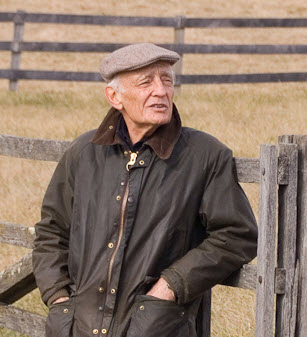
Mr. Stewart’s Cheshire Foxhounds (PA) boasts a sporting field of superb horsemen and women that love to gallop and take their own lines over the post-and-rail line fences in their country. Seven years ago, the Cheshire Masters and staff embarked on a bold experiment to breed a new foxhound for that country. Our feature article below tells of their decision to cross the The Old English (also called the Traditionally-Bred English) foxhound and the Penn-Marydel foxhound.
Their plan was a gamble because the two breeds are about as dissimilar in type as foxhounds get, and the crossing of the two types would produce litters that varied greatly from pup to pup. However, the Cheshire Masters and huntsman believed that the strong points of each type would tend to compensate for the perceived weaknesses in the other and result in a foxhound superior to either type.
Here are some examples of the perceived differences between the types. Just remember that generalizations are only generally valid!
The Cheshire Crossbred: A Bold Gamble
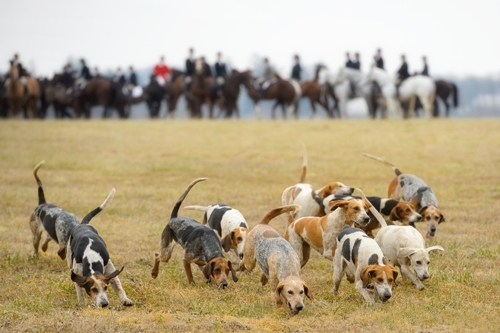
The new Cheshire Crossbreds combine the best traits of two disparate foxhound types / Jim Graham photo
When an established hunt with a reputation for showing the best of sport to the best of horsemen in the best of countries comes up with a novel idea for breeding a better foxhound, and sees it through to fruition and success, one has to pay attention.
The venerable—one hundred years this season—Mr. Stewart’s Cheshire Foxhounds in Unionville, Pennsylvania traditionally hunted the Old English foxhound under the hunt’s founder W. Plunket Stewart and the active Mastership of his step-daughter, the late Mrs. John (Nancy Penn Smith) Hannum. Masters and members know the breed very well.
Ireland’s County Galway Foxhounds (The Blazers), another venerable hunt renowned for showing world-class sport, also hunts the Old English foxhound. Cheshire huntsman Ivan Dowling grew up following the Blazers, and he too knows the Old English foxhound very well.
History and familiarity notwithstanding, seven years ago the Cheshire Masters and their Galway-born huntsman Dowling decided to continue a breeding experiment begun two years earlier by former huntsman John Tullock. They committed to the notion of crossing the English foxhound with the Penn-Marydel foxhound—two disparate types—in the hope of making a better foxhound for their country. This was a chancy endeavor, understandably fraught with controversy within the hunt.
Peer Pressure
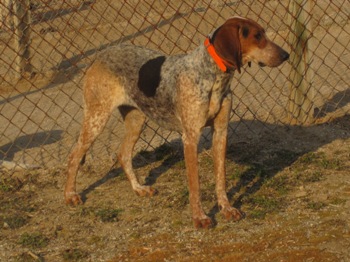
Emmy LouHounds are fascinating to watch, even after so many years at this game. Consider a recent Carrollton (MD) hound exercise, for example.
We were exercising the pack around the kennels and introduced our new entry, Emmy Lou, a blue tick Penn-Marydel that was recently drafted from a hunt in the Carolinas. I picked her up last week from Doc Addis who transported her for us from the Huntsman’s Weekend down in Emporia, Virginia. She is a pretty, petite thing—timid—but seems to have loads of personality. We have all fallen in love with her, and she is getting used to her new home.
As we walked out, she ran about sniffing and exploring with the pack. Occasionally we had to tell her to “pack in,” which she readily responded to. At one point as we were going up a rise, deer bounded out of the woods to our right. I turned to face our pack, and huntsman Dulany Noble told them to “steady up.” She counted the deer: one, two, three, and up to eight, not more than fifty yards or less above us. Our pack watched intently but did not break. Suddenly Emmy Lou broke and went after them. My heart sank. Huntsman Dulany told everyone—canine and human alike—to steady up and she raised her new horn to her lips and blew a lovely melodic note. Emmy Lou stopped, turned, and came running back. We were so pleased, but here’s the cool thing.
Peer Pressure
Emmy LouHounds are fascinating to watch, even after so many years at this game. Consider a recent Carrollton (MD) hound exercise, for example.
We were exercising the pack around the kennels and introduced our new entry, Emmy Lou, a blue tick Penn-Marydel that was recently drafted from a hunt in the Carolinas. I picked her up last week from Doc Addis who transported her for us from the Huntsman’s Weekend down in Emporia, Virginia. She is a pretty, petite thing—timid—but seems to have loads of personality. We have all fallen in love with her, and she is getting used to her new home.
As we walked out, she ran about sniffing and exploring with the pack. Occasionally we had to tell her to “pack in,” which she readily responded to. At one point as we were going up a rise, deer bounded out of the woods to our right. I turned to face our pack, and huntsman Dulany Noble told them to “steady up.” She counted the deer: one, two, three, and up to eight, not more than fifty yards or less above us. Our pack watched intently but did not break. Suddenly Emmy Lou broke and went after them. My heart sank. Huntsman Dulany told everyone—canine and human alike—to steady up and she raised her new horn to her lips and blew a lovely melodic note. Emmy Lou stopped, turned, and came running back. We were so pleased, but here’s the cool thing.