
Carol Easter Tribute Draws Hundreds to Farmington

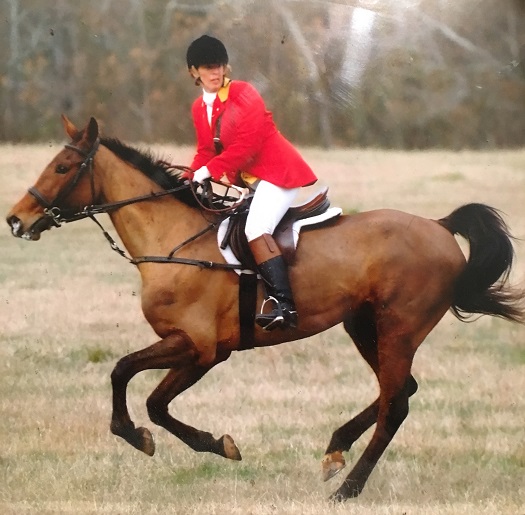
Honorary whipper-in Tom Bishop, huntsman Matthew Cook, and honorary whipper-in Kimberlee Morton move off from Springhaven Farm for a memorial meet in honor of the late Carol Easter, MFH. / Cathy Summers photo
On a clear, sunny Saturday morning, December 19, 2015, two days after what would have been Master Carol O. Easter’s seventy-seventh birthday, the Farmington Hunt gathered on a grassy knoll at her beloved Springhaven Farm in Charlottesville, Virginia to celebrate her life and legacy.
MFH W. Patrick “Pat” Butterfield addressed a large gathering of fifty-five riders, family members, and guests as a chilly breeze prompted me to adjust the buttons on my coat. Blue Ridge mountains in the distance framed the classic scene of hounds rolling in the grass, horses milling about, and riders exchanging greetings in anticipation of moving off for the morning’s sport.
Multiple generations of friends and family, young and old, were there to be part of this special day. The entire Easter family was on hand to welcome a steady stream of visitors–a serious yet jovial field of riders and onlookers that included life-long close friends Carter McNeely and veteran octogenarian foxhunter and neighbor Bobbie Wells; on foot, Phyllis Jones and daughter Robin Mellen, and Ellie Wood Baxter. Bobbie shrugged against the chilly wind and quipped, “I might have not picked this day to come out, except for the day it is.”
Eat First; Worry Later
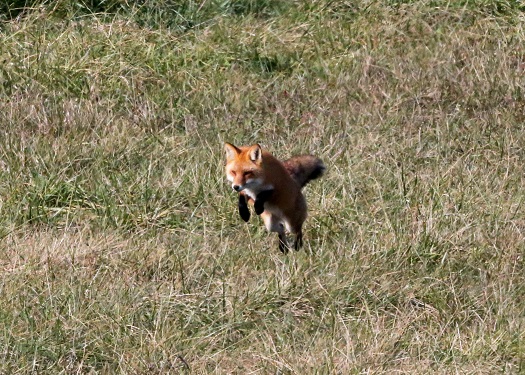
Mark Houliston’s fine photo of a fox pouncing on a mouse becomes all the more interesting when the context is revealed. For a good half hour, this red fellow hunted confidently and unconcerned, all the while trucks and trailers carrying Blue Ridge Hunt members, horses, staff, and hounds were arriving and unloading at a popular […]
Billy Vance at Eighty, and The Fermanagh Harriers
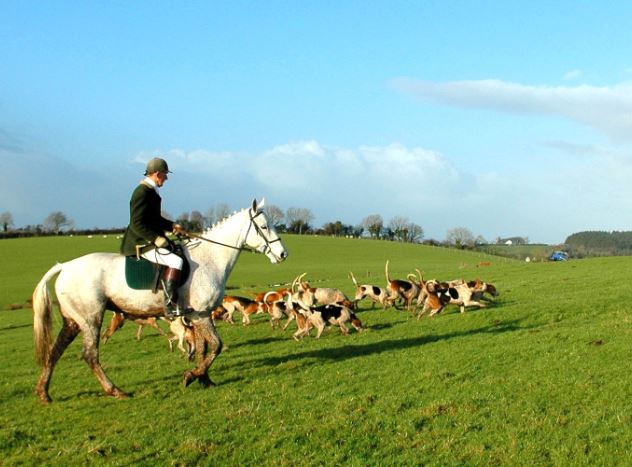
Master and Huntsman Billy Vance (80) watches his Fermanagh Harriers at work. / Noel Mullins photo
How many huntsmen are hunting hounds at eighty years of age? Or to add a twist to that question, how many huntsmen having achieved that age have already hunted hounds for the previous fifty seasons?
Billy Vance, Master and huntsman of the Fermanagh Harriers, has achieved this remarkable milestone. To see him hunting hounds is inspiring, humbling, and brings home just how lucky we all are to be able to follow great horsemen like him across the countryside.
Vance is special—a consummate and stylish horseman across what can only be termed as challenging hunting country with drains, banks, walls, and wire to contend with. And he is usually riding horses he bred himself. He is a genius with a pack of hounds, but don’t get in his way when they are running! If Ireland is in need of role models in these difficult economic circumstances, then Billy Vance fits the bill. He never seeks attention, yet is respected not just in his own hunt but by the hunting fraternity at large. And it is sometimes difficult to get a photograph of him.
“I am not into photos!” he says.
Three Generations of Foxhunters at Tennessee Valley
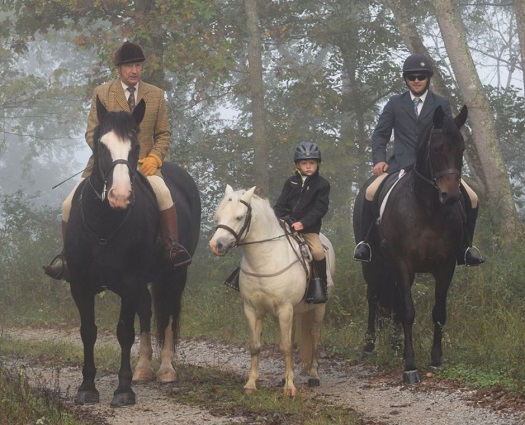
 Click photos for full size. / Cristy Grimsley/Hernandez photo
Seven-year-old Skyler Beauchene was the youngest member of the field out with the Tennessee Valley Hunt when hounds met at Riverplains, the family farm, in Strawberry Plains, Tennessee. The more senior generations of Skyler’s family in the photo are State Senator, Grandfather Frank Nicely (left) and international trainer and rider, Uncle Jose Hernandez (right).
Riverplains is one of the founding farms for the Tennessee Valley Hunt. They do organic growing, carriage driving, dressage, three-day eventing, and so much more. I also live there. Could not be anywhere else!
Skyler is mounted on his pony Cruisy; Riverplains owner Senator Frank is mounted on Farrah; and Jose is riding Roma, a carriage horse for his four-in-hand. All the horses are owned by Skyler’s mother Rachel Nicely, Frank’s daughter. Rachel also trains and has hunted since she was very little.
A Fast Day and Foxes Aplenty at Blue Ridge
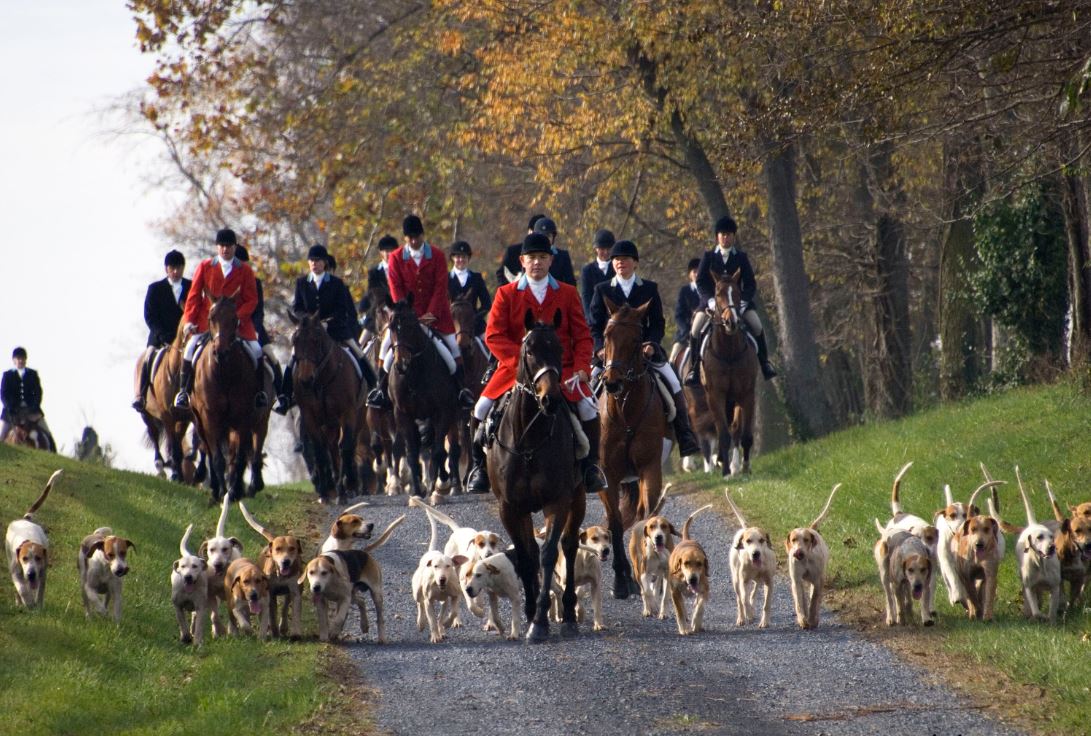
Huntsman Graham Buston, hounds, staff, and field of the Blue Ridge Hunt / Joanne Maisano photo
The November morning was unseasonably warm as I tacked up my beautiful Cleveland Bay/TB cross, Fearnought. It was a surprise that I had come home from school, but with my mother keeping him fit for me, I knew that he would be all ready for a day’s hunting. Conveniently, the Blue Ridge Hunt (VA) meet was only a fifteen-minute hack from my grandmother’s stable where I keep my horse. By the time we arrived I was already very warm in my formal coat and wondering, ‘Did I drive all the way home for nothing?’
Boot Camp at Belle Meade
Belle Meade First whipper-in Barbara Lee organizes the hunt’s annual Foxhunting Seminar for all new members. / Bella Vita Fotographie photo
Individuals interested in joining the Belle Meade Hunt (GA) quickly learn what they need to know in the hunting field, and they also learn what is expected of them as members. The hunt holds an annual Foxhunting Seminar that all new members are required to attend, whether or not they have hunted elsewhere.
New members learn that they are expected to have fun and to be contributors. “Mandatory Volunteerism” is the principle, and every member must subscribe to it. From that institutional expectation, the unique Belle Meade culture has developed.
It all began with the hunt’s founder, the late Master James Wilson, an inspirational leader who believed in teamwork. According to the seminar handout explaining the principle of mandatory volunteerism, “Master James knew that it took every member chipping in to make Belle Meade the place we have all come to love. As a member you were expected to respond with a willing, ‘Yes, sir,’ to anything you were asked to do. Most of us would have jumped through hoops of fire if the man asked us to! One of the unique things about our hunt that drew all of you here was the tradition of working as a family for the good of the hunt.”
Opening Meet at Woodbrook Is a Weekend Affair
by Tami Masters
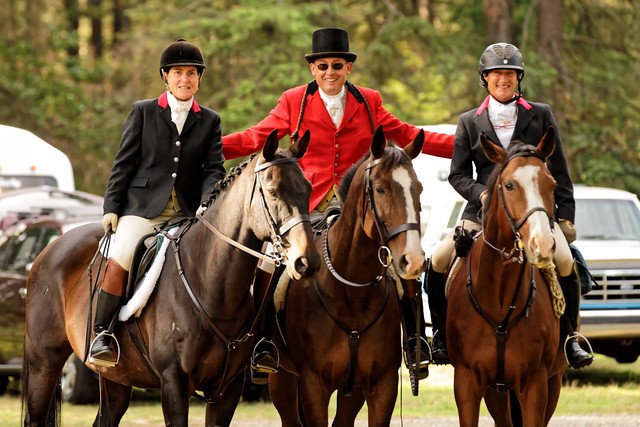
(l-r) Field Master Patty Steimert, Eric Stiemert, and author Tami Masters / Andrew Towell photo
The Woodbrook Hunt Club in Washington State was established in 1925 and is the oldest hunt west of the Mississipi. The drag hunt was recognized by the MFHA in 1962 and has recently undergone a changing of the guard. Huntsman Jennifer Hansen has brought about much newfound energy and enthusiasm to the clubhouse and to the hunting field. We have a rather diverse pack of hounds that Andrew Barclay helped us to acquire from all around the country.
Opening Weekend was a spectacular affair, starting with our annual Hunter Trials and Hunter Pace on Saturday and ending on Sunday with a lively eight-mile drag hunt through the beautiful woods and prairie on military land just southeast of the kennels.
Bizarro Politics
Awash in the political tsunami of hopeful presidential nominees swarming over us on TV, Bena Mae Seivers, writing for the Corbin News Journal in Kentucky, is reminded of something she read a few years ago. At the time she just thought it was just a funny story. Now, she says, it begins to make some sense.
by Bena Mae Seivers
The story goes that one fine evening a Mrs. George Wood called a Dr. Martin Satterfield, a veterinarian, from her home. It was about her mule, Horace. After asking a few questions and hearing the answers, Dr. Satterfield said, “Give him a dose of mineral oil, and if he ain’t alright in the morning, call me, and I’ll come out and take a look at your mule.”
She wanted to know how to give the mule the mineral oil and the Doctor said “Give it through a funnel.”
She protested that the mule might bite her, and the Doctor, becoming exasperated, said, “You’re a farm woman, and you know about those things. Give it to him in the other end.”
Bizarro Politics
Awash in the political tsunami of hopeful presidential nominees swarming over us on TV, the author, writing for the “Corbin News Journal” in Kentucky, is reminded of something she read a few years ago. At the time she just thought it was just a funny story. Now, she says, it begins to make some sense.
The story goes that one fine evening a Mrs. George Wood called a Dr. Martin Satterfield, a veterinarian, from her home. It was about her mule, Horace. After asking a few questions and hearing the answers, Dr. Satterfield said, “Give him a dose of mineral oil, and if he ain’t alright in the morning, call me, and I’ll come out and take a look at your mule.”
She wanted to know how to give the mule the mineral oil and the Doctor said “Give it through a funnel.”
She protested that the mule might bite her, and the Doctor, becoming exasperated, said, “You’re a farm woman, and you know about those things. Give it to him in the other end.”
The Eastern Coyote
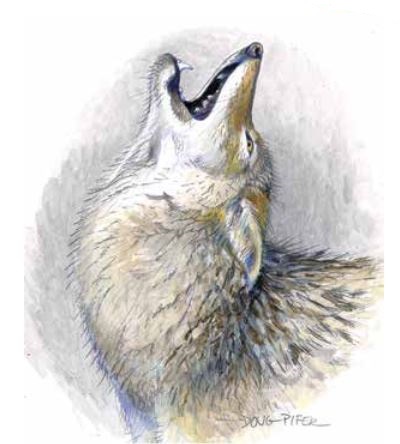
Illustration by Doug Pifer
Early in the twentieth century, at the behest of western ranching and agricultural interests that were losing stock to predators, the U.S. Government instituted program after program designed to erase the wolf, grizzly bear, mountain lion, and coyote from the landscape. The programs were mostly successful in their purpose: the wolf, grizzly, and mountain lion were driven nearly to extinction. The coyote, however, was the one predator that not only survived the pressure, but increased its population and its range. How it did that is one of the mysteries of the animal world.
The Pennsylvania Game Commission has published an excellent study of the eastern coyote (Wildlife Note 39), which we believe readers—even those familiar with the species—will find substantive and revealing. We republish it here with the kind permission of the Pennsylvania Game Commission.
The eastern coyote has stirred as much interest and emotion as any other animal in Pennsylvania. Seeing a coyote or hearing the howl of this wild, wily animal is a great reward of nature to many people. Others fear this animal just knowing it is in the wild. Some sportsmen dislike coyotes because they think the predators kill too many game animals. Trappers and hunters find coyotes to be especially challenging. Some farmers lose livestock due to coyote predation. The coyote has been referred to as the brush wolf, prairie wolf, coy-dog (misnomer) and eastern coyote.
The eastern coyote, Canis latrans, is found throughout the northeastern United States and southeastern Canada. Recent research shows the eastern coyote is an immigrant, the origin of which likely involved interbreeding between coyotes and gray wolves. Analysis of DNA suggests coyote-wolf hybridization has occurred. Other studies indicate that the eastern coyote is intermediate in size and shape between gray wolves and western coyotes. As a result, the eastern coyote exhibits different behavior, habitat use, pelt coloration, prey preferences and home-range sizes from its western cousin. The eastern coyote is the largest canine found in Pennsylvania. The following information pertains to the coyote in Pennsylvania and throughout northeastern United States.