
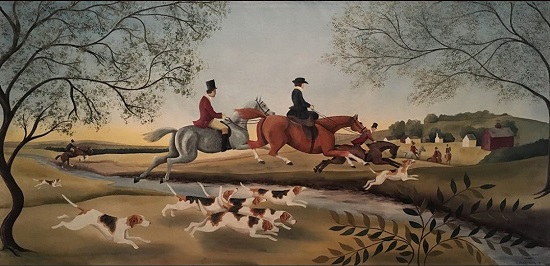
 Original painted canvas wall hanging by Lisa Curry Mair (3 feet x 6 feet)
Artist Lisa Curry Mair works in a unique genre from her studio in an eighteenth-century farm at the base of Mount Ascutney in Perkinsville, Vermont. She creates paintings, custom murals, and floorcloths on canvas in a folk-art style. Much of her work includes foxhunting scenes.
Mair’s commissions have come from Boston’s Museum of Fine Arts, several National Historic Sites, and hundreds of homeowners with specific ideas of what they wanted painted for their homes. Over the last twenty-five years of research, study, and “lots of mistakes,” she has developed the tools and knowhow to bring the client’s vision to light. Mair has attended classes and workshops since minoring in Art at Acadia University in Nova Scotia (while majoring in Mathematics and focusing on a career in riding).
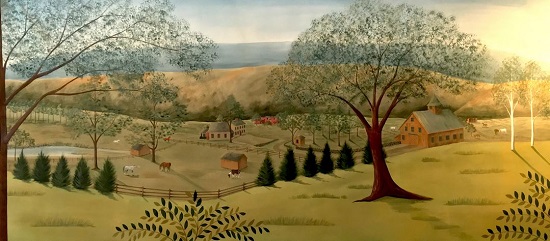 Original painted wall mural in Hartland, Vermont by Lisa Curry Mair
“Having spent my life caring for, training, and competing horses, I am always intrigued by the unspoken communication and relationship between the rider and the horse,” Mair told Foxhunting Life. When my work shows trust, cooperation, and unity between rider and horse (and maybe a foxhound or two!), then I am happy with it.”
Folk Realism is how Mair describes her art. “Because I am primarily self taught, it definitely has a naive quality to it” says Mair. “Rufus Porter’s mural work influences me a lot. I love the simplicity and the quiet, soothing colors. There’s also a sense of whimsy. I like people to smile when they look at one of my pieces. I want them to wonder what’s going on, to travel back in time for a moment, and imagine being there. Decorative Art? Fine Art? Folk Art? Maybe a bit of all of the above. What it’s called matters less to me than the feelings it evokes.”
“I have always admired the paintings of the eighteenth and nineteenth centuries, particularly of horses and farm life,” Mair said. “The work of Stubbs, Seymour, Herring and, a little later, Munnings, all inspire me.
“The traveling back in time part is most important to me. Maybe that’s what foxhunting is all about. Foxhunters adhere to the traditions, etiquette, and formality of a centuries-old sport. They join a community of like-minded, horse, hound, and nature-loving folks who think nothing of galloping through mud and brush to follow the sound of hounds and the horn. There really is nothing quite like it, and it’s something that I hope is protected and enjoyed for centuries to come. For now I will celebrate it in my drawings and paintings and hope that I can do my part in enabling a bit of historical preservation!”
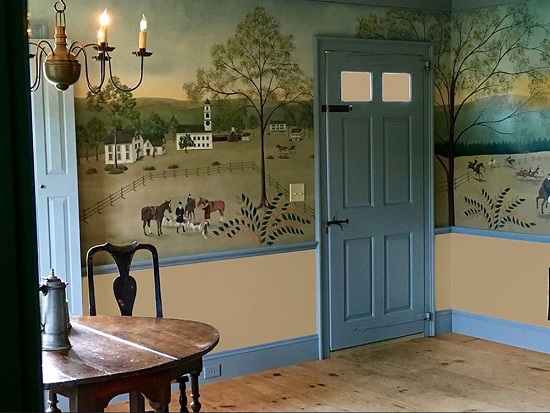 North Country Hounds wall mural by Lisa Curry Mair, installed in Lyme, New Hampshire.
How It’s Done
The canvas wall murals and floorcloths are designed in consultation with the home owner and embellished with personal touches—homes, local landmarks and landscapes, and specific people and animals. Foxhunting scenes, coastal villages, historic farm countrysides are painted meticulously on canvas in a style reminiscent of the nineteenth century. Mair’s paintings are suitable for any room in the home where one wants to bring a special landscape indoors.
Mair’s consultations with clients takes place at client’s homes or via Skype. Reference photos and measurements are taken, and initial studies in pen and ink or pencil detail content, composition and layout. Once the studies are reviewed, a full-color, to-scale sketch of the work is created on canvas for final approval.
The mural is painted in Mair’s studio using a wet-on-wet technique (similar to watercolors), creating soft skies and backgrounds. Images of the actual people, animals and places to be included are used as reference for a completely personalized piece of art. When the mural is complete, it is rolled and shipped for installation by a professional wallpaper hanger. Once installed, the mural looks like it has been painted directly on the wall.
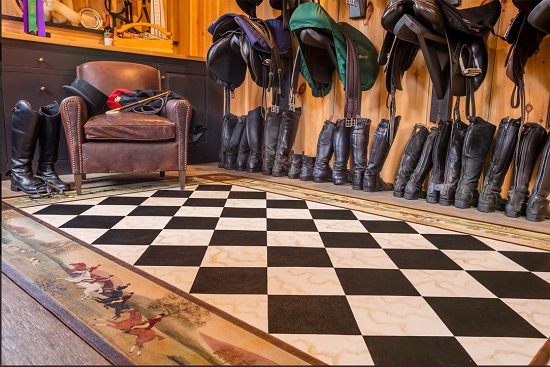 Tackroom floorcloth by Lisa Curry Mair
Floorcloths
Also known as oylcloths, floorcloths date back to fifteenth-century France, where canvas tapestries were used to cover cold stone floors. The ancient designs often mimicked tile and marble flooring. The basics of a floorcloth haven’t changed much since.
In old New England, worn out sailcloth from the ships that plied the world’s oceans were often decorated and used as floorcloths. After linoleum was invented in the mid-1800s, however, floorcloths pretty much disappeared. Mair is partly responsible for the resurgence in these decorative and colorful floor coverings. With more than a thousand in use and on display in museums, she has been a part of the awakening.
Mair paints floorcloths using the heaviest canvas available. The intricate design is applied in layers of washes, building up to the finer details. When complete, the floorcloth is sealed with a durable finish that is tough enough to withstand dogs, kids, and furniture, but can be easily cleaned with a damp mop.
Floorcloths can be based on existing designs, or can be a completely customized. The canvas texture shows through, creating an aged, elegant charm. Installation is easy; simply unroll it!
Mair lives the traditional New England country life, and painting is just one part of her day. The farm’s old dairy barn is home to her four horses, which she cares for and rides daily. In the winter, the woodstove must be stoked and the walkways must be shoveled. In the summer, the flower gardens around the pond in the backyard require time and attention. She has been known not to leave the property for a week at a time. “Why would I?” she says. “Everything I need is right here.”
Mair has created over fifteen-hundred handcrafted floorcloths, paintings, and murals, which now reside in private homes, historic houses, and museums across North America and Europe. She has been chosen for over fifteen years as one of the country’s top Traditional Craftsmen, a designation given by a strict jury at Early American Life Magazine. Her work was featured on the cover of The Chronicle of the Horse in 2011. She has also been featured in Equestrian Living, Horse and Style, Covertside, Yankee Magazine, and This Old House.
Posted September 12, 2017