
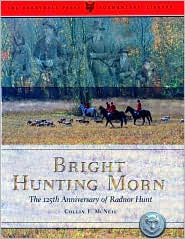
Bright Hunting Morn: The 125th Anniversary of Radnor Hunt, The Derrydale Press, 2008, 357 pages, four-color, 10-1/4 x 14 inches (large format), glossy, ISBN 1-58667-111-1
Reviews:
“…beautiful tome, written and crafted with great attention to detail….wonderful vintage photographs and gorgeous artwork….magnificent.” (Covertside, Spring 2009)
 This article from The Philadelphia Inquirer on November 29, 1889 was reproduced in Bright Hunting Morn: The 125th Anniversary of Radnor Hunt by Collin F. Mc Neill. The merits of the English and the American hounds were being argued by their respective proponents even then!
English and American Foxhounds
What the Radnor Hunt Is Doing
Mr. John Matthews took charge of the Radnor hounds on the 5th of last January. He was born and bred a hunter, the last of his several engagements in the old country having been with the “Subscription” pack, well known all over England.
“When I took charge here ten months ago,” said Mr. Matthews, “there was nothing but the large yard on yonder hill for a kennel, and for want of proper care of the dogs I have been fighting mange and skeptic ever since. Be good enough to make examinations of our present kennels, built on the European system.” The door of the structure, a building 40 feet by 28, was opened.
THE INQUIRER reporter was ushered into an open hall which extends the full length of the house. Facing this are three compartments, each supplied with a cement floor. The central room, the sale a mange, is fitted with troughs and affords opportunity for running water. On either side a door opens to the apartment of the dogs on the right and the bitches on the left.
Iron work benches raised three inches from the ground and supplied with straw matting accommodate twenty hounds in each kennel. Around all of the three rooms are displayed wainscot of straw, prettily interwoven with the sporting colors red, white and blue. Doors connect these rooms with spacious yards, sawdust covered.
“We have imported twelve English hounds and hoped they would be on hand for the opening,” continued the whip, “but they are now on the steamer Indiana.
“Wherein do you consider lies the advantage of the English dog over the American?” asked your reporter.
“In discipline and in slowness of pace. The American hound goes his own gait and too fast to follow. I have labored continuously ever since taking charge here, but without much success, to take them to covert bunched.”
“But do you not think if young American dogs were handled properly the discipline attained in English packs could be enforced here?” Jesse Hickman has a pack of American hounds which he can call to heel and take down the length of Chestnut Street.
“Hunting in this country,” he replied, “is yet in its infancy; but the day is not far distant when we shall find things put on a firm basis according to European principles. Hunting here is at the status of 150 years ago in England.
“The members of the Radnor are particularly fortunate in having at their head a most efficient master; for having served many masters in the old country, I can say most conscientiously that I never rendered my service to an employer with greater pleasure than to Mr. Mather. In my opinion he is nothing short of a superior sportsman and gentleman, too.”
Dr. L. H. Twaddell, of Forty-sixth and Baltimore Avenue, this city, who is one of the best authorities in the country on dogs, and who is present at all the Radnor Hunt meets, believes in the superiority of the American foxhound over the English. He said yesterday,
“The foxhound was the first of the breeds of hunting dogs introduced into colonial America. The cavaliers who settled Virginia and Maryland did not forego their love of the chase, and the thoroughbred horse and hound quickly followed their masters to the new world; but the native gray fox was found unsuitable for the chase. He would stick closely to the dense thickets, and if hotly pressed would climb a tree. Besides, he lacked the speed and endurance necessary to test the qualities of rider, horse and hound. Failing in such essential requirements, these enthusiastic sportsmen decided to bring over the English fox as well and attempt to colonize him also. The venture succeeded to the fullest extent, and Reynard to-day is found in every suitable covertside.
“The foxhound of that day was the breed that King James followed, as described in the first canto of The Lady of the Lake, when he rode his ‘gallant grey’ to his death in the wild gorges of the Trossachs.
Unmatched for courage, breath or speed.
“From Virginia these dogs in their purity have spread into the adjacent States, and the American foxhound is of blood unalloyed and unmistakable in appearance, with racing outline, deep chest, long, pendulous ears and melodious tongue he is the hunter’s ideal.
“In the American hunting field, where the topographical conditions are such that the hound has to work out the intricacies of the trail without assistance from the huntsman and whippers-in, the native foxhound is par excellence the dog. He has plenty of hunting sense, an exquisite nose and a deep stirring note that ‘wakes the echo.’
“The modern English hound—a composite animal—has been imported and tried, but generally discarded in our packs, where the red fox is the legitimate game. They lack nose and voice, and in our extensive woods and thickets, where half the time huntsmen cannot see the line of the run, if a chuck (check?) is made they are hopelessly thrown off. On the open downs and cultivated fields of England they may do if carefully assisted by the huntsman and his aids, and here may answer to follow the aniseed bag; but for a lively old red jumper on his native hills, we want the American, who ‘knows all about it.”
{jcomments on}