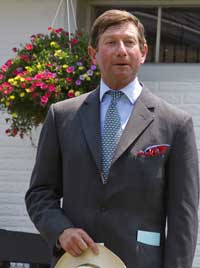
Karen L. Myers photo
The Question
“I have read Lt. Col. Foster’s book Whipper-In which states the basic premise that whips must know the names of each hound to truly be of assistance,” writes Kathy Rubin. “What contribution can I make as an honorary whip when I cannot devote the time to know each hound? Where should I set my sights so I can be of help to my huntsman despite the fact that I cannot be with hounds on a daily basis? I believe many of the smaller hunts in the country face the same problem. Can you give me some guidance and recommend additional reading?”
Knowing that Messrs. Scott, Robards, and Peel—world authorities on the subjects of foxhounds and the hunting of hounds in the field—are geared to thinking at the most sophisticated levels of hound management, I had to wonder, as I posed Kathy’s question to them, if they could truly identify with her less than ideal aspirations. They did. But at the same time, they didn’t let her completely off the hook.
Martin Scott begins with the language of the field.
“The whipper-in—not whip, please—does have a vital role to play, and his/her job is to be everything and everywhere
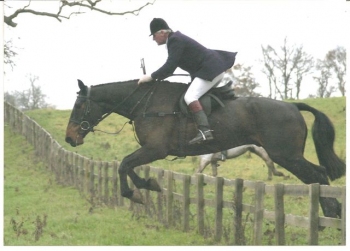
when required. Remember that you will not always get it right, and most good huntsmen need to let off steam at somebody, so I expect it will be you! Never answer back, especially in the field, and remember that what you did right last week may not be right this week!
“The huntsman should give you clear instructions on what he or she wants you to do. Many years ago now, when I went to help at the Heythrop when Captain Wallace was in his heyday, I was the third whipper-in. I certainly did not know all the hounds but I tried to learn them, and my advice is to ask when you are standing around and try and learn some of them. Always have a hound list on you and memorize it. This will help you know the names and you can mark on the list any memory joggers that you find helpful.
“The time when you might be most useful is if and when the pack splits and you have to stop some hounds and then bring them along. Never go after a hound or number of hounds while making any noise at all; this will only distract the others. Do not make a noise until you can get to their heads and are in a position to stop them. Stand on the line, and if you have somebody with you, then encourage the hounds to come with you. If they know you, they are more likely to follow you. Do not make too much noise if they are coming with you. Usually one will come, and the others will follow. Remember, it is better to encourage than chastise hounds, especially if they have not done wrong. Let the other hounds do the chastising if they have done wrong. But if you do know their names it does help as they are more likely to respond.
“Never ever hit a hound unless you know that the hound knows it is doing wrong! Leave the discipline to the huntsman, especially if you are an amateur. I rarely see a hound hit, and good huntsmen do not like their charges to be hit, especially if the culprit has not really done wrong.
“Learn as many of the hounds’ names as possible and learn their relations, i.e., their sisters, etc.. With this extra knowledge you may then be able to discuss with the huntsman which hounds have been working well and make the days hunting even more interesting. Good whippers-in even know the different voices of each hound, so there is a lot to learn.”
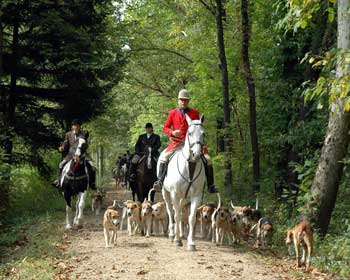
David Pollock photo
Hugh Robards agrees that Kathy should make an effort to learn the hounds’ names.
“I think it is fair to say,” says Robards, “that if a person can afford the time to hunt twice a week during the season they should be able to devote the same amount of time during the summer months to exercise the hounds with their huntsman. By doing this an honorary whipper-in can not only learn the names of the hounds but also get to know their characteristics.
“If it is not possible for an honorary whipper-in to do this, then perhaps if that person sees a hound doing something wrong or right in the hunting field they must at least be able to point out or describe the individual to the huntsman, even if the name is not known.
“An honorary whipper-in should learn the hunt country and be aware of all major roads and railways so they do not have to be told by the huntsman to get on when hounds are heading in the direction of one, but use his or her initiative and get there before the hounds.
“Counting the hounds is most important and must be done at every opportunity, particularly on leaving an earth or drain where the pack has marked its quarry to ground. There is the chance that a hound could have followed its quarry into the drain or earth and become stuck. A hound may go missing at any time during the day, and if it is noted where the pack was last all on it makes it easier when looking for the missing individual.
“Lord Coventry tells the story of when he was hunting the Croome country in England. He had found a fox in Tiddesley Wood and, counting the hounds away, he was one short. Having achieved a six-mile point, the hound was still missing. Therefore he sent his second whipper-in back to the find to look for the hound. After much searching, the whipper-in found the hound caught fast in a wire snare. If the pack had not been counted away, one of the most influential sires of the English foxhound would have been lost. The hound was Lord Coventry’s Rambler 1873.
“When a fox has been viewed, the information given to the huntsman must be short and precise: where it was last seen, how long ago, and did it look hunted.
“When the huntsman puts the pack on the line, the whipper-in must position himself or herself in such a way that the hounds do not take the heel line (back trail).
“There is indeed much to learn, but if a person is prepared to give the time and listen to advice from the huntsman, much pleasure can be enjoyed from working in the field.”
Nigel Peel offers a distinction between whipping-in and scouting.
“It is often the problem with amateur whippers-in that they cannot give the time to the hounds in the kennels to be truly useful in the field” says Peel.
“Dennis Foster in his book Whipper-In states correctly that the whipper-in should know the name of each hound. If he or she does not know the hounds, how will the hounds know him, and therefore what help will he be in retrieving lost hounds, etc?
“The best assistance that Kathy Rubin can offer to the huntsman is by going on and getting a view of the quarry. First class scouting is truly valuable and on bad scenting days will make a hunt. The other help that she could offer is to stay handy to the trouble spots, i.e., roads and railway lines.
“Tell her not to despair; there is a place in the game for all comers,” concludes Peel.
FHL invites subscriber comments that will expand, enlighten, or offer new ideas related to the question. Since our experts agree on the importance of knowing the hounds, what ideas can be shared to assist Kathy in this endeavor. One idea involves taking photos of the hounds and writing their names on the back of the photos. The stack can be carried about and used as flash cards even when away from the kennels. What techniques have worked for others?
August 26, 2010