
This morning I daydreamed of my beautiful Virginia home, while I hurried breakfast and went out to ride Kit. I craved having a barn/stable/stall/crosstie to use for grooming and tacking. (Greg’s setup does not include a barn or shed; they use their horse trailer for storage as well as transportation.) I thought of the great footing on my Aiken line down by the Jordan River, while I tried to navigate between rabbit holes and ground squirrel holes in the corner of the field where I tried to work. I had a yen for some soft green clover as I stalked across the pasture through a healthy crop of tall tough native weeds to turn the mare back out (beside her nemesis Heidi, who, by the way, is realizing that having Kit as her one-and-only-friend may be better than having no-friends-at-all.) As I trotted along the cinder path in Greg’s development, I thought longingly of living in my Rappahannock ‘hood with dozens of horsey neighbors to ride with on any of hundreds of miles of trails every day of the week.
I went so far as to yearn for Washington DC traffic later as I negotiated the 101 highway from Santa Barbara. With apologies to Yeats, this six-lane behemoth, slouching towards Los Angeles to be born is a rough beast. It wasn’t so much with introspection as longing that I pined for crew cuts and swingy bobs from back east, in lieu of the dreds and rasta hats that prevail here from downtown Burbank to the beach boardwalk.
Meaning no disrespect, I realize I’m an easterner at heart, a South-easterner at that, and while I find California exotic and exciting, unique and intriguing, there isn’t a snowball’s chance of me converting to the left coast. Until around sunset. At which time I find myself mesmerized by the Golden State’s siren call, sucked into feeling like I might want to stay.
There must be a story, you opine. You’d be right.
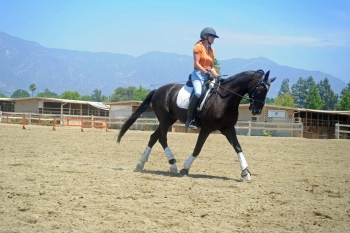
So, after I rode this morning (nice school, good work on Kit’s part, as much as we could do with a limited riding area available), I deposited Beth and John at the pier near downtown Santa Barbara. I went a few blocks more to pick up some furniture for a friend-of-a-friend who’s relocating to DC (he’s going to culinary school; she’s getting a Masters from American University). Then I hit the 101 and headed south to Burbank to check in with Katherine Mashbir, the dressage trainer who’s relocating to Baltimore. I’m taking a good bit of her stuff for her, so we discussed loading options and layering while she schooled a horse.
The Los Angeles Equestrian Center is a fascinating place—squarely in downtown Burbank. It must have 1,000 horses squashed onto a couple dozen acres. There are tons of arenas and lots of schooling areas but zero turnout, not a blade of grass, and the horses live in covered 12 x 24 stalls 24/7. I understand that many creatures across the globe have a worse lot in life, but, still, it makes my tiniest paddock (the one that’s been chewed down to nubs) look like a hundred-acre field of emerald green. Katherine is excited about relocating to the east coast, but I heard concern in her voice as I complimented her on her nice horse (she was working a young Holsteiner) and on the “neat place!” she works at (until next week).
“What do you think?” she asked. “Do you think I’m crazy? Do you really like California? I’m worried about moving east.”
I decided to bolster her confidence and tell the truth, the whole truth, and nothing but the truth. “Not a chance I’d choose this over the east,” I said. “Not a flippin’ chance. Here you get the amateur hour and a thousand horses on a couple of acres. Back east you have the highest concentration of Olympic riders, lifelong professionals, the best bloodlines in the world, wonderful footing, excellent venues and space. Miles and miles of space. Granted,” I added, “the weather in California is wonderful.”
We were speaking at high noon, on a bright, sunny, mid-summer day. It was deliciously warm but not hot, toasty but not humid, and, even though we were at the biggest equestrian center in the state, with horses circling like a merry-go-round as far as the eye could see, you couldn’t find a fly on the place. There are just no bugs out here. Too dry, I guess.
“You’re making the right move,” I assured her. Katherine seemed relieved. “Thank you!” she gushed. “I am so worried. I don’t know anybody (much) out there. I don’t know the area. I don’t know the roads.”
I told her I’d bring her to my place to teach some clinics, and Beth would do the same in Jersey, instantly spreading her spider web network a hundred miles in each direction of her new farm in Union Bridge.
“That makes me feel better,” she said.
I was dreaming of home, still, with nostalgia as I headed back onto the blasted 101 to take in a little sunshine at the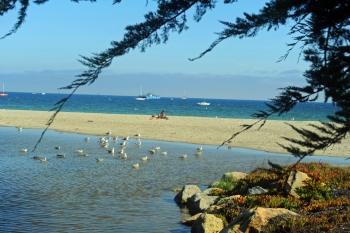 end of the day before meeting John and Beth for dinner at the Santa Barbara Shellfish House at the end of the public pier. Homesick or not, I decided to make the most of it, so I grabbed a towel and headed onto the sand. A couple of volleyball games were still going on. I set up nearby so I’d have some entertainment while I basted in the afternoon sun. Working on the regular yoga breath (in for four, hold for four, out for four), I yielded to the West Coast rhythm a little more, mesmerized by the seagulls’ fuss and snickering at the argument between two volleyball players about which brand of organic chicken stock they preferred. Any conversation on a playing field back east centers on the Redskins or relative (bra) size, so I’m mightily impressed by the general level of enlightenment these Californians have.
My ardor deepened over dinner. The perky waitress happily trotted out the list of locally-caught seafood so we could sample the freshest Pacific catch. Local crabs were in season so I opted for that while John and Beth shared a clam dish.
As the sun set over the Santa Ynez Mountains to the east, we strolled back down the pier. The water shimmered, the air practically glistened. The perfect end to a perfect day. Beth and John got caught up watching a homeless man shaping wet sand into a temporary veteran’s memorial (GI with a fallen comrade in a shoulder carry), so I padded on alone, joining the boardwalk and heading toward the skateboard park and my truck parked in the lot beyond.
There is a long avenue of mature palm trees shading against the last strong rays of sunlight. Underfoot was the only patch of green grass I’d seen all the time I’ve been here. I slowed to enjoy the soft turf underfoot, and began to notice small groups of people sitting in kumbaya clusters under the trees. Here was a group encircling a girl with Heidi-braids strumming a six-string. A companion, the boy with the matching Heidi-braid, tapped rhythm on a tambourine. Over there was another group of older men, some in biker gear, a couple in rags. They sipped from a brown paper bag. Another group looked to be playing some sort of jackstraws or pick-up-sticks on the sidewalk. I’m not so much of a people person, but these looked like seriously interesting characters. Maybe slightly deranged, some of them likely damaged, but you could see the stories they’d tell if you got into their circle.
I was barely focused as I rounded a slight bend in the boardwalk, but something shiny caught my eye and I pulled to a stop. There, on a (seemingly) hand-woven Indian blanket laid across the turf, was an array of baubles and beads and shells and stones, snips of wire, strands of pearls, strings of unidentified gewgaws shimmering in the sunlight. Sitting on another blanket nearby was a young man, early twenties, one eye closed in concentration as he threaded a thin wire through a sliver of shell.
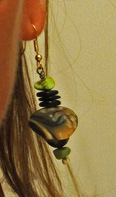
I looked more closely. He appeared to be making jewelry, pretty beaded bracelets and necklaces, deftly knotting the wire through pieces of colored glass and slivers of stone. I stepped back to see what he had. “See anything you like?” he asked. “That’s Albacore,” he said as I fondled a shiny earring that looked like the inside of an oyster shell—soft and darkly luminous.
“I’ve been wanting some new earrings,” I explained hesitantly. This boy and his silent companion a few yards over in the grass fiddling with a music CD on his computer drive, must get this all the time. Middle aged women checking out their wares. Terminally unhip but going for a post-modern look that’s not hopelessly juvenile. “I need something to go with black.”
The artisan perked up. “Ah. Black. I like turquoise with black. You mean you want the earrings black or goes-with a little-black-dress black?” He’d already started gathering items to assemble for the late afternoon project.
“Little-black-dress black,” I said tentatively. I thought of my favorite pair of earrings (one-of-a-kind purchased at a craft fair in Annapolis last year) and how they don’t actually match much of my wardrobe at all. I love them; they jangle invitingly every time I move my head; but they have limited use.
“I like the albacore,” I said, picking up a half-inch diameter bit of pearl-black shell. “And, sure, why not the turquoise.” My new friend, twenty-two-year-old Santa Barbara native Derrick, began to assemble the earring. He adjusted his squishy cap to the back of his head and lit a Marlboro red. “I want it to jangle. You know, click.”
In the gloaming I began to see a new, updated Betsy—hip, youthful, pertinent. I sat myself—uninvited—on the corner of his blanket. Derrick didn’t seem to mind. He grabbed another piece of albacore. “I don’t usually do custom work,” he said. He gently swung the two pieces of shell together to demonstrate. They jangled melodiously.
“Perfect.”
I settled back on the blanket while Derrick worked, chatting with his friend about what music he was playing (I guessed hip hop). I asked them about growing up in Santa Barbara. “Pretty cool,” Derrick said. I asked them if selling jewelry by the shore paid for rent. “It pays for food,” he said. “I don’t have any rent.” He nodded to a shapeless heap by the closest palm tree. “Home sweet home.” He grinned.
Mystifyingly, as sudden as a switch being flicked, I could picture myself there, staying on the sand, having no responsibilities other than to eat, living the gypsy life. I watched Derrick assemble a stack of tiny black discs on my earring (“it’s petrified wood”) to create length and swing. I thought about it some more. I could learn a trade like Derrick, maybe learn to play an instrument, and busking during the season on the pier. Or perhaps I’d hone some skill (maybe my mom would teach me) with watercolors, and I’d paint colorful miniatures to sell by the shore. Failing that, the Santa Barbara Polo Club is just across the highway at Montecido, giving the notion a more realistic spin. I could easily land a job at the polo club stomping divots or warming up ponies between chukkers. I’d live on the beach, I thought, staring out at the wide lawn leading to the chalky shore and soft blue water. I’d shower at the beach bathhouse. I’d learn to fish and eat fresh seafood every day. I’d put a little cash in my pocket walking hots for the Argentine team at the polo field. I’d live the life of an aimless drifter, sort of an endless-summer-meets-talented-vagabond. I’d write poetry and learn the constellations.
Beth came over to check our progress. “You ready, sister?” she said with a sassy drawl. “Let’s go.” I hardly heard her.
Derrick was nearly done. He tightened one last thread and handed me the earrings to put on. “Those look s-w-e-e-e-t,” he said, drawing the word out.
“Perfect,” I said. I stood, dizzy partly from sitting cross-legged for nearly half an hour, partly from the life-changing visions clouding my mind. I shook my head lightly. It was the jangle of my earrings that at last broke the spell.
“C’mon,” said John, tired and cold from a long day playing in the chilly Pacific surf. “Just remember, no clicking in the truck.” He remembered my fuss about his retractable telescope. To him a jangling earring represented the same incessant annoyance. Beth laughed mirthfully. I pulled myself up into the cab, moving aside the Coggins report and Jockey Club papers I’d left on the seat to remember to hand over to Greg. Something of a Pavlovian response—responsibilities—flooded my brain. I’d started a list of things to do when I get home: call the farrier, take my saddle to Skeeter’s, mow the Aiken line, start to chart my Paul Striberry clinic next month. The list sat tauntingly on the dashboard. How dare you daydream, it seemed to say. How dare you consider walking away. We need you, it clamored. We need you more than you need you.
I put the truck in gear and maneuvered out of the space—none too easy in that big rig. I wheeled around the corner. Derrick saw us go and put up a wave in the rearview mirror. I gave him a jangle and drove.
To be continued….
Editor’s Note: Previous days’ accounts may be accessed from the Horse and Hound drop-down menu above. Click on Travel.
August 8, 2010