“I have a question about foxhound conformation,” writes Kelly Bryant who has hunted with the Mill Creek Hunt in Illinois. “I have noticed that in the hound show galleries, some winners have a level back and some have a curved back. How does the back relate to the performance of the hound, and what difference does a level or curved back make? Which is preferred?”
These are excellent questions, and, as we have noted before, there are no right and wrong answers—only opinions and cautions. A wheel back is desirable to many breeders and judges of modern foxhounds, but a roach back is—most will agree—a weakness.
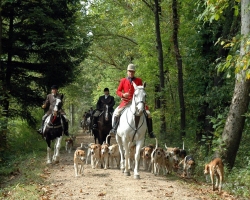
As in all judging, different people have different opinions, says Hugh Robards. “Some consider a curved back a fault, calling it a roach back and a sign of weakness. To others it is known as a wheel back and a sign of speed. I have yet to see a racehorse with a wheel back and I have not seen it in a Greyhound. I prefer a straight back, well muscled, and not chopped off behind.”
To illustrate the variety of opinions on the subject, Robards recalled an incident at the Heythrop kennels in the days when Captain Ronnie Wallace was Master there. Lord Daresbury, MFH of the County Limerick in Ireland was visiting, and he noticed a dog hound possessing what he considered to be a roach back.
“What is that?” exclaimed Lord Daresbury to the Captain.
“Oh, that hound has a wheel back, which is a sign of speed,” replied Captain Wallace.
Turning to Bill Lander, who was showing the hounds, Lord Daresbury said, “He is only saying that as the hound is in his kennel!”
Robards admits that the wheel back is not looked upon favorably by those who bred the Old English Foxhound. To be sure, Lord Daresbury was an ardent breeder of the Old English foxhound, while Captain Wallace was in his time arguably the foremost breeder of the modern English foxhound.
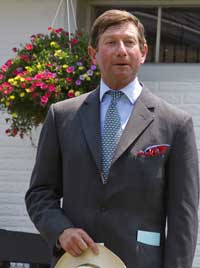
We also posed Kelly Bryant’s question to Nigel Peel, another brilliant breeder and devotee of the modern English foxhound.
“In answer to your question about conformation of the foxhound’s back,” writes Peel, “both level and slightly curved, or wheelback, are acceptable. I prefer the wheel back, as I think it denotes a greater strength and is associated with a fast hound. I can do no better than quote from Daphne Moore’s wonderful book, Foxhounds:
‘There are two schools of thought regarding backs. Some experts prefer the flat, level type whilst others, particularly the modern breeders, swear by the wheelback, which carries great muscle and is usually associated with a fast hound. This should, however, not be confused with the weak, narrow roach back, nor should it slope over the stern to give a chopped-off appearance.’
“Mr. Delme Radcliffe, who was Master of the Hertfordshire Hunt, wrote in
1839, ‘I am myself fond of what are called arched loins or wheelbacks. Arched loins are better adapted to hills and are most in harmony with the symmetrical outline requisite for speed and bottom.'”
Since most experts agree that a roach back is a fault, while a wheel back may be an attribute, it becomes important to distinguish between the two by understanding the root cause underlying each condition. The wheel back, Peel explains, is a curve made up of loin musculature, while the roach back is a structural curve of the spine.
July 20, 2010