Photos by Garth Thompson and Derek de la Harpe
The author discovers a new adventure on horseback that features good horses, wide open spaces, abundant wildlife, and a measure of risk.
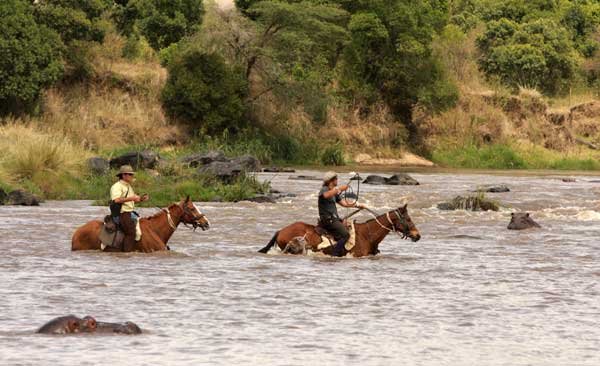
Ten horsemen stood on the bank of the Mara River under the midday equatorial sun as Tristan explained the crossing.
“We must cross here and land on the far bank at that tree, you see. You must point your horse upstream so the current doesn’t carry you down to the hippos there.”
(scroll down for a slideshow of the incredible photos)
A half dozen hippopotamuses—a species that kills more people in Africa than any other animal—alternately submerged, surfaced, snorted as they watched us not twenty-five yards downstream of our ideal route. A pair of ducks paddling furiously were carried rapidly downstream as we watched. A single, large male hippo broke the surface just upstream. We would be surrounded, while our horses would struggle over the rocky bottom, water over the saddle flaps. We exchanged glances, each of us holding to our own thoughts. I moved forward in line—get in and get it over with—my way of dealing with apprehension.
Not five minutes earlier, as we approached the river, our little band of horsemen happened by a safari vehicle carrying tourists safely inside. Several faces peered out at us curiously, and we sat tall in our saddles. The difference between a safari on horseback and a safari by vehicle has to be the difference between a warm embrace and a handshake. On horseback we are directly in touch with the earth. We walk over the animal tracks, the bleached bones, the lumps of elephant dung, the eons-old volcanic rocks in our path. We inhale the scents of nature, not diesel fumes. We hear the myriad unfamiliar bird calls instead of the engine’s roar. We are dancing to the rhythm of our horse’s footfalls rather than the random jostle of the all-terrain vehicle. All such feelings of superiority had vanished, however, as we stood on the river bank trying to assay the mood of the hippos.
Tristan led the way down the riverbank, and we followed in single file. The good news was that we all made it safely across; the bad news was that we learned we would have to re-cross the river a couple of days later.
It had all started with an email from Heidi Beaumont, a horsewoman and foxhunter I met in Aiken, South Carolina last year. Heidi runs International Ventures, Ltd. and specializes in organizing safaris in eastern and southern Africa. I learned that many of her clients for horseback safaris were foxhunters, and I was anxious to discover the common ground for myself. Heidi arranged for this, my first ever African safari, with Offbeat Safaris in Kenya, run by the husband and wife team of Tristan and Cindy Voorspuy.
Our Little Band
In addition to Tristan, there were nine other riders in our little band: two more American foxhunters in addition to me, Angela Royal from the Red Mountain Foxhounds in North Carolina and John Huganir from the Rose Tree Foxhunting Club in Pennsylvania; John Romero, a trail rider from California; three Frenchmen, Bertrand Devillars, Phillipe Pascal, and Loïc le Masne de Chermont, who brought with them several bottles of exquisite wine and enormous senses of humor; and two of Tristan’s friends, Derek de la Harpe, a tourism and wildlife consultant from South Africa and Garth Thompson, professional guide, author, naturalist, and brilliant photographer from Zimbabwe. All photographs used in this article were taken by Garth and Derek on this safari.
Garth has guided people by canoe and on foot on photographic safaris in southern Africa for twenty-nine years. However, “Here,” he admitted, “is the greatest wildlife spectacle in the world.”
Garth loves the riding safari.
“It’s the greatest thing in the world to be able to cover the country on the back of an animal you have a natural affinity for and watch all the wildlife around you,” he said.
The Horseback Safari
The horseback safari experience is relatively recent. In 1984, English-born Tristan Voorspuy went to work for Tony Church, who owned and ran Safaris Unlimited. Tony was the first to introduce riding safaris in Kenya in 1972. Tony’s son Gordon now manages that company. In 1990, Tristan went off on his own and established Offbeat Safaris.
The Offbeat Safaris literature tells you up front that “you must be a good enough rider to be able to gallop out of danger.” That is a statement not to be ignored, for Tristan caters to the more adventuresome traveler.
“Adventuresome. Yes, I suppose that’s what we have a reputation for,” Tristan agrees. “But I don’t court disaster. You’ll see our setup at Deloraine, where we have our own polo ground and cross-country schooling course. We spend a lot of time and effort on the horses. They play polo; they event; we work through the mistakes; we find out what they’re good at.”
{pgslideshow id=7|width=600|height=400|delay=5000|image=L|pgslink=1}
The Voorspuys keep eighty horses at Deloraine, and Cindy—a brilliant horsewoman—does most of the schooling there. Tristan believes that when you have a reliable horse under you, and the footing is right, you can safely be more adventuresome. And he never misses an opportunity for adventure. Trekking across the landscape, whenever he judged the footing favorable, he would stop and turn to us with a trace of a smile and a faraway look. That was the giveaway that he was ready for some excitement.
“Let’s have a trot-canter.”
That meant five strides at the trot followed by a two-mile hand-gallop. If there was a herd of animals grazing, so much the better. We would find ourselves galloping as fast as the horses could go, with wildebeest, zebra, and gazelles galloping on both sides of us, wheeling ahead, changing direction, splitting, reforming, drumming across the plain, a kaleidoscope of blurred motion, noise and color.
Tristan can identify every animal, bird, and tree we pass, and his eyes are tuned to picking out and pointing out the smallest creatures well before anyone else can even see them. He and his staff take every opportunity to do more to make the adventure memorable than anyone could expect. There was a chair in front of my tent, ostensibly for sitting, reading, or relaxing, but I never had a moment to use it. A typical day began with an early game ride at sunrise, back for a full-course English breakfast, off again on horses or vehicles, lunch of cold cuts, cheeses, avocado salads at two, brief period for rest, afternoon ride at five until sunset, return for showers, cocktails, dinner, picture show of the previous day’s photos, night game ride in the vehicles, bed at eleven.
From Camp to Camp
Our first camp is Olare Lamun on the southern edge of the Loita Plains. On the very first game ride, the first full day in camp we ride past zebras, giraffes, wildebeest, impala, Thompson Gazelles, Grant’s Gazelles, topi, hartebeest, dik-dik, baboons, warthogs, mongoose, jackal, aardvark, and hyenas. In the feathered category, we see the Batteleur Eagle, Long-Crested Eagle, Augur Buzzard, Superb Starling (looks like ours, but has a rose-colored breast and iridescent blue wings and back), Lilac-Breasted Roller, Egyptian Geese, among many others I never put names to. On a game ride in the vehicles after dinner, we view spring hare, white-tailed mongoose, and bat-eared fox, among other exotic creatures.
After two nights at Olare Lamun, we’re up at six for breakfast, then break camp for our longest ride—about thirty miles—to the next camp, Olare Orok, at the edge of the Masai Game Reserve. Eleven riders spread out on the plain including a groom with the extra horses—riding one, ponying one. The ponied horse is turned loose when we are far enough from Olare Lamun, and he follows.
We’re crossing the country in the same way the early English settlers did a hundred years ago when they came to colonize Kenya. From the backs of our horses, we’re seeing it just as they saw it. This is the bush; it hasn’t been developed or “improved”; the Masai still build their brushy enclosures of acacia branches and huts of mud and dung. The men, draped in their colorful robes, tend their cattle, each holding his spear and his stick. Sun-bleached skeletons of animals long since passed are strewn over the Mara as they were then. There are some differences in our appointments, however: Derek has a portable GPS receiver tracking our route which he will later paste onto Google Earth for us; Angela has a minicam strapped to her hat brim; and others have international cell phones that communicate via satellite.
Soon we find ourselves galloping along with a herd of seventeen giraffes. They gallop in what looks like slow motion—a smoothly coordinated, rocking gait—but with their long legs they cover ground surprisingly swiftly.
We arrive at our rest stop at one-thirty pm in a small grassy bowl by a stream surrounded by rocky outcroppings. We change to bathing suits and have a cool and refreshing dunk in the small ponds of water collected by the rock formations. Then a picnic lunch from our saddlebags. All followed by a brief siesta under the tree. The only sounds are the tinkling of cow bells from a Masai herd grazing nearby.
On the horses and moving again at three pm, we pass the bleached bones of an elephant that died, according to Tristan’s estimate, in the early 1990s. We can still see the Loita Hills we left behind. Ahead we see the high escarpment marking the western edge of the Mara. To our left the hills in Tanzania are visible.
At four pm we top a rock ridge high above a breathtaking, broad and lush, flat valley colored in every hue of green and studded with small groves of trees. We take advantage of the good footing with a couple of long gallops across the valley floor.
I had been paranoid about the holes made by the aardvarks that dig for termites near the ubiquitous termite mounds, and find that I have been unnecessarily over-controlling my horse. Today, I begin to see that my horse knows exactly where she wants to place each foot at all times. She sees or senses the holes and either avoids or leaps them. I succumb to her good sense and loosen the reins. She proves her point by galloping through a rocky place without touching a rock, with no guidance from me.
We arrive at Olare Orok, our camp at the edge of the Masai Game Reserve, just before five pm after seven-and-a-half hours in the saddle. We’ll spend the next three nights here. The tents are already up, and the grooms are laying out the tarp onto which we will deposit saddles and bridles when we dismount.
The sun has set, and we are relaxing with pre-dinner cocktails when a vehicle arrives to announce that a leopard has been seen. We pile into the vehicles for an evening game drive, bumping along in search of the leopard. With the help of the lamp we soon find her, hunting her way through the bush, a magnificent and healthy specimen. We savor for a short time our close encounter with this queen of beasts, then leave her to her quest.
The weather and temperature are perfect, so the dinner table has been set outside the dining tent in the open air. What emerges from the cooking tent, prepared over open fires and served by two of the staff in white jackets, would make any fine restaurant proud. Bread is cooked fresh daily. After the soup course this night we have beef curry accompanied by a half dozen bowls from which we can select a variety of chopped fruits, vegetables, and chutneys.
Later in my cot, tent zipped closed to keep out any wandering wildlife, I fall asleep to the night sounds of Africa—the ratchet and screech of the tree-dwelling bushbabies, the singsong of hyenas, the bark of baboons.
An Ancient Culture, Scarcely Changed
Much of the fertile Mara is owned by the Masai people. Past attempts by the various governments to coax them into a modern way of life have been generally unsuccessful, and they continue to live their semi-nomadic life in which wealth is measured by the number of cattle owned, and the important things in life—like the acquisition of wives—is paid for in cattle. Family groups build their own compounds—manyattas—which they enclose in an outer perimeter of thorny acacia branches interleaved to form a large ring. A smaller ring of brush inside contains the cattle at night. Between the two rings, individual huts are built of mud, water, and cow or elephant dung packed between laths of sticks in the ground. There is no electricity or running water.
Tristan and other safari operators rent camp space from the local Masai. Tristan has established relationships with some of the Masai so that we were able to visit a compound, buy bracelets and trinkets directly from the women, and even visit the inside of one of the huts. The floor was earthen. The first room opposite the entrance was for sheep, goats, or calves. Further into the smoky interior was the main room, quite bare, with a small fire burning. On each side of this room were two sleeping rooms—platforms, really—covered in skins.
A group of Masai men had danced for us in camp on a previous night as we sat by the campfire after dark. We cleared some space as they formed up outside of the ring of firelight. All was still. Then a rhythmic chanting. In formation, they come into the firelight stepping to the rhythm of their chant. One of the dancers tells the story in Masai, the others punctuate their chant with short shrills and cries. The dancers were exuberant and genuinely happy to demonstrate their skills, performing several dances including the famous jumping steps for which they are renowned.
The Matador and the Elephant
Tristan and Cindy’s second-in-command is a handsome twenty-eight year-old from Argentina, Jacob von Plessen, who subscribes to Tristan’s adventurous spirit entirely. During the winter, Jacob leads four or five riding safaris in Argentina, stressing a very comfortable camping experience similar to the African concept he has learned in Kenya.
Born in Austria, Jacob moved with his mother to Argentina at the age of three. He is fluent in five languages: English, French, German, Spanish and Swahili. What brought you here? I asked.
“I just think that third-world countries are far more interesting than developed countries, he replied. “Africa is a wonderful place. It comes with its disadvantages, but I think I’d rather choose a place like Africa with its disadvantages than a place like Europe with its advantages. There are beautiful places in Europe, but everything is so under control, so sterile.
“I live in the bush. That’s my life now. But when I go on holidays, I go to the cities. I was in Europe for a month and a half on my last holiday, and I loved it—the culture, Vienna. My granny took me to museums and opera and all that, trying to civilize her wild little grandson.”
Granny’s wild, little grandson, Jacob, was our guide on a couple of occasions when Tristan had other business to attend to. Here’s how my diary recalls it:
We hear lions from our beds at about five this morning. Mounted at nine am we’ve been riding for four hours at the top of the escarpment. Very different sort of terrain than where we have been—almost park-like—the sort of terrain that could be found in any country, even England. Very beautiful.
To reach the valley from our ridge, we dismount from the horses, change to rubber-soled walking shoes, and lead the horses on foot down a steep, narrow trail of rocks. The footing is treacherous; it would be impossible to ride horses down this trail. Jacob tells us that we must lead well ahead of the horses, and if one should lose its footing and fall, we must get out of the way quickly. The descent takes about twenty minutes, each footstep carefully chosen, leaping from one rock down to the next, but is accomplished without mishap.
Riding along the valley floor, we see a single, large bull elephant. Jacob confronts it by walking slowly, one deliberate step at a time, toward the elephant. The elephant spreads its ears and puffs itself up so as to appear as large as possible. It is exceedingly large! Jacob continues to approach. I look behind me to find a nice, clean, open area for a galloping escape should the need arise. The elephant trumpets in anger and charges. Jacob’s horse whirls, and he retreats until the elephant stops. Jacob resumes his advance, one step at a time. His adversary trumpets again and makes a mock charge. Jacob is no more than fifteen feet from the elephant, face to face, when the animal finally turns and slowly walks away. Jacob has faced down a wild bull elephant, just for kicks.
After about five-plus hours in the saddle, we are met by one of the vehicles and break for a lunch of sliced grilled sirloin cooked over an open fire by Jacob and accompanied by various salads. Siesta under a tree. The return ride will take about two-and-a-half hours, so we expect to get back around sunset.
On the way, we visit with large herds of Cape buffalo and gallop with the zebras. We hear the chinspot batis sing its signature descending three-note tune, “Three Blind Mice.” We discover the water buck—a handsome antelope, medium dark brown, thickly furry, deer-like. He sports a bright, white hind end and is generally found near marsh or water.
What struck me powerfully about the animals I saw in Kenya was their superb state of health. Their coats are clean and sleek, their bellies full. Herbivores, carnivores, and scavengers—all living symbiotically on the plains as part of a complete and working ecosystem that has not yet been spoiled by man. It’s all made possible by the particular geography and scale of the landscape. And by devoted naturalist like Tristan, Jacob, Garth, Derek, and others who have committed their lives to the preservation and enjoyment of these treasures.