
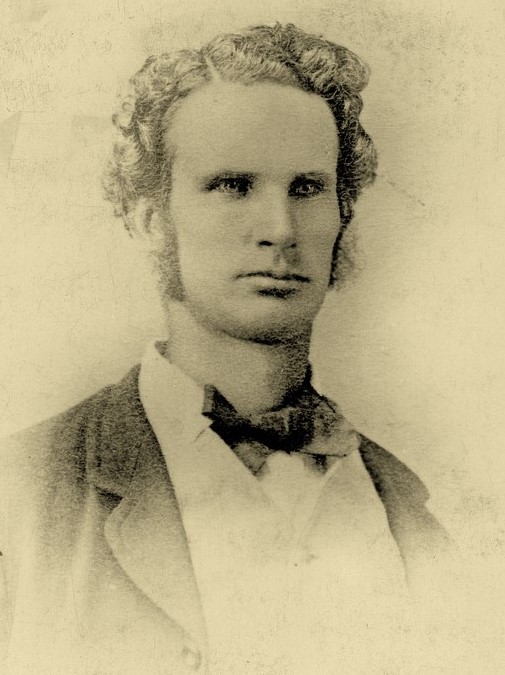
 Adam Lindsay Gordon, c. 1860
English-born Adam Lindsay Gordon was a maverick. At least from the standpoint of a series of boarding schools through which he passed, having been shipped off from home at the age of seven. At age nineteen, he was again shipped off, this time to Australia. His father hoped his son would find a fresh start.
Adam’s life was short but active. He was an exceptional horseman. After arriving in Australia, he joined the mounted police. He trained and rode steeplechasers, never shrank from a dare, was elected to Parliament, and is considered one of Australia’s finest poets. A statue of Gordon was erected in Melbourne, near Parliament, bearing these words from his poem, “Ye Wearie Wayfare.”
“Life is mostly froth and bubble
Two things stand like stone,
Kindness in another’s trouble
Courage in your own.”
What follows is a toast by Gordon, written to be sung. The first line is especially familiar to foxhunters when raising a glass. With apologies, I must admit that this toast was pretty much written for the men’s bar.
A Hunting Song by Adam Lindsay Gordon
Here’s a health to every sportsman, be he stableman or lord,
If his heart be true, I care not what his pocket may afford;
And may he ever pleasantly each gallant sport pursue
If he takes his liquor fairly, and his fences fairly too.
He cares not for the bubbles of fortune’s fickle tide,
Who, like Bendigo can battle, and like Oliver can ride.
He laughs at those who caution, at those who chide he’ll frown,
As he clears a five-foot paling, or he knocks a peeler down.
The dull cold world may blame us, boys! But what care we the while,
If coral lips will cheer us, and bright eyes on us smile?
For beauty’s fond caresses can most tenderly repay
The weariness and trouble of many an anxious day.
Then fill your glass, and drain it, too, with all your heart and soul,
To the best of sport―the Fox-Hunt, the Fair Ones, and the Bowl;
To a stout heart in adversity through every ill to steer,
And when fortune smiles a score of friends like those around us here.
~
Contrary to much of the twentieth-century sporting literature, Gordon was not born in the Azores but in England near Cheltenham. Shipped off to boarding school at just seven years old, the youngster saw the insides of a succession of boarding schools through which he was to pass. Better at his sports than his studies, he developed into a wild teenager but an excellent horseman. He attended the Royal Military Academy in his early teens and, after four years, was back in the school where he started and leading a rather undisciplined life.
His father, a military man, decided that his nineteen-year-old son might benefit from a period in Australia to make a fresh start. Gordon had just turned twenty-one when he arrived in Adelaide in November 1853. He quickly joined the mounted police force, also acting as a groom for one of the senior police officers. He resigned from the force after a couple of years and took up horse training and steeplechase racing.
He was making a name for himself in racing circles and met the Rev. Julian Tenison Woods, who lent him books and talked poetry with him. Gordon was gaining a reputation for being “a good steady lad and a splendid horseman.”
In 1857, at the age of thirty, he married, and in that same year, he bought a cottage near Port McDonnell and began to write poetry. He had not, however, completely abandoned his reckless days.
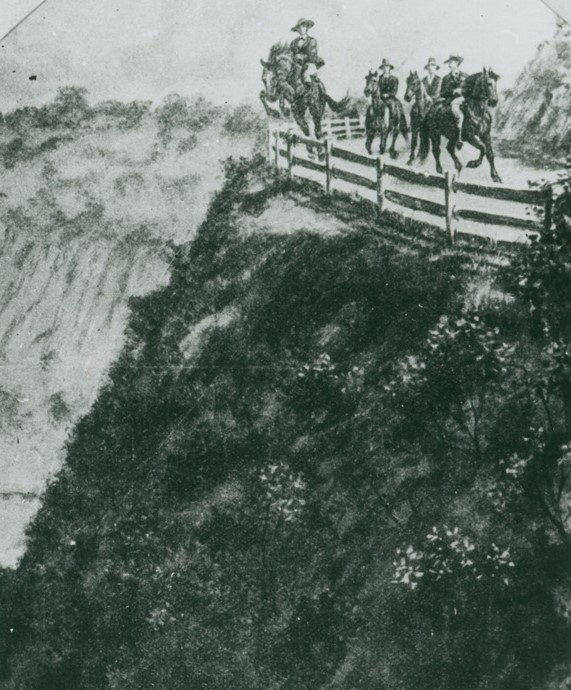 Gordon’s Leap at Blue Lake, 1864
Around the edge of a large crater lake, the Blue Lake in southern Australia, a post-and-rail safety fence separated the roadway from the edge of the precipice that drops a hundred or more feet to the water below. At one point along the fence―according to the artwork commemorating Gordon’s feat―there was a small area of firm, flat ground on the lake side of the fence just before the cliff’s edge, only a couple of horse-lengths long and about one horse-length deep. On a dare, Gordon jumped his horse from the road to this tiny patch, then turned and jumped back to the road. (If any reader ever jumped their horse on a dare remotely comparable to this piece of madness, please send me the story for publication!)
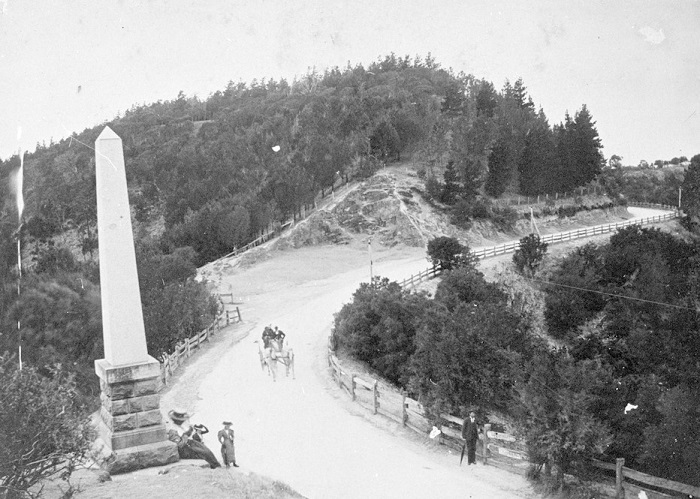 Monument erected at Blue Lake in 1887, commemorating Gordon’s Leap
Six months later, Gordon was asked to stand for a parliamentary seat in the Southern Australian House of Assembly in the district of Victoria to which he was elected by three votes. As a political speaker, he was often largely irrelevant. A year-and-a-half after being sworn in, Gordon resigned his seat and returned to his writing, riding, and racing. His poetry was more warmly received in Victoria than it had been in Melbourne, and he stayed.
On March 12, 1870, Gordon suffered a serious fall while riding, from which he never fully recovered. A few months later, his last book was published. Critically regarded now as a most important piece of Australian literature, it wasn’t successful at the time. Lacking the funds to pay for the printing, he went to his cottage near Brighton beach with a rifle and ammunition and shot himself early the following morning. He was thirty-seven years old.
His friends erected a monument upon his grave in his memory. The nation memorialized him with a statue near Parliament in Melbourne.
Posted April 9, 2022
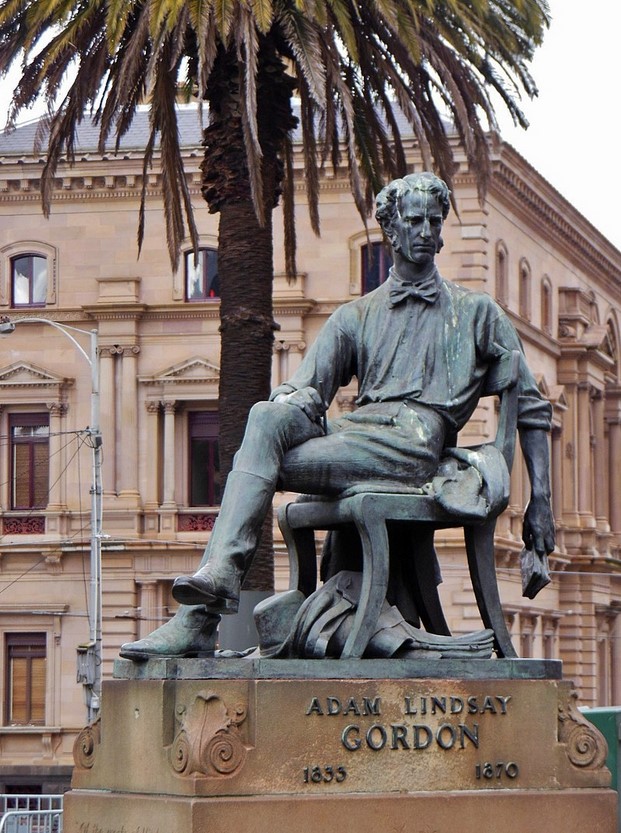 This statue of Adam Lindsay Gordon stands near Parliament in Melbourne, Australia.