
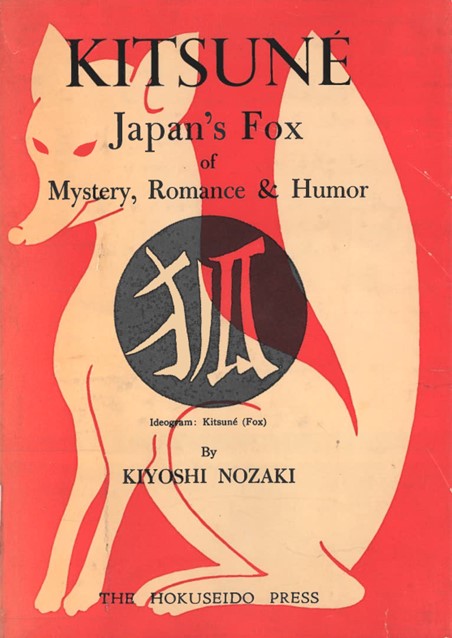
At the National Sporting Library & Museum, there are over twenty-thousand books on foxhunting, horse racing, fishing, field sports, and other related topics. In my first few weeks as a Visitor Services Associate, I found what was probably the last thing I thought I’d see on the shelves: a book on kitsuné.
Kitsuné: Japan’s Fox of Mystery, Romance, and Humor by Kyoshi Nozaki is a delightful read for anyone who enjoys learning about the fox in Japanese culture or who likes folklore and mythology. This book contains many stories from legend, literature, theatre, and fairytales about the Japanese fox.
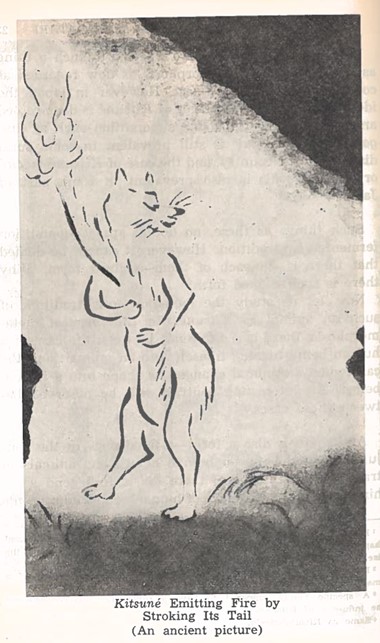
The word kitsuné comes from two Japanese syllables. Kitsu is the sound a fox makes when it yelps, and né denotes a feeling of affection, which fits perfectly for a creature so well-loved by the Japanese people (Nozaki, 3). Kitsuné refers both to ordinary foxes and foxes that have lived long enough to obtain supernatural abilities. In kitsuné lore, once a fox reaches the age of one-hundred, they gain the power of shapeshifting. The fox grows a new tail every century until they have nine, and the color of their fur will eventually change from red to gold and finally to white (Geller). Kitsuné are also capable of possessing people and creating elaborate illusions. While Kitsuné: Japan’s Fox of Mystery, Romance, and Humor doesn’t reference it by name, there are several instances in stories depicting kitsuné with an item that may be a hoshi no tama. Hoshi no tama is a glowing ball or gem that contains the kitsuné’s soul, so they must always keep it with them (Geller). There are some stories in the book that only refer to this object as a “white ball,” but other stories specify when the object is kitsuné-bi or “fox fire.” Some stories say kitsuné emit fox fire by stroking their tails, while others say it comes from a kitsuné’s mouth (Nozaki, 183).
Each individual kitsuné has its own personality, but they generally fall into two broad categories: zenko and yako. Zenko are the messengers of Inari, the Japanese god of rice and fertility, and you will likely find many fox statues at each shrine. One of the most notable and popular shrines is the Fushimi Inari Shrine in Kyoto, which is famous for its thousands of red torii gates (Fushimi Inari Shrine). According to legend, the first foxes to come to this shrine were a pair of white foxes and their cubs. They beseeched Inari to give them a purpose so they might spread peace and prosperity. Their wish was granted, and they went on to serve in the temples there. One of the duties of the foxes at the Fushimi Shrine was to drive away the yako―wild foxes also called nogitsune. The zenko were certainly capable of stirring up some trouble, but the nogitsune were most often responsible for bewitching and possessing people, sometimes with disastrous consequences (Nozaki, 18).
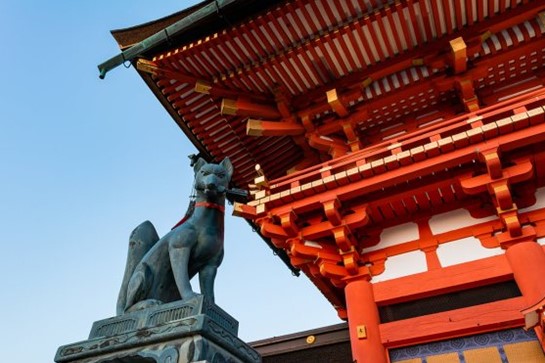 Entrance to Fushimi Inari Shrine
These wild foxes appear in most kitsuné stories, using their powers to cause mischief. The yako may play their tricks solely for amusement or to teach a bothersome human a lesson. One story features a carpenter who doubted the power of the kitsuné and was tricked into shaving his head. The kitsuné made him believe he had killed an innocent girl and he was going to become a Buddhist priest as penance for his supposed crime (Nozaki, 107). In another tale, a fox, disguised as an old lady, kidnapped a girl named Masu because she had blocked the entrance to the fox’s home. After a day or two, the fox let Masu go, recognizing that it was an accident (Nozaki, 147). One of the slightly more disturbing stories tells of a sozu, a Buddhist priest, who stayed in a luxurious mansion with a beautiful woman for seven years, or so he thought. They were discovered by another priest, and the mansion was revealed to be no more than an illusion. The lady and her staff disappeared, the house was reduced to straw and broken furniture, and the sozu woke to find human skulls all around him. He had been tricked by a kitsune and had only been held there for seven days (Nozaki, 164-166).
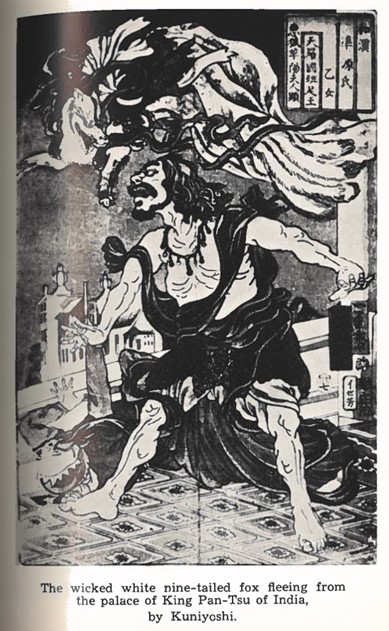
One of the most notorious kitsuné of legend was Tamamo-no-Mae, a white, nine-tailed fox who lived to be about 3,500 years old. Throughout the course of her life, she used her abilities to disguise herself as a beautiful woman, becoming the consort to kings in India and China (Tamamo no Mae). Everywhere she went, she brought ruin. She had a taste for cruelty and torture, and she charmed kings into doing terrible things for her until she was forced to flee or the kingdom was destroyed. Eventually, she made it to Japan and became the consort of Emperor Toba, and almost immediately, the emperor fell ill. The emperor’s astrologer discovered Tamamo-no-Mae’s secret, and she fled to the Nasu district (Kamishima). When the Emperor’s soldiers eventually caught up with her, Tamamo-no-Mae supposedly turned herself into a stone that killed everything that approached it (Nozaki, 113). It was called Sessho-Seki, The Killing Stone. You can still visit this stone in the Tochigi prefecture in Japan today, though you’re probably safe. The fox’s spirit has long since been put to rest (Kamishima).
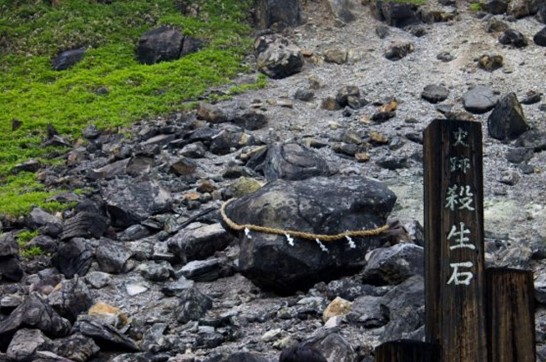 Sessho-Seki, “The Killing Stone,” Source: en.japantravel.com
Luckily, most kitsuné are nowhere near as frightening as Tamamo-no-Mae must have been. Though it’s true they are tricksters, kitsuné are also loyal and loving creatures, and they are known to repay humans for any kindness shown to them. There is one fairy tale in which an old man gave meat to an injured fox. To thank him, the parents of the fox gave the man a book that would allow him to understand the speech of any animal. The next morning, the old man used the book to listen in on two crows talking about a woman in the next province who was having difficulty in childbirth and a way to ease her pain. The man used this knowledge to help the young woman, and her father rewarded him handsomely (Nozaki, 101-104). In one account from an ancient book of records, four or five samurai staying at a temple frightened away a group of foxes who left behind what looked like a white stone but was actually a ball of fox fire. Over the next few nights, the bishop of the temple heard a voice asking for the fireball, which the samurai were refusing to return. Finally, the bishop forced them to surrender the fireball and gave it back to the foxes. Many years later, the bishop was on his death bed when his brother arrived with several relatives to see him. His brother said a messenger had come from the temple and informed him that the bishop would soon die, but no one at the temple had dispatched a messenger. The legend leads us to believe that the foxes repaid the bishop’s kindness by notifying his family of his illness and allowing him to see his family one last time (Nozaki, 183-185).
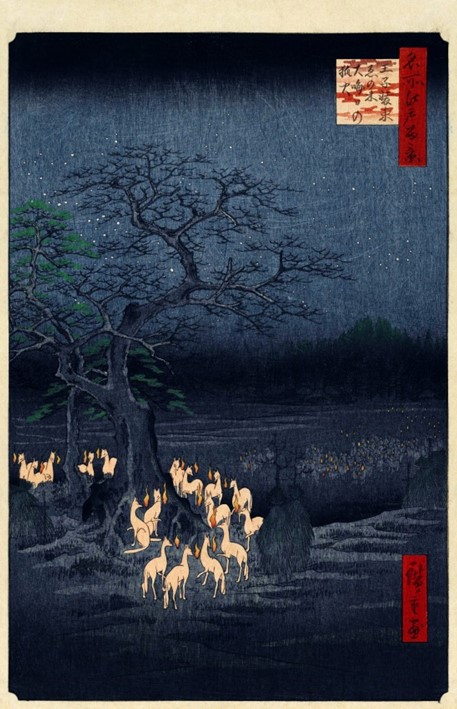 New Year’s Eve Foxfires at the Changing Tree, Oji. Woodblock print by Utagawa Hiroshige, c. 1857’’
The stories mentioned above are the ones that stood out most to me while I read Nozaki’s book. He uses these and many more legends from Japanese literature, plays, and fairy tales to show a multifaceted creature that is capable of good and evil and is well known and loved in Japan. Even today, there are many things in Japan named after kitsune, ranging from plants to an architectural feature (Nozaki, 228-233). In the town of Oji, there is a local legend about kitsune coming from all over the region on New Year’s Eve to gather at a special tree near Oji’s Inari shrine, lighting their way with fox fire. This legend inspired the Oji Fox Parade, held every year on December 31st. During the Oji Fox Parade, people gather at the Shozoku Inari shrine wearing fox masks and carrying lanterns. Just before midnight, they will begin a procession to the Oji Inari shrine. In addition to enjoying the costumes and lively atmosphere, many people use this time for hatsumode, the first visit to a shrine in the New Year (Takaramura).
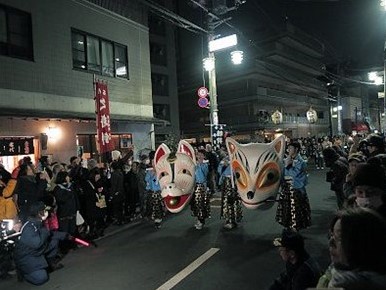 Oji Fox Parade, Source: visiting-japan.com
China and Korea have their own names for these many-tailed fox spirits: huli jing and gumiho, respectively. According to Nozaki, the idea of the kitsune was likely introduced from China and Korea, although the Japanese did put their own spin on the creature. There are some subtle differences between the three, but they are all nine-tailed foxes with the power to change shape and a tendency to cause mischief. These creatures also show up in modern games and fiction. The huli jing made a brief appearance in Shang-Chi and the Legend of the Ten Rings. Dragon Pearl, a novel by Yoon Ha Lee, features a young gumiho on an adventure across the galaxy. As for games, these little critters might look familiar to any Pokémon player:
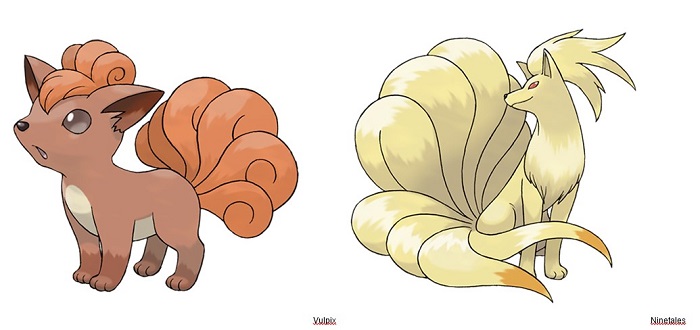
The adorable Vulpix has red fur and six tails and sprouts more as it grows. Eventually, Vulpix evolves into a white nine-tailed fox called Ninetales, which parallels the progression of a kitsune’s abilities and appearance as they age. They also both use an ability called Flash Fire. Anyone who’s seen MTV’s Teen Wolf might think of Kira Yukimura, the katana wielding kitsune who first appeared in Season 3, along with a nogitsune who caused havoc in Beacon Hills.
 Arden Cho as Kira Yukimura, still from Teen Wolf Season 3, Episode 13
I had a basic idea of what a kitsuné was when I first started Kitsuné: Japan’s Fox of Mystery, Romance, and Humor, but the stories Nozaki tells go so much deeper than my initial beliefs. These are detailed accounts of hilarious and occasionally frightening escapades of fascinating magical creatures and the people who lived alongside them. Kitsuné were loved and feared as helpful guardians or mischievous tricksters. From ancient texts to modern pop culture, these creatures have captured people’s imaginations for centuries and likely will continue to do so for years to come.
Sources:
“Fushimi Inari Shrine.” Kyoto Travel: Fushimi Inari Shrine (Fushimi Inari Taisha), d
Geller, Prof. “Kitsune – Intelligent Fox in Japanese Folklore.” Mythology.net, 18 June 2017, https://mythology.net/japanese/japanese-creatures/kitsune/.
Kamishima, Tomoko. “Nasu Sessho-Seki Rock – Nasu, Tochigi.” JapanTravel, 29 Sept. 2013, https://en.japantravel.com/tochigi/nasu-sessho-seki-rock/6797.
Nozaki, Kiyoshi. Kitsuné: Japan’s Fox of Mystery, Romance and Humor. Hokuseido Press, 1961.
Takaramura, Shinji. “Exploring Oji, the Town of the Sacred Foxes.” Matcha- Japan Travel Web Magazine, 13 May 2017, https://matcha-jp.com/en/3352.
“Tamamo No Mae.” Yokai.com, https://yokai.com/tamamonomae/.
Posted March 1, 2022
This article was first published in Drawing Covert. Republished with permission. Author Nicole Stutt is a Visitor Services Associate for the National Sporting Library and Museum in Middleburg, Virginia.