Book Review by Norman Fine
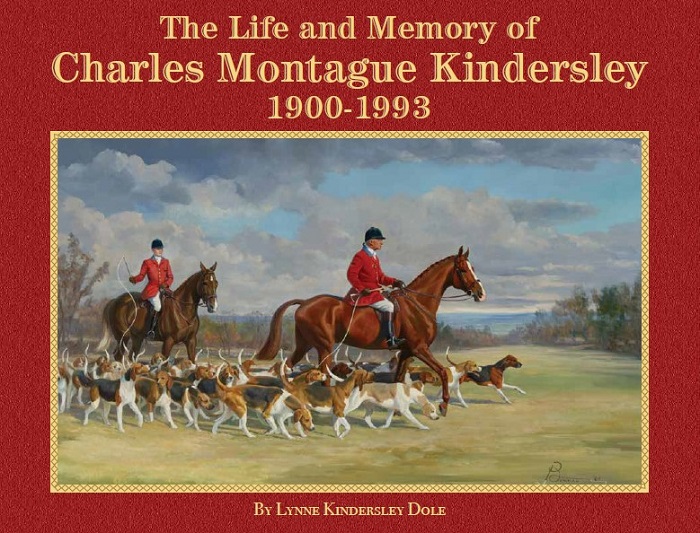 Major Charles Kindersley with hounds and son, Richard, whipping-in. Painting by Jean Bowman. This book is available in the U.S. for $30.00 (USD) and in Canada for $40.00 (Canadian). Shipping is included in the price. Please e-mail your order directly to the author and include your phone number. She will call you for your credit card information.
The Life and Memory of Charles Montague Kindersley by Lynne Kindersley Dole is a story of ingenuity and adventure that takes us well beyond Major Kindersley’s distinguished Mastership of which many readers are already familiar.
He was born in 1900 and lived through most of the twentieth century―until 1993. This story deserved to be written because he lived such a remarkable life. Likewise, it well-deserves to be read because it is authentically written by his daughter and is a riveting read.
He grew up in his native England and attended Harrow, as did his father. In 1920, he accepted his first paying job as a cowboy on a cattle ranch in the Canadian west. That led a few years later to his lifelong career in the oil industry, one of the most critical industries of the twentieth century. He learned the refinery business living in company compounds in South America over his next twenty years with his wife beside him.
Major Kindersley served in both World Wars, first with the Royal Air Forces in World War I and then with the Royal Canadian Engineers in World War II. He was seriously wounded by a Nazi shell in the latter conflict.
He was still recovering in a British hospital when the war ended in 1945. Four years later, Major Kindersley was Master and huntsman of the Eglinton Hunt (ON). He served as Master of the Eglinton for nineteen years. In 1968, the Eglinton merged with the Caledon Hunt (ON), and it was decided to employ professional huntsmen for the newly combined hunt. After the merger, the Eglinton Masters continued their leadership of the new Eglinton and Caledon Hunt. Major Kindersley remained as Master until 1991―forty-two years in all.
The Major was a renowned breeder and judge of foxhounds, popular at the hound shows, and a mentor to other competent men whom he groomed to become Joint-Masters in their own time. Throughout his life, he recreated himself according to what was required to complete each chapter successfully and leave it better than it was when he arrived. He earned his place as one of the most highly regarded Masters and houndsmen of his time and was inducted into the Huntsmen’s Room at the Musem of Hounds and Hunting in Leesburg, Virginia.
In the Foreword to Lynne’s book, Bill Bermingham, founder and longtime Master of the Hamilton Hunt (ON) and also revered for his knowledge of hounds, puts it this way:
Charles was a kind and witty man with a grand sense of humour, who took life as it came. There is an old hunting adage that one should never look back, just kick on. This is what Charles did all his life. When he was eighty, he bought himself a new saddle….
Lynne Kindersley Dole―writes:
He was born into a comfortable life with a family who valued Victorian principles of honour, gentleman’s word, high moral standards, respect for elders, and a life geared to country living. During his lifetime [through a century of incredible change] Charles managed to adjust to changes as they occurred while still maintaining the decorum of his upbringing.”
Early Life
Born in Dorset, England, young Charles was the third of six children. There was a family pony shared by all. He was only twelve when his mother died, but after a few years his father remarried. The new Mrs. Bermingham, called Madre by the children, came with a wonderful sense of humor and made the household complete and happy.
When World War I struck, Charles mentally added a year to his age and joined the Royal Flying Corps, later renamed the Royal Air Force. After training in aeronautics, bombing, and gunnery he earned his wings. Before he ever had to face the enemy in combat, peace was declared. He wasn’t that lucky in the next war.
Charles’s interest in hunting hounds flowered after returning home from service. The local veterinarian hunted a beagle pack which Charles enjoyed following. The vet soon became too busy to take his pack out, however. He handed his horn over to Charles, thus igniting a lifelong fascination with hunting hounds in the field, the vagaries of scent, and hound management and care.
Meanwhile, Charles needed a paying job after being mustered out of service. Jobs at that time in England were difficult to find, however, so Charles’s father suggested that both his sons’ prospects might thrive better in Canada.
Arrival in Canada, 1920
Charles’s mother had been Canadian. Charles’s father―Captain Charles Kindersley-Porcher of the Coldstream Guards―had met her when he was Aid-de-Camp to Lord Aberdeen, Governor-General of Canada. Charles, Sr. wrote ahead to friends in Canada, and Charles and his elder brother embarked westward to “prospect the future.”
One of his father’s friends had become a millionaire in the meatpacking business. He owned ranches in Alberta, running 38,000 cattle, 20,000 sheep, and 1,500 horses. He was also one of the three men who established the Calgary Stampede and later became a Senator. It was 1920, and Charles accepted a job at the Bow River Valley Ranch for $25 per month. He started by helping to unload two hundred cattle and driving them three miles to the stockyard. With his riding experience, Charles cared for horses, plowed with a three-horse team, and drove large herds of cattle. On evenings and Sundays, he joined the other ranch hands playing polo, golf, and tennis. And he attended dances and parties in Calgary. He enjoyed his life there but decided he would never make much of a living if he stayed.
He worked at open-pit coal mining, then heard of a job opening in British Columbia training polo ponies. A team was in the formative stages, and Charles was hired to train the ponies. The year the new Grand Prairie Polo Club won the Cup in Vancouver, Charles was on the move again.
On his way back to England for a visit, he arranged with one of his Canadian relatives to stop in Montreal for a job interview with the Imperial Oil Company. The interviewer admitted to Charles sometime later that he agreed to the interview only as a favor to a friend. During the interview, having learned from Charles all he had been doing out west, the interviewer became more interested in assessing him as a potential employee. The interviewer asked to look at Charles’s hands. The callouses convinced him of the hard work Charles had done and offered him a job as a trainee to be ultimately sent to the Colombia refinery of The Tropical Oil Company in South America, a subsidiary of Imperial Oil.
While in England, Charles attended a hunt ball at Stinsford House, the home of A. Henry Higginson. One of the founding fathers of organized foxhunting early in twentieth-century North America, the American-born Higginson, scion of an accomplished Boston family, was at the time Joint-Master of the Cattistock foxhounds in England.
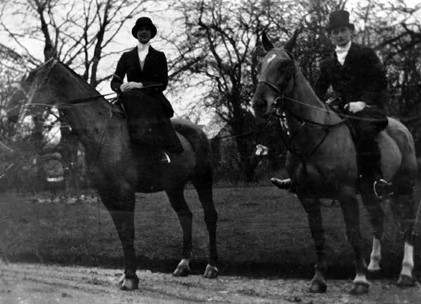 Chrissie and Charles hunting with the Cattistock
At the ball, Charles met, danced, and fell in love with Chrissie Crawford. With time running out on Charles’ commitment to return to Canada and begin a new career path, he used every available moment to be with Chriss―on the tennis courts, in the hunting field, and at dinner. On one lovely day as hounds were drawing a covert, Charles proposed marriage. Chriss’s parents, hoping for a proven match for their daughter, resorted to an old parental tactic―delay by travel. An extended visit was arranged for Chriss to travel to India, where her mother’s family owned a tea plantation.
South America, 1927−1938
In 1923, Charles returned to Montreal to begin his training program at the Imperial Oil Refinery. Upon completion, he moved on to the Tropical Oil Company in Columbia, South America.
In 1926, Chriss Crawford’s parents motored to Southampton to meet their daughter’s ship returning her from India. As the liner docked, they looked up to see Chriss waving from the upper deck. Next to her, also waving, they were astonished to see Charles Kindersley. Charles had returned to England on leave and had persuaded the pilot to allow him on board to meet the ship before it docked. Charles and Chriss had accounted for a great deal of letter mail over the prior three years.
Chriss’ parents were clearly beaten. They wanted the “Hunting Parson”―Reverend E.A. Milne, Joint-MFH with Higginson of the Cattistock―to officiate at the marriage of their daughter. Reverend Milne often hunted six days a week during that time of year. Upon hearing the request by Chriss’s parents―landowners and members of his field―he was heard to mutter his hopes for frost on the wedding day. There was a frost that day, and hunting was canceled!
The newlyweds were soon aboard a ship bound for New York. After the five-day trip, they boarded another ship for Cartagena, Columbia, and the mouth of the Cartagena River. After another week’s journey upriver by steamship to a small town in a deep valley between two ranges of the Andes Mountains, they disembarked at their new home in Columbia.
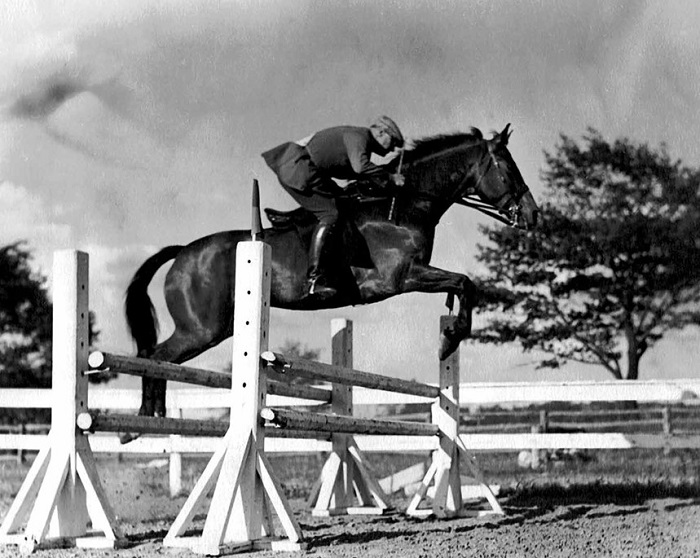 Charles had a natural seat on a horse.
For Chrissie especially, it was an entirely new way of life: afternoon siestas to escape the heat and humidity in what was known as the hottest city in Columbia. The houses were constructed wide open to the air…and to lizards, spiders, and mosquitos as well. On the plus side, there was a stable of saddle horses for staff. There was also a company train that would take the Kindersleys and friends to a beautiful glade where they could picnic and swim in a pool above the waterfall that kept the alligators at bay.
Charles often brought his ukulele upon which he could play the well-known tunes of the time. He also played the banjo or ukulele at the company clubhouse with other musicians in a band they formed. On other evenings elsewhere, if there was a piano, Charles could pick out the chords by ear. While Charles worked, Chriss taught school.
Charles’ next assignment was a refinery in Talara, Peru. After his two-month leave, during which their first child, Lynne, was born, Charles traveled to Talara and made preparations for the later arrival of Chriss and Lynne.
The International Petroleum Company in Talara, Peru, was a subsidiary of Standard Oil of New Jersey. Talara was on the westernmost part of northern Peru, a desert landscape on the Pacific coast. The company compound provided living quarters, a doctor, a school, a clubhouse, tennis courts, and a swimming pool. (Swimming in the ocean was out because of sharks.)
Though the author doesn’t speak of her father’s advancements in the Company, calling them transfers instead, Charles clearly exhibits ingenuity and creativity at all his postings. After arriving, it didn’t take Charles long to persuade his fellow workers to build a stable for saddle horses and learn to play polo.
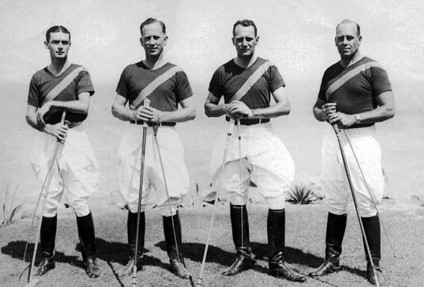 Talara polo. Charles is 3rd from left.
With Charles giving riding lessons one evening a week, the team members improved their game and their riding. Real polo ponies were imported from Chile and Argentina. It soon became possible, when ships of the Royal Navy docked at Talara, for Charles to invite naval crew members on ships with a polo team to play matches against the oil company team. These invitations were greatly appreciated as welcomed diversions in their cruises. One result was the gift of a ship’s bell formally presented to Charles by Commodore Harwood, captain of the destroyer H.M.S. Exeter docked at Talara at the time. The bell was a gift of the Royal Navy Polo Association, arranged by Lord Montbatten and was put to use to mark the chukkers.
Commodore Harwood, later Rear Admiral Sir Henry Harwood, is remembered in World War II history when H.M.S. Exeter, along with H.M.S. Achilles and H.M.S. Ajax, attacked the fast German battleship, Graf Spee, causing it to be scuttled.
About a year after Chriss’s arrival in Talara with Lynne, their son Richard was born. The parents very much wanted him to be christened on British “soil,” so on the occasion of the HMS York’s arrival and docking at Talara during a cruise, it was arranged that young Richard Kindersley was christened on board with the ship’s officers in their white uniforms and the crew lining the rails.
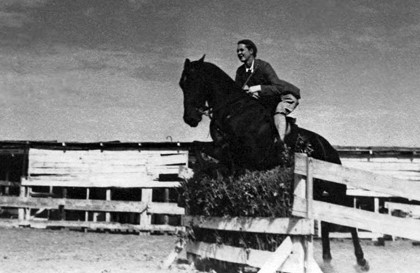 Chriss in the new ring
With polo ponies and horses available, it was natural for other riding activities to develop at the company compound, such as steeplechases, paper chases, and jumping events. All were taken advantage of by the Kindersley family. Lynne went on the long Sunday rides, and Richard, nearly four by the end of their stay in Talara, was paddling in the pool and happily sitting on the back of a polo pony.
If this isn’t the stuff of novels, I don’t know what is. I won’t divulge Charles’entire life story and adventures in this article, but I urge you to read the book while it is available. It spans a century of life in a fast-changing world: the company compound in Peru where a company train would take the Kindersleys and friends to a beautiful glade where they could picnic and swim in a pool above the waterfall that kept the alligators at bay; World War II during which Charles was severely wounded; six years of war while the Atlantic Ocean separated the author, then in her teens, and her young brother from both parents; finally, the family reunited in Canada but with Charles still hospitalized; Master and huntsman of the Eglinton Hunt; merging with the Caledon and moving to new hunting country; assisting Bill Bermingham, MFH, in establishing the Hamilton Hounds (ON); gaining recognition as a superb breeder and hound judge; and still hunting at age ninety as Master. A life well-lived.
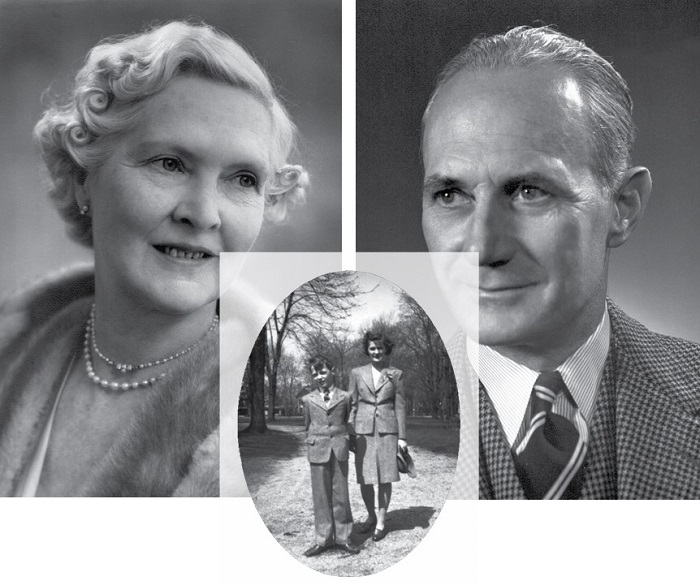 Family reunited after World War II: (l-r) Chriss, Richard, Lynne, Charles
Andy Bite, MFH, Toronto and North York Hunt (ON), adds:
Major Charles Kindersley was passionate about foxhunting. He was an outstanding hound breeder, hound judge, and a wonderful horseman. When I first started hunting with the Eglinton and Caledon Hunt some ten years after his passing, I would hear stories and anecdotes about ‘the Major.’ He was known as a true gentleman, always generous, with a great sense of humour.
His daughter, Lynne Kindersley Dole, has captured the essence of the man. She has eloquently described his life from his early years in Dorset, his time in the Royal Air Force, his arrival in Canada and his subsequent postings in Columbia and Peru, the World War II years, and the family reuniting in Canada after the war, where he and his family avidly pursued the sport of foxhunting. After two years hunting hounds for the Eglinton Hunt, he also became Master, a position he held for forty-three years. Many of those years he served as both Master and huntsman. He was instrumental in improving the conformation of hounds, and he founded the Canadian Annual English Foxhound Show.
After hearing small pieces of Major Kindersley’s foxhunting life, it was wonderful to read more about the man, his family, his numerous friends, and his many accomplishments. Truly beautiful writing with many photographs from the family archives makes this a memorable read for anyone, especially foxhunting enthusiasts.
This book is available in the U.S. for $30.00 (USD) and in Canada for $40.00 (Canadian). Shipping is included in the price. Please e-mail your order directly to the author and include your phone number; she will call you for your credit card information.
Posted January 15, 2022