
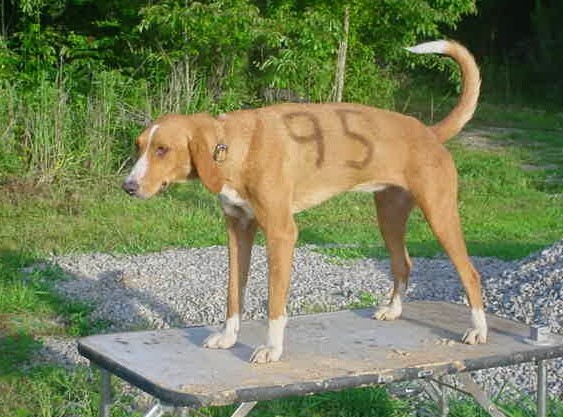
 A July foxhound used for field trials. Note the narrow white blaze, curved stern, and shorter ears than many strains of American foxhound, all characteristic of the July. This fox dog is prized for his hunting ability, not his conformation.
Bob Mitchell, retired editor, and publisher of the Cassville Democrat in Cassville, Missouri, has left his mark. He is a 2017 inductee to both the Missouri Press Association Hall of Fame and Missouri Southern State University’s Regional Media Hall of Fame. Though retired, Mitchel still keeps his hand in the game with stories about the good ol’ days. His piece in the December 15, 2021 issue caught my eye about the Houn’ Ditch Inn and the man who built and owned it, Gentry German―“famous for his Fox hunting dogs, of the July breed.”
In the years running up to the 1940s, the Houn’ Ditch Inn was the place for young adults to congregate and feed the jukebox facing the dance floor. There, Mitchell’s female cousins, “quite accomplished in the social activities,” did their best to teach him to dance but were “never completely successful.” There was always a “ballgame somewhere in town” where he decided he ought to be. Mitchell admits, however, that despite his dislike for the dance floor, “the Houn’ Ditch Inn remained paramount in Cassville throughout all Gentry German’s successes.
German was “a tobacco-chewing teller of tall tales regarding his sport,” wrote Mitchell. A clipping from another newspaper of the time published the following notice:
Gentry German reports the sale of six young July foxhounds during the past few days.
Three of them were shipped to Pampa, Texas, and the other three were bought by an Oklahoma party.
Mr. German has been raising dogs for a number of years and has been very successful with them. He has shipped dogs to many sections of the United States.
This was old-time American foxhunting practiced by rural families for sport and competition. Such foxhunters far outnumbered those who practice organized mounted foxhunting in the English manner as we do. Some rode farm horses, driving horses, saddle horses, and mules. Many hunted on foot. They hunted at night, sitting ‘round a fire, listening to hounds and rooting for their own dog to be in the lead. And they ran their hounds in field trials.
Much of this foxhunting sadly faltered and closed down for many of the same reasons that we encounter today. Mitchell writes, “Two things closed the German Kennels south of Cassville, Gentry’s age and the demise of Fox Hunting as more and more property changed hands, larger parcels being purchased by people desiring a small acreage. This meant barbed wire would be stretched on the boundary of their property, and more than likely, no trespassing signs posted. The inability to run their animals on a large stretch of land was the downfall of the sport.”
The closing of sport resulted in the demise of local and regional foxhunting associations, many of which had helped support other social service organizations in the communities through fund-raising shows and events.
The Cassville Rotary Club counted on the Barry County Fox Hunters Association hunt and bench show. One of the last such events was held at the Jim Fogg place. Fogg was a foxhunter in his day and was proud to host the association for this important community fundraiser.
The Rotary Club was later helped by the Coon Hunters’ Association hunts, which events, says publisher Mitchell, started him in service as a fry cook. But let’s get back to the July foxhound. It is an American strain of hound, developed mainly in Georgia, and found in virtually all Hardaway Crossbreds (Midland Fox Hounds). Hardaway Crossbreds with Midland bloodlines are prime ingredients in many Crossbred packs across North America today. They are valued ingredients in some British packs as well, treasured for their low-scenting capabilities on the dry days occasionally encountered there.
The following succinct history of the July foxhound by Marty Wood, MFH, Live Oak Hounds (FL), appeared in Foxhunting Life on June 2, 2011.
July was descended from the famous imports, Mountain and Muse, which were brought to Maryland from Ireland in 1814. Mountain and Muse provided pre-potent bloodlines for nearly every strain of American hound that we hunt today, including Penn-Marydel, Walker, Trigg, and others.
In Georgia, July was crossed with the Birdsong hounds and other well-bred Georgia hounds, producing a strain of American foxhound known as July.
Around 1900, the July was described as having short, pointy ears, a broad forehead, and a snipey nose. He had longish, curly hair with a flag to his stern (brushy tail). This description is characteristic of the pure July hound to this day.
It was said that July could outrun any red fox and kill it by himself. This was the chief characteristic of his forebears, Mountain and Muse, and why their bloodlines were prized by so many American hound breeders of the time.
Probably the biggest champion of the July hound is Ben Hardaway, MFH of the Midland Fox Hounds in Georgia. As he says in his autobiography, Never Outfoxed, he would still be hunting pure July hounds to this day if it had not been for the arrival of deer into his country. He crossed his beloved Julys with various other bloodlines over a number of years, searching for the best cross that would hunt aggressively like the July yet be steady on deer. [Hardaway finally found the out-cross he liked in the Fell hounds of the Border country between England and Scotland.]
All the Hardaway Crossbreds hunting today—across North America and abroad—have July bloodlines.
More detail may be found in Alexander Mackay-Smith’s definitive The American Foxhound: 1747–1967, published in 1968 by The American Foxhound Club. The book is long out of print but still highly prized by all serious breeders of American and Crossbred foxhounds.
Posted December 30, 2021