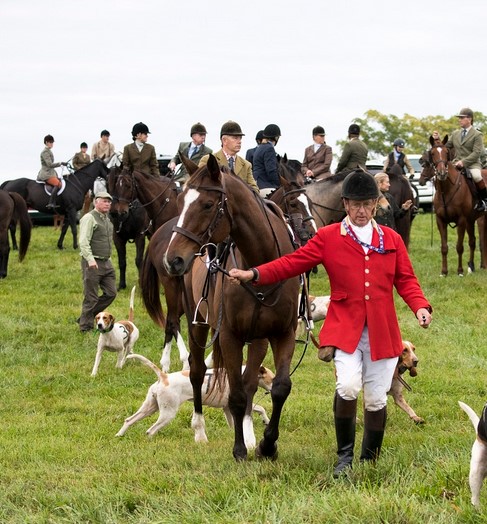
 The author takes competing hounds, mostly strangers to each other, to the first draw on foot. / Joanne Maisano photo
There is something magical about Rosie. Two of my all-time favorite people and one of my all-time favorite hounds are named Rosie.
Being asked to carry the horn for the Bull Run/Blue Ridge Foxhound Performance Trial this fall in Virginia was a thrilling honor. Spencer Allen, huntsman for the Long Run Woodford Hounds (KY) had originally been invited to serve as trial huntsman but had to withdraw when his knee was injured. His horse fell while hunting.
Personal Checklist
- Horses fit and ready. Not just ready―coyote ready.
- General knowledge of the two hunt territories―adequate.
Bull Run Hunt
I had hunted The Preserve fixture and adjoining lands many times in recent years. Amazing, beautiful, large country. Mixture of row crops, cattle fields, and forests with thickets. Well-paneled, good trail system, easy to get around. We always had good sport there on both fox and coyote.
Blue Ridge Hunt
Judith and I had hunted the Shannon Hill fixture just last February. It had all the good things that the Bull Run territory had―plus the incredibly beautiful Shenandoah River. So wide the quarry almost never crosses it. The river is a barrier that helps keep the quarry in the country.
The deck was stacked for good sport in fine country. Expectations were high. Note to self: don’t screw this up!
These are two of the most beautiful and most hunt-able territories in America. I was so excited about hunting them that I lost sleep every night for the month leading up to it. Not worried. Just excited. Excited to carry the horn. And excited to get to see so many of my good hunting friends in one place on one weekend. Good-Fun-With-Good-Hunting-Friends: one of the best things about performance trials!
Most critical for the trial huntsman is to have the pack of hounds from all the competing hunts accept him or her as their huntsman. We learned early in the development of the performance trial format― 1996 and 1997―that hounds should be mixed together prior to the hunt. Imagine ten hunts, each bringing ten hounds, and all dropping their tailgates at the same moment before moving off. Then imagine some huntsman they never met, blowing his horn and expecting hounds to follow him and perform for him. Finally, imagine overly-excited whippers-in trying to push hounds, each outnumbered ninety-to-one by strange hounds, on to the guest huntsman. It was a perfect recipe for mass confusion.
We learned the necessity of mixing all hounds together in an enclosure―a pen or large trailer―up to an hour before moving off. This was huntsman Charles Montgomery’s suggestion, and it works like a dream. The hounds get all the shoulder bumping, growling, and butt-sniffing out of the way. The guest huntsman spends most of that time in the enclosure with them―talking to them, loving on them, trying to connect the invisible thread.
The Bull Run /Blue Ridge Performance Trial was typical. Most of these hounds had never hunted together before. They didn’t know what the heck was going on. Even hounds who have participated in a joint meet haven’t experienced anything like this. At a joint meet, each pack brings about half the hounds for that day. So each hound knows about half the pack. That is a comfort to them. At a performance trial, each hunt’s group of hounds is vastly outnumbered. Some of the best hounds at home simply don’t perform well in this very different setting. Others seem to perform better than at home. It’s often a roll of the dice on which hounds to bring.
The first morning at Bull Run, some hounds went into the trailer just fine. Many of the others were horrified, entering screaming and kicking, locking their paws on each side of the door frame, every muscle tense, twisting and squirming, trying not to allow themselves to be shoved into the trailer.
Imagine me trying to get all these hounds to settle―with each other and with me. Most of them start out by avoiding eye contact altogether. So it took a real effort to get even part of them to begin to accept me.
Hounds know who loves them. I had that advantage. After a few minutes of loving on them and talking to them, some of them acknowledged me. They could tell that I am a dog man at heart. The more I went through the group petting them and loving on them, the more comfortable they got with me. Then Tim Michel gave me some biscuits. More and more hounds decided I was acceptable and worthy of a chance.
Hunting at 9:00 am. By 8:45, about one-third of the hounds would look me in the eye. Pretty good. I knew they would be fine. But, I wanted to give them every opportunity to start out right. I had an idea to do something quite different from usual. Andrew Barclay, MFHA Director of Hunting, was standing just outside the trailer. He was one of the judges.
“Andrew, I need your advice. Do you think it would be OK to walk them to the first covert on foot? My gut is telling me to do it that way. It will be much less confusing to them.” Andrew said he thought it would be fine. So that is what we did. Well, almost.
After standing on foot with them while the usual welcome and announcements were made, I trotted with them on foot to the first covert. Hounds always seem to like it when I am on foot. This day was no exception. They may not have been sure about me, but when I trotted to the first covert, they knew it was time to hunt.
Over the first hour and a half, hounds drew pretty well. But they were uncertain about the hounds they didn’t know. They were still sizing each other up. They were still sizing me up, too. When we found that good red fox at the subdivision―overlooking the Robinson River―with its wonderful thickets and high cliffs, it was game on.
People always ask me how such a diverse pack works together. That part is easy. Quality recognizes quality. After a few minutes of running this fox, this group of hounds from eight different hunts was running this fox like they had hunted together for years. An hour later we had had all the sport we wanted, as well as plenty of scores. We had the added benefit of a quarry running by the field and the hilltoppers several times. That helps everyone enjoy the day more, and brings them into the action.
We actually went in early―another benefit. These hounds understood each other now. They knew what the game was. They knew it was fun and something they wanted to do again. This was the perfect preparation for the second day. We mixed them in the trailer again, with almost no resistance. When the trailer door opened they came out like a seasoned happy pack ready to hunt together and hunt for me. It was magical.
Huntsman’s Choice
This is usually a tough call with so many high-quality hounds. I don’t always notice individual hounds. I have to think about it and focus on it. This is all the more true during performance trials, as judges are flying by my horse racing to get the scores. My horse doesn’t understand that part. When he is in a good hand gallop, he has a big afterburner and he wants to use it. So part of the time, I am simply trying not to die. And I dang sure can’t see what every hound is doing. Even after thirty-five seasons carrying the horn, it takes an extra effort. Watching for those snapshots of the brilliance of certain hounds is a challenge for me.
Even so, the hound with the numeral, “1,” painted on her―Rosie, as I later learned― caught my eye again and again. The first time was when she looked me in the eye in the hound trailer on the first morning. It wasn’t because I was throwing biscuits. I did not have any biscuits at that point. It was like looking across a crowded room and making eye contact with an old friend. She looked me in the eye and smiled. She didn’t turn away. She held the eye contact as if to say, “OK Chief, if you are the huntsman of the day, I will hunt for you. Let’s go.”
Over that day and the next, I noticed her several times. Always in the right place and doing the right thing. I never saw her lead. I never thought she was scoring remarkably. I just liked her. The first-day scores had her well above average, but not leading in any category. I even asked my good friend, Jeb Blount, to help me watch for a hound who deserved to be Huntsman’s Choice. Jeb was judging as well. He is the genius behind the new computerized scoring system―the one that gets us the results so much faster than ever before. Now it takes longer to get the scores from the individual judges than it does to input them into the computer.
Huntsman’s Choice is a big deal, very important. I didn’t want to get it wrong. I kept going back to the definition. Huntsman’s Choice is for the hound that I, as guest huntsman, would most like to take home. After two days of outstanding hunting by this brilliant pack, the choice became fixed.
Middleburg Rose 2015, an American bit*ch of Keswick Hunt (VA) breeding and a veteran in her seventh year of hunting was the one for me. She was, far and away, the hound I would most like to take home.
I had no idea that she had scored so well the second day of hunting and ended up being the top-scoring hound that day and the Overall Performance Trial Grand Champion. I just knew that I loved her.
The Other Two Rosies
Rosemary Merle-Smith, former MFH at Tennessee Valley and Rosie Campbell, MFH, Bull Run. If you know them, you know what keen foxhunters they are, in addition to being good, fine, fun people. I recommend that you arrange to hunt with all three of these wonderful Rosies! Then you will understand exactly what I am talking about.
Posted December 15, 2021
The author is Master and huntsman of the Belle Meade Hunt (GA).