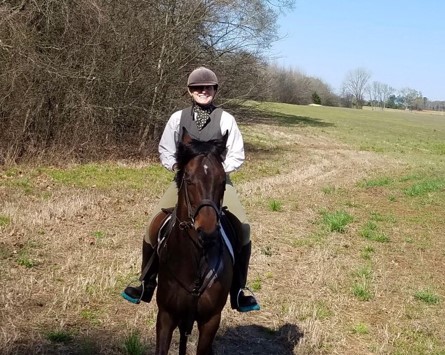
 The author rides Merry on the family farm. / Cary McWhorter photo
Every year, fields, woods, copses, and little dells are turned into McMansions, strip malls, and highways. Occasionally, even some truly lovely or necessary structures are built. But the countryside is still gone in the process.
For hunters, this means that land available for shooting, riding, or chasing becomes increasingly rare and precious. Inevitably, there is competition for the wildlands that remain. This competition can be limiting for one group or another. But what if it were possible to share that land? Could different groups work it out to use the land, not perhaps simultaneously but at least during the same season? Wouldn’t that be better for everyone? Can it be done?
One shooting sport that is increasing in popularity is deer hunting. What Charles Ruth of the South Carolina Department of Natural Resources calls “still hunting.” As opposed to stalking or hunting deer with dogs, still hunting means sitting in a stand or other predetermined spot, waiting for deer to come by. It is a sport embraced by countrymen and city-dweller alike and across all social groups―much like foxhunting. You don’t need a lot of land to go deer hunting, though it helps. Considering the large numbers of hunters taking up the sport, a lot of land is being used for deer hunting.
Foxhunters do need a lot of territory and sometimes the two overlap. So, can these two groups use the same land? A good case can be made for, absolutely! With communication and proper timing, deer hunters and foxhunters can be good neighbors and even benefit each other.
There is actual science to back that claim up. Charles Ruth, Certified Wildlife Biologist and Deer and Wild Turkey Program Coordinator at the South Caroline Department of Natural Resources, is keenly interested in this very question. When I asked him about deer hunting and foxhunting on the same land, he quoted from research done by the South Carolina Department of Natural Resources at Clemson University. The study was sparked by deer hunter’s fears that hunting with hounds would negatively impact their deer population.
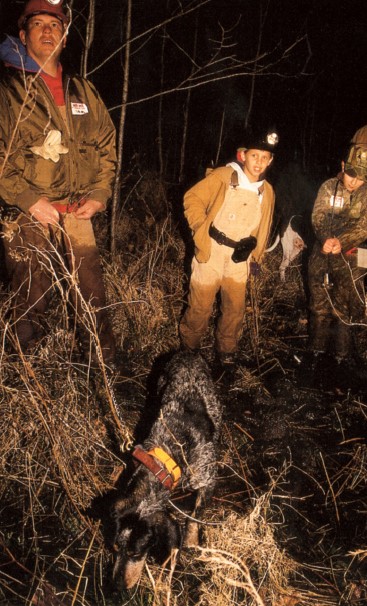 Coon hunters with hounds, participate in the South Carolina Department of Resources study.
The study was conducted at the North Whitener Tract, a vast 7,769-acre property with a deer hunting club, which allowed raccoon hunting only when deer season had ended. The property was known to have a high density of both deer and raccoons. As part of his Master of Science degree Jim Weshold set out to see if the ideas some deer hunters held about hounds causing deer to move out of territory was true or not.
First, he divided the North Whitener Tract into 2 areas: one for a control area, the other to be hunted by coon hounds. Deer were captured and radio-collared, then released. This made it possible to determine the range for each deer before any raccoon hunting began. Raccoon hunts were held weekly between December and February for two seasons. In other words, enough coon hunts to get a good base of information. Only one side of the property was hunted at a time so a comparison could be made with the side that wasn’t being hunted. Trail cameras were also used to mark where deer traveled before, during, and after the hunts. This DNR pamphlet describing the study and the results makes for fascinating reading.
The upshot, as quoted from the pamphlet, is “No statistically significant changes in these deer’s movements were measured. The radio-collared deer continued to move at the same times of day and for the same distance each day despite raccoon hunting activity the evening before.” Mr. Ruth was not surprised by the study; that was also his observation, but it was nice to have it backed up by science.
Master and huntsman Jay Athon, Full Cry Hounds (AL), is a deer hunter as well. Athon agrees completely with the findings. Far from believing hunting with hounds is bad for deer hunting, he thinks it’s beneficial.
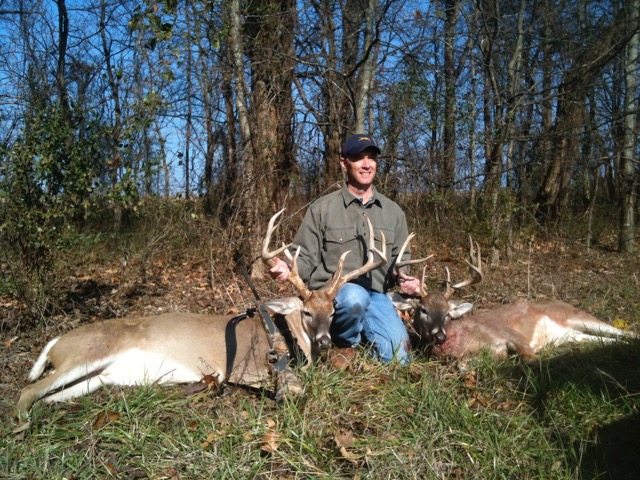 Huntsman Jay Athon, MFH, Full Cry Hounds, shot these bucks in the country where he was hunting hounds that morning. / Martha Chardavoyne Athon photo
According to Athon, hounds get through a lot of thick brush and make deer move―just not out of the country. So if deer are lying up for the day and hounds go through and get them moving around, isn’t that good for the deer hunter? He has excellent proof of this in a photograph with not one but two nice bucks, taken within minutes of one another, on a day when hounds had been hunting in the area that morning.
As Master, Athon says communication with everyone is key. The oft-heard motto, “It’s easier to ask forgiveness than permission,” is a lot of rot. Most problems can be avoided by being a good and consistent communicator with all the hunters in the area. Full Cry Hounds usually go out at 10:00 am. According to Athon, that gives all the deer hunters time to hunt and then go to the local greasy spoon for breakfast. He’s usually finished in around four hours, giving the afternoon hunters plenty of time to spot those deer the hounds have gotten up and moving.
Athon has hunted deer successfully in areas shared by deer hunters, rabbit hunters, quail hunters, and foxhunters. And, according to Athon, all hunters had excellent sport.
One of the best deer hunting/foxhunting stories came from the gregarious Lynn Lloyd in Nevada’s High Sierra. On one hunt with her foxhounds, Lloyd noticed she was being shadowed by four pickup trucks on the ridge above where she was hunting. The trucks moved forward when she did and stopped when she stopped.
Finally, Lloyd decided to see what was up. She gathered hounds and trotted up the ridge to the trucks. As she came up, six guys in camo began to feed her hounds their sandwiches. When Lloyd asked if she was impeding their sport, they replied, No! They were waiting for her hounds to go through the heavy brush and get some deer up.
Lloyd told them she was about to move on. Where did they suggest she go next? They told her, and a working friendship ensued that finished the day at a local bar. In other words, far from being upset at the presence of hounds, these deer hunters were using them to make their hunting day more productive. And Lloyd made six new friends.
Of course, one of the keys here is to have well deer-broken hounds. No self-respecting huntsmen tolerate deer-running foxhounds in their pack.
As hunting country shrinks, it behooves hunters of many stripes to share territory. While it does require some effort, sharing is not difficult for deer hunters and foxhunters. According to scientific research, hounds hunting other quarry do not drive deer away from their territory. And both sets of hunters may well find a new sport of interest and make new friends in the bargain.
Posted November 24, 2021
Andrea Simpson lives in Courtland, Alabama, in her great-grandparents’ house with her husband, four dogs, the old retired horse, and the new horse. She hunts with Mooreland Hunt and Full Cry Hounds. Full Cry hunts across her family’s farm.