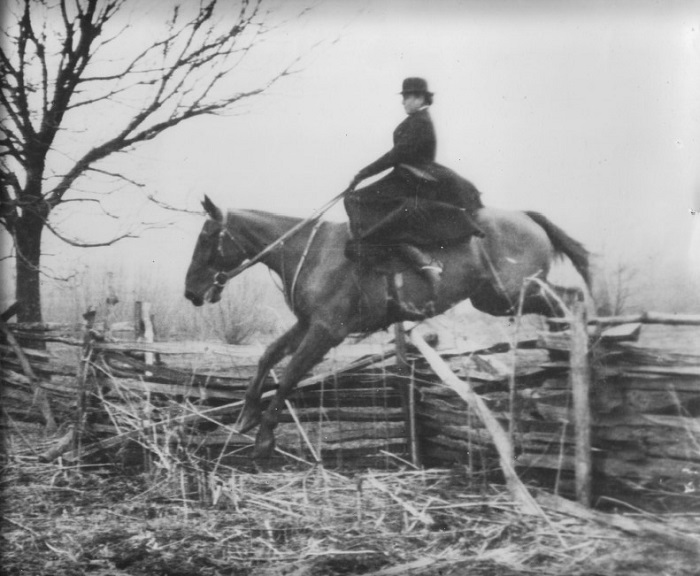
 Carrie Randolph Joslin hunting with Keswick, circa 1905
The Keswick Hunt Club (VA) is celebrating its 125th anniversary. Responsible for the hunt’s longevity are its kind landowners, hard-working professionals and volunteers, and generous special angels.
Foxhunting was a feature of Keswick area life since colonial days. According to sporting historians and family tradition, Dr. Thomas Walker (1715-1794) kenneled four couple of English Foxhounds at his home, Castle Hill.
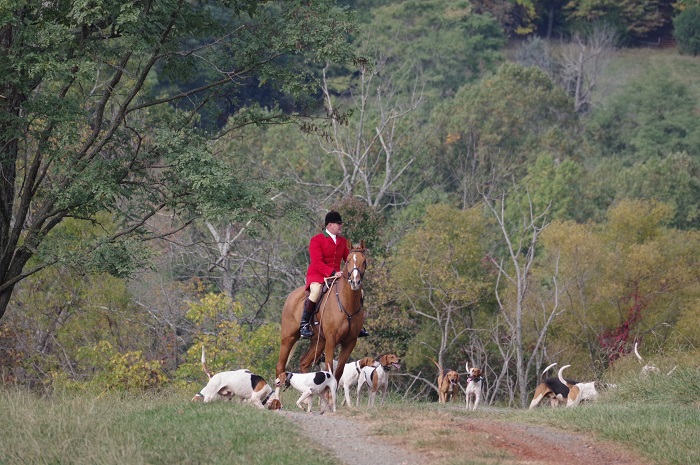 Huntsman Paul Wilson and hounds draw the country on Opening Meet, 2021. / Warner Granade photo
On the evening of December 10, 1896, nineteen foxhunting enthusiasts gathered at Cloverfields, the Keswick area home of Frank Randolph. At the meeting, which lasted until 2:00 a.m. the following morning, the parties organized the Keswick Hunt Club and elected Cary Ruffin Randolph to be Master of Foxhounds and John Armstrong Chanler to serve as president. Chanler was an eccentric philanthropist who patrolled Keswick roads, mounted and armed. His purpose was to enforce Virginia Code Section 2139 requiring automobile drivers to give horse traffic the right of way. Halting traffic for hounds and horses nowadays requires greater discretion.
Drafts from local farmer packs constituted the first Keswick Hunt Club pack. Dues were $12.00 a year for gentlemen and $2.00 a year for ladies. Some early members contributed hound puppies instead of dues. The puppy breeders then claimed that raising the puppies cost so much that the club owed them money. Hunt club treasurers must contend with all varieties of expectations.
A. Henry Higginson and Julian Ingersoll Chamberlain, in their 1908 Hunts of the US and Canada, declare the Keswick pack then used for Saturday drag hunting and Thursday foxhunting to be of inferior quality compared to Keswick hunt horses. The latter included show champions belonging to Julian Morris, MFH. Higginson and Chamberlain suggest that more attention be paid to the canine “arm of the service.”
Little or no wire spoiled the country during the club’s early years. Jumps were high split rail fences enclosing pastures. Automobile traffic was minimal. Keswick members did not realize how lucky they were. Beginning in the late 1920s, encroachment of wire fencing necessitated construction of dedicated hunt jumps.
Despite bouts of scarcity, inactivity, and political turbulence, Keswick Hunt Club has maintained good sport and good times. Hunting in the 1950s and 60s with Roberts Coles, MFH, was always lively and fun. Following Coles was the successful Mastership of Jake Carle, who served from 1964 to 2000. Carle expanded Keswick’s territory into Orange, Louisa, and Madison Counties. He used mostly Bywaters American bloodlines in Keswick’s foxhound pack, which lines remain in the kennel today.
Keswick recently completed massive renovation and reconstruction of facilities. The clubhouse, built in 1898, was in danger of collapsing under the next heavy snowfall. The building has been re-engineered, brought up to present day code and needs, while retaining its distinctive character. The kennels have been modernized, made more comfortable for hounds, and more easily maintained. A new staff horse barn, with huntsman’s cottage above, has replaced a structure the walls of which were caving in.
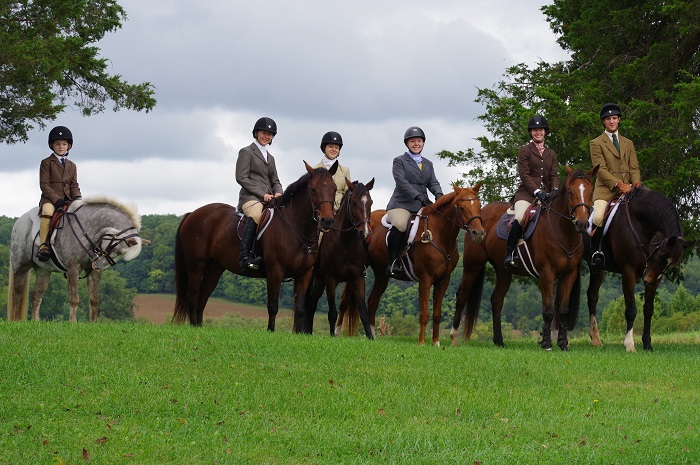 These young Keswick riders qualified for the Junior North American Field Hunter Championship finals this year. (L-R) Shep Turner, Selah Bowman, Mia Valdez., Carryn Mullins, Kaileen Wentz, and Giacomo Wilson. / Warner Granade photo
Present Masters―Will Coleman, Nancy Wiley, and Mary Kalergis―have instituted frequent junior meets, which have drawn many enthusiastic participants. Fresh young faces in the hunting field and at the clubhouse offer a promising start to Keswick Hunt Club’s next 125 years.
Posted November 3, 2021
Barclay Rives, a longtime Keswick honorary whipper-in, has assisted numerous Keswick huntsmen over the years and is a popular writer on the subject of foxhunting and sporting history.