Middleburg Brings a Lovable Veteran; Blue Ridge Shows Depth
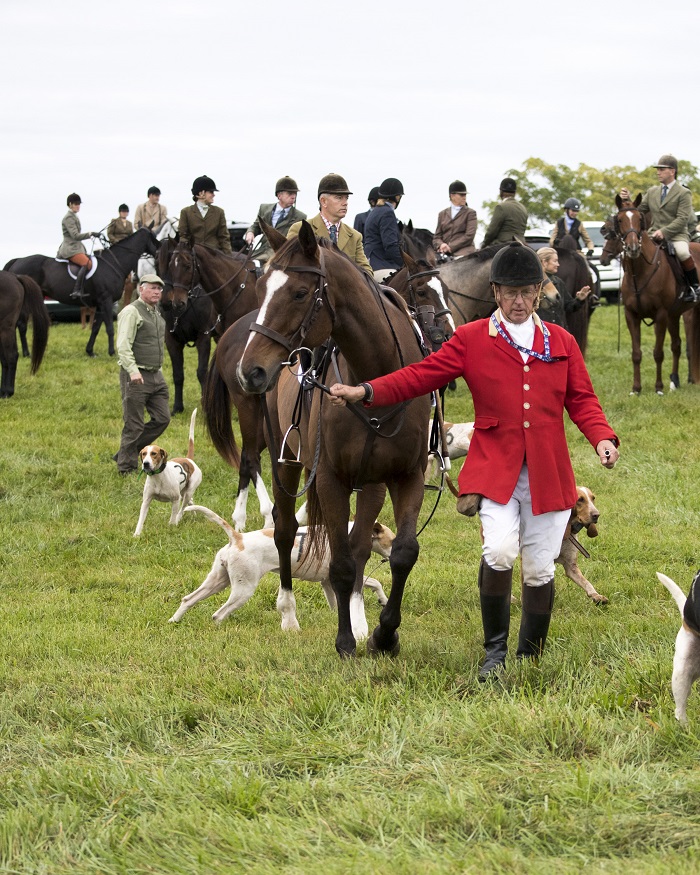 Trial Huntsman Epp Wilson, MFH, Belle Meade, leading hounds, is ready to mount up and move off for the second day of the Bull Run/Blue Ridge Performance Trials. Directly behind is his guide through the country, Blue Ridge huntsman Graham Buston. Judge Grosvenor Merle-Smith, ex-MFH, is on foot. The faces visible behind Grosvenor are (l-r) Lindsay LeHew, her father, Jeff LeHew, MFH, Blue Ridge, Anne McIntosh, MFH, Blue Ridge, and whipper-in Ross Salter. / Joanne Maisano photo
The fourth Foxhound Performance Trial of the 2021/2022 season was hosted jointly by the Bull Run Hunt and the Blue Ridge Hunt in Virginia. Hounds hunted on Saturday, October 23, 2021, in the Bull Run hunting country of open farmland, fields, and woods, followed by dinner and first-day awards. On Sunday, October 24, hounds hunted in the Blue Ridge country by the western banks of the Shenandoah River through open flood plains, over scarcely negotiable cliffs above the river, through woods, and across open farmland.
Hounds from eight hunts competed: Blue Ridge Hunt, Bull Run Hunt, Deep Run Hunt (VA), Farmington Hunt (VA), Marlborough Hunt (MD), Middleburg Hunt (VA), Rappahannock Hunt (VA), and Thornton Hill Hounds (VA).
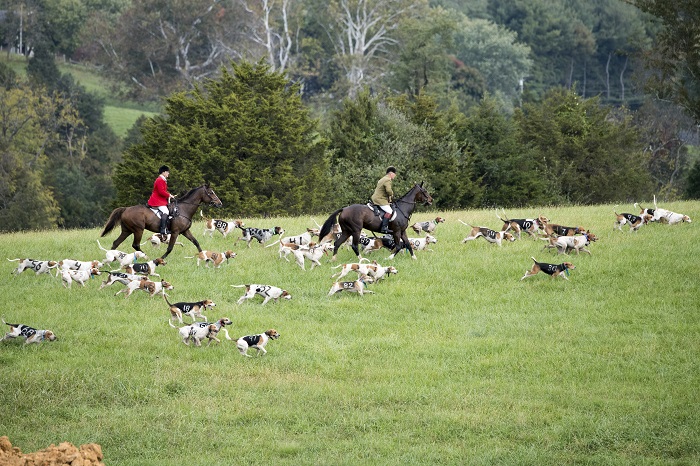 (L-R) Trial Huntsman Epp Wilson and guide Graham Buston with hounds. The two top-scoring hounds of the trial —Middleburg Rose (#1) and Blue Ridge Newtown (#8)—are seen in the middle of the pack.. / Joanne Maisano photo
Hunting was good both days, with plenty of hard running for the combined pack of nearly thirty couple. Following by car on day-one at Bull Run, Middleburg Master Penny Denegre had a grand view of the hunted fox crossing the road with all hounds on.
“He was a handsome, deep red fox. He’d been running in big circles, and the hound music was phenominal,” she said.
Some light rain fell overnight between hunts and Sunday at Blue Ridge started with moisture on the ground and overcast skies that presented excellent scenting conditions early on. Hounds found in the first hour and ran a quite large coyote that was viewed numerous times by the entire field.
The coyote stuck to his territory as had Saturday’s fox, repeatedly running big circles over and around the cliffs above the river, refusing to leave. Hounds hunted fast and hard for an hour-and-a-half, giving the judges ample Full Cry scoring opportunities―often difficult to get compared to the many Hunting and Trailing scores. The coyote finally bumped off a helpful fox in a cornfield, got it up on its legs, and while the confused hounds were busy sorting out the lines, both coyote and fox disappeared. More Hunting and Trailing scoring opportunities for the judges, however!
But here’s where hound fitness comes into play in the scoring. After an hour-and-a-half of running, hounds, riders, horses, and (presumably) the coyote were cooked. The temperature was rising, and the early cloud cover was burning off, revealing what soon turned out to be a bluebird day by lunchtime, three hours after the first draw. But the fittest hounds were still busy and trying. And receiving scored.
Trial huntsman Epp Wilson, MFH, Belle Meade Hunt (GA), collected hounds, brought them to water, then crossed the road into the Chatfield-Taylors’ Thoroughbred farm. He drew the flat flood plains northward along the Shenandoah, but temperatures were climbing. The three-hour mark was approaching, and with plenty of scores already recorded by the judges, Wilson collected hounds again and drew his way back through the vonGontards’ farmland and back to the meet at Blue Ridge MFH Jeff LeHew’s Shannon Hill.
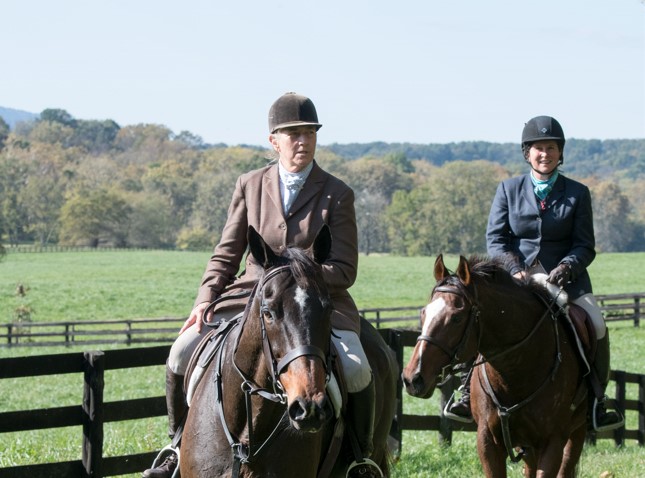 Anne McIntosh, MFH, Blue Ridge, guides judge Cameron Sadler, MFH, Moore County through the country. / Joanne Maisano photo
Judges for the trial were Fred Berry, MFH, Sedgefield Hunt (NC) and 2021/2022 Hound Trial Chairman; Jeb Blount, Belle Meade, designer of the superbly improved scoring software program; Sean Cully, MFH, Rose Tree-Blue Mountain Hunt (PA) (Saturday); Brady Cully, Rose Tree-Blue Mountain (Aprentice Judge on Sunday); Jean Derrick, Belle Meade Field Master; Joel Merle-Smith, Keswick (Sunday); Chris Moll, honorary whipper-in, Sedgefield; Cameron Sadler, MFH, Moore County; and Epp Wilson. Judging from trucks were Grosvenor Merle-Smith, ex-MFH and Andrew Barclay, MFHA.
Liquid refreshment and a lunch of southern fried chicken with all the trimmings were waiting for the field and followers. During those festivities, judges’ scores were fed to the computer, tallied for the second day’s hunting, and combined with the first day’s scores to determine and finally announce overall results and present awards.
The Winning Hunts
After two days of hunting, the top four scoring hunts were, from first to fourth: Blue Ridge, Bull Run, Deep Run, and Middleburg. The winning hunt, Blue Ridge, had five of their six hounds finish among the Overall Top-Ten scoring hounds. Two Bull Run hounds finished in the top-ten, and one each from Middleburg, Deep Run, and Thornton Hill finished among the top-ten scoring hounds.
All hounds that finish a Performance Trial among the Overall Top-Ten scoring hounds automatically qualify for entry in the final championship trial in North Carolina at season’s end.
Blue Ridge didn’t have a number-one winning hound in any of the individual scoring categories―Hunting, Trailing, or Full Cry―but their hounds were second, or third, or fourth in every scoring category. Their number of well-scoring hounds across the board demonstrated the depth and strength of the pack and produced the top score of all participating hunts.
The one category that Blue Ridge did win was Endurance, a testament to professional huntsman Graham Buston and staff for the pack’s fitness. Endurance points are automatically added to each hound’s score by the scoring software program. These Endurance points automatically increase in small increments as the day’s hunting progresses, hour by hour and day by day. For example, if any two hounds are scored early on the first day by a judge for Trailing, they each receive the same number of points and are equal in standing. But if one of the two receives another Trailing score later in the day, he receives an Enduance score as well―a bonus for being fit and still working for his huntsman. Thus, the clever software rewards the hunts that best prepare their hounds to hunt―and keep on hunting―hour after hour and day after day.
Of the five Blue Ridge hounds finishing in the top-ten, Blue Ridge Newtown 2020, a second-year Crossbred dog hound finished second only to Middleburg Rose 2015, the Overall top-scoring foxhound of the Trials. Back to Rose in a moment.
Newtown is out of a strong Ullswater (UK) line of English fell hounds that Deep Run huntsman John Harrison brought to America. Harrison had been a longtime huntsman to the famed Ullswater foot pack, hunting the intimidating hill country in England’s Lake District. When Harrison moved back to America, he brought an Ullswater bit*ch from that line with him, puppies of which he kindly drafted to fellow huntsmen who wanted to add proven fell bloodlines to their own packs. Blue Ridge huntsman Buston was one of those happy recipients!
The Winning Hound
About fifty hounds competed for judges’ scores at the Bull Run/Blue Ridge Performance Trials. After two days of hunting, the Overall Top-Scoring foxhound was Middleburg Rose 2015, an American bit*ch and a veteran in her seventh year of hunting.
Rose is by Middleburg Newton 2011 out of Middleburg Rumour 2011. Both sire and dam, though entered by Middleburg, are of established Keswik American bloodlines ultimately going back to old Greenville County breeding.
“She’s a terrific hound,” said Penny Denegre, MFH, Middleburg Hunt. “What struck me from the start about her was how she focussed all her energy on hunting. Hunting was her life, and she knew hunting was her life.
“She’s not a big hound, and she always got through the country easily. She’s a good marking hound. Her littermate, Robbie, was a remarkable marker as well.”
Denegre gives former huntsman, Barry Magner, credit for having bred Rose. Her sire and dam, being of Keswick breeding, prompted Keswick huntsman Tony Gammell to suggest that Barry use the pair in a mating. Barry did his homework researching the pedigrees and made the match.
“He liked Tony and trusted his advice,” said Denegre.
“Rose really blossomed under [current huntsman] Richard [Roberts],” she said. “She and her litter bonded with him so well, and he’d been afraid they might not bond like that with another huntsman.”
Rose’s first litter of eleven pups is entering with the Middleburg pack this season. The youngsters are entering well, and Masters and staff have great hopes for Rose’s offspring!
Huntsman’s Choice
After the final day of hunting, one of the duties of the Trial Huntsman is to announce at the awards ceremonies the hound that he or she would most like to take home to their own kennels―a Huntsman’s Choice.
Early on Saturday morning, perhaps thirty minutes before the first day of hunting began, Trial Huntsman Epp Wilson entered the trailer onto which the competing hounds from each pack were being hustled by their respective huntsmen. Wilson planned to spend a half-hour or so with the hounds to try to settle them. With only his personality and a pocketful of biscuits, he wanted to connect with hounds, ease their confusion, and calm their fears from suddenly being thrown in with a bunch of strangers. This short exercise, established years ago by huntsman Charles Montgomery, definitely improves that first day of hunting, which was often somewhat chaotic.
“None of the hounds knew me,” Wilson explained. “They scrambled into the trailer, glanced at me, wondered ‘Who the heck is that?’ and went about their business checking out the other hounds, also strangers. Then one hound came in with a big smile and looked directed at me. She came right over and said hello.”
That was the beginning of a beautiful friendship. Epp knew her as Hound #1, but her name was Middleburg Rose. As he watched hounds working over his two days as huntsman, he saw Rose was always there, diligently doing her part in the work of the pack and contributing effectively in every aspect of the hunting. How could Epp choose any other hound but Rose as Huntsman’s Choice?
Posted October 29, 2021
*For any reader wondering about the author’s use of “bi*ch” to designate the female hound, know that we have no sensitivity to the word, but we have discovered that some computer firewalls will decide the content is porn and will block the entire e-magazine from loading. We use the asterisk to foil any such mistaken interpretations.