
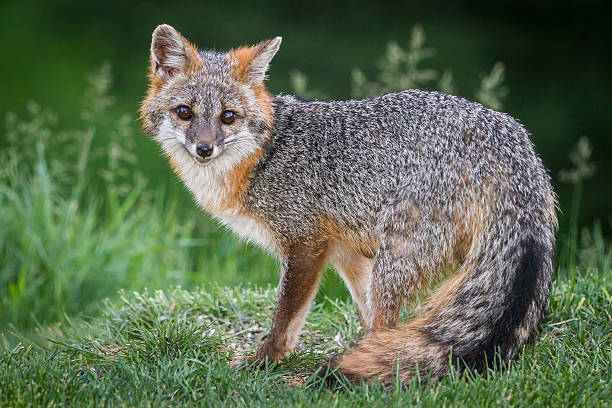
Blane Klemek, a wildlife manager with the Minnesota Department of Natural Resources, describes gray foxes as cat-like and rarely seen. Cat-like in that it is the only canid that can climb trees with ease. Which it does to escape predators or pursue its own prey.
The gray fox is often confused as being a red fox. It can have red in its coat on its ears, neck, and along its sides and belly. However, the rest of the coat is grayish―salt-and-pepper―especially from head to tail. Unlike the red fox, the top of the tail shows a black streak along its entire length all the way to a black tip at the end. Like the red fox, it often has a white breast and underside, but it has a shorter muzzle, shorter legs, and is smaller than the red fox.
Of all the wild canids across North America―gray fox, red fox, coyote, and wolf―the gray fox may be the least observed and least understood. But they are unique and interesting.
Other canids may occasionally be seen scrambling up a tree to low branches, but no canid except the gray fox can easily scale, cat-like, a smooth-barked tree free of branches such as the aspen or birch. The gray fox has been seen sleeping on branches and even in old raptor nests. They have been noted raising litters of cubs in a hollow tree twelve or more feet off the ground.
The gray fox’s diet consists of mice, voles, chipmunks, squirrels, rabbits, and hare, like the red fox. Being smaller than the red fox, however, they rely even more on keen eyesight, super-sensitive noses, hearing, and speed afoot. They are highly intelligent, skilled, and capable. They also prey on birds, bird eggs, frogs, snakes, insects, and some insect larvae. Also, like their red cousins, they eat berries of all kinds, nuts, and seeds. Being the smallest of the canids, they must also be wary of the larger predators like bobcats, coyotes, and wolves.
Gray fox pups are born in the spring from March to early May. By August the youngsters are accompanying the parents on hunting expeditions and learning how to fend for themselves. They learn their home territory but eventually seek mates and establish their own territory. Again similar to the red fox, except, as we foxhunters have seen, the smaller and more vulnerable gray fox finds territories less suited to the red fox, such as swampy and thicker coverts. As the red fox, smaller than the coyote, finds territories less attractive to the coyote in which to establish its own range.
The Latin name for the gray fox is Urocyon cinereoargenteus. The first part, the genus name, combines two Greek word that refer to its bristly, dog-like tail. The second part, the species name, translates roughly to ashy-silvered, a good description of the gray fox’s coat.
I always enjoyed the chance to hunt the gray fox because, with its smaller range, one often sees more of the hunt and the hound work. Also, the gray fox throws in more twists, jinks, and double-backs than the red fox, once again allowing the field to observe more hound work and often resulting in a real hound hunt.
Posted September 22, 2021