
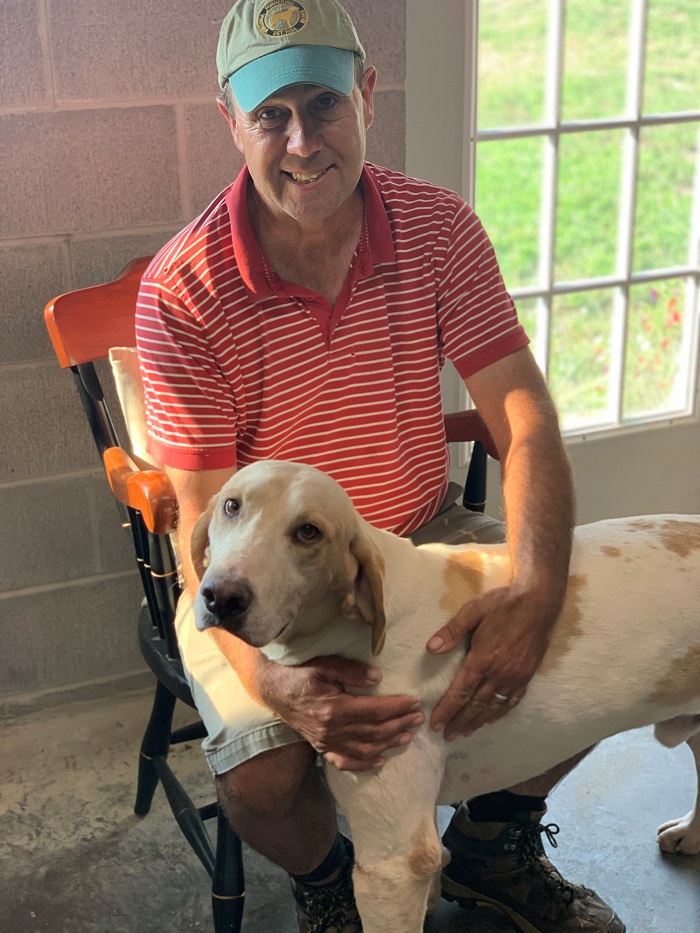
 Camargo huntsman Andy Bozdan and a healthy Fargo.
With permission, here’s a recent FaceBook post by Andy Bozdan, the London-born huntsman at the Camargo Hunt (OH). The post generated excited congratulatory praise from foxhunters all over, and justly so. This is a man with a big heart for animals. Let’s just say, “a big heart…period.”
I contacted Andy, wanting to write about his experience in Foxhunting Life, and Andy agreed by saying, “If it could be helpful, then yes.” After adding that what he did was based on training he’d had for humans, Andy suggested, “I think it would be good to get a knowledgeable vet to give the actual procedural advice.” Right you are, Andy, so here’s both.
Andy Bozdan’s Original Post:
Poop happens! A day in the life of a huntsman!
So down to kennels I go this morning. All good. Get kennels done, hounds fed, and out on the horses. All goes well. Beautiful Kentucky morning with hounds and wifey. What more could a man want?
Get back to kennels and get them all sorted and back in their lodges. So far, the day is going remarkably well. Let puppies out onto the grass yard and start washing their lodge down. I hear a commotion! In the first lodge, and it sounds at first like Ransom, one of this year’s new entries, playing with the water bucket he has taken to doing when we got back from exercise! But this noise is different. Strange noises need swift action!
So I run over to the lodge, and there is Fargo hanging from the water bucket with its head stuck between the handle and the wall!
You would have to be a contortionist or very unlucky to be able to get in the position he was!
So I get in and manage to get him free of the bucket, but he’s not really breathing and trying to cough up water! So into full CPR and recovery mode we go! I manage to help him push some of the water out by massaging the rib area, and then he goes quiet on me! Nothing for it but mouth to mouth!! Yuk! Much as I love hounds, their breath can stink! Still, no time for fresh mints!
Thankfully after a minute he splutters more water out and coughs pretty well, and his flanks start moving again! We may have just done enough! He came round slowly but could not stop twitching!
Of course, all this happened in a lodge of about fifteen other hounds who were less than helpful at the critical moments! He is now walking around as if nothing happened, and I’ve popped him in one of our isolation lodges so he can fully recover without fuss from anyone else.
And now for breakfast! Let’s hope that’s not as dramatic!
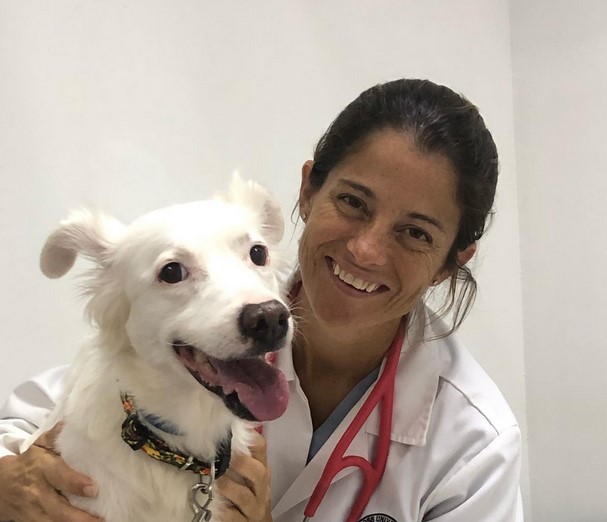 Delia Large, who hunted with the Live Oak Hounds (FL) throughout her childhood, cares for a patient.
Delia Large, DVM Candidate 2022, longtime Clinical Vet Tech, Foxhunter
We all love that Andy saved his hound! Now for tips on how to resuscitate canines. We need to keep the humanity and fun of his story, and at the same time, we need to make sure we watch for certain things following an episode.
First: CPR on a dog is really about the compressions. You do need to make sure the airway is clear so they can breathe. But the focus is on doing rhythmic compressions.
I like to use the Bee Jees’ song, “Stayin’ Alive.” It’s the same beat. You want to be doing 120 beats per minute, so two beats per second.
“Ah, ha, ha, ha, stayin’ alive, stayin’ alive.”
You can hear it and keep time with that one pretty well.
Depending on the size―pup versus adult―is how you choose what kind of compressions. First, the dog should be laterally recumbent―lying on its side―rather than supine like humans. Assuming I’m on my knees on the ground or a kennel floor, and because I’m small, I would want to be over the animal, elbow locked, to get enough vertical weight into my compressions. (The bigger guy may be able to just kneeling beside it.)
With a pup or small dog, again try to clear the airway however you can. Even a few upside-down shakes, holding it by the hind legs. Medically speaking, try to shake the gunk out. (Some vets no longer do this, but some swear by it.) Then, put your mouth around the whole snout to seal the mouth and nose, or just hold the mouth closed and blow through the nose as you would with the larger animal.
Again, however, it’s the compressions that will do the trick. The movement and massaging are most likely what truly helped this hound. Being stressed at the moment, I’m sure Andy was tough with those movements, which is probably what actually saved the hound.
Next, one needs to be concerned about aspiration pneumonia. The hound needs antibiotics immediately. I would assume water got into its lungs, and probably in the process of resuscitation, the hound would have inhaled more fluids and possibly bacteria. Aspiration pneumonia is your big enemy here.
(To Andy’s credit, he did consult the vet after the event and reports, “Fargo was put on a course of antibiotics for a week after to prevent pneumonia or any other infection problems.”)
Your vet can also describe the proper techniques for resuscitation and may give you other tricks besides keeping the beat. You generally check to see that the hound is breathing every 4-minutes. Usually, a person switches out compressions every 2-minutes with another person. Statistics show that people can’t keep pace and be good at compressions past 2-minutes. Of course, that statistic relates to ordinary people, not kennel staff!
Posted August 23, 2021