
Book Review by Caroline Treviranus Leake
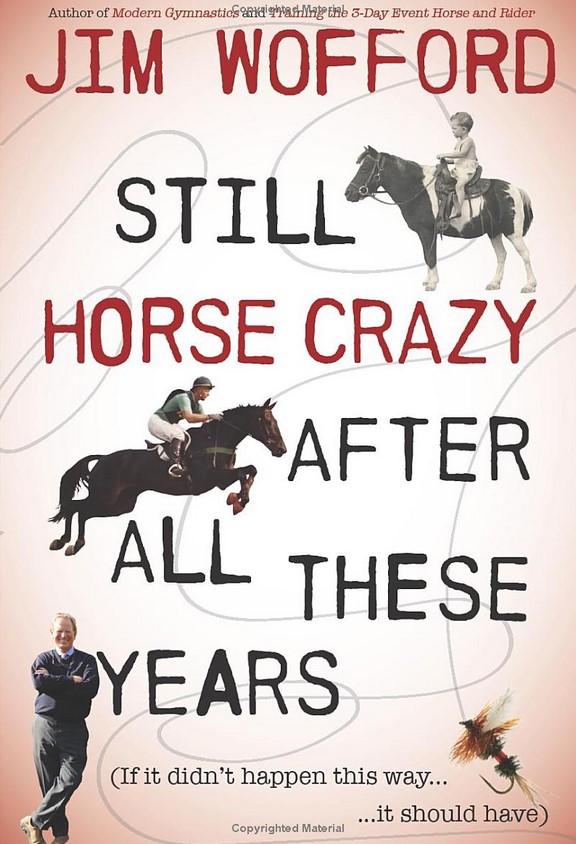 Still Horse Crazy After All These Years, James Wofford, Trafalgar Square Books, North Pomfret, Vermont, 2021, $27.95
James Wofford was born in 1944 in Kansas. His father was stationed at Fort Riley, longtime home to the U.S. Cavalry. Early on, at the age of three, Jim received ‘riding lessons’ from his older sister and brothers, including jumping little fences on his 12-hand Shetland pony, Merrylegs. He would grab the horn of his Western saddle and ‘hang on.’ His siblings led the pony over the fences after which they allowed Jim to jump on his own.
As a result of that early and sophisticated training regimen (or despite it), during Jim’s competitive career, he earned team silver medals in two Olympic Games, an individual and a team bronze at two World Championships, and team gold at the Pan American Games. He also won five US National Championships (each on a different horse) and two Rolex Kentucky Three-Day Events on two different horses.
During an illustrious coaching career, he had at least one student on every US Olympic, World Championship, or Pan American team. He raced steeplechase horses and foxhunted his great Olympic horse Kilkenny in Virginia. His wife Gail was Joint-Master at the Piedmont Fox Hounds in the 1990s.
During Jim’s younger years, the family lived beside Fort Riley and the U.S. Cavalry School. Jim’s father, Colonel John “Gyp” Wofford, rode in the 1932 Olympics. Colonel Wofford was the first President of The United States Equestrian Team in 1951, and he coached both the Olympic Eventing and Show Jumping Teams in 1952. These were the first Olympic Games at which civilians were permitted to participate in Eventing alongside cavalry members, and nineteen-year-old Jeb Wofford, Jim’s brother, won a bronze medal. In 1956, Jim’s other brother, Warren, qualified for both the showjumping and the eventing teams in Olympic competition, the only American equestrian ever to do so.
As Jim matured, he observed, processed, and stored for future reference both the good and ‘the not so good’ practices of veterinarians, riding instructors, and equestrian politics. Loaded with personality, Jim recognized that each horse comes with its unique personality and that training regimens must take those differences into account.
He has schooled hundreds of horses and competed many. He has successfully trained a variety of horses of different types, and they learned to work with him.
In his book, we can read about some of his training methods but more importantly, we can read about his personality with his horses, and his ability to adjust his training methods to the unique personality of each horse and give what they need to succeed.
The year 1958 was a milestone in Jim’s life. He was fourteen years old, showing open jumpers for his brothers in Colorado Springs. He entered the ring on one of the horses and as he was making his preliminary circle he heard a woman’s voice proclaim at ringside, “Get that child off that horse or he’ll be killed!” Her prophesy remained unfulfilled, and the fourteen-year-old survived to meet a lovely Colorado native named Gail, his future wife.
Jim decided to attend the Culver Military Academy so he could ride with the Black Horse Troop. Following Culver, he went to the University of Colorado and graduated from the School of Business.
While at Colorado, Jim found an eventing trainer near Denver, in those early days probably the only eventing trainer in Colorado. Bill Bilwin had been a Polish cavalry officer when Germany invaded Poland in 1939. Jim helped Bill to build the Cross-Country Course outside Denver and assisted him in the stables. The time he was spending under Bilwin’s wing was not helping his grades, however. In one semester, Jim sunk from the Dean’s List to Academic Probation. With Gail’s help, he improved his grades, but he continued to drive each afternoon to ride for Bill and coursework continually suffered.
Jim writes about the “Founding Fathers of Eventing,” include Stewart Treviranus, my father, and Alexander Mackay-Smith, my step-father! Also in the small group are Jack Fritz and Phil Hoffman. Jim tells of the time when Rick Eckhart and he went to walk a course in Warrenton, Virginia, before competing. My father handed them red and white paper plates, a hammer, nails, and pens to write fence numbers. He asked them if they could flag and number the fences as they walked the course! Such was the informality of eventing and paucity of volunteers in those days.
Everyone comes across a spooky horse now and then. Veterinary surgeon R.H. Smythe (The Mind of the Horse) recommends that if a horse spooks at something, de-sensitize it rather than punish it. Punishing only confirms there is something of which to be afraid. As well, horses generally focus where their noses are pointing. Galloping towards a cross-country jump, the horse has to see the obstacle. As Jim writes, “lightbulb!” He has learned to bring his horses to the jumps “on contact” rather than “on the bit.”
Jim seemed always ready to recognize sound advice when he heard it. After not riding well during a cross-country schooling clinic, General John Cole, who rode with Jim’s father in the 1932 Olympics, took Jim aside. “Boy,” said the general, “get your head out of your backside. Your horse knows his job. Get out of his way and let him do it.” At the time, Jim was riding his future Olympic horse, Kilkenny. Jim took the general’s advice, and Kilkenny responded by jumped beautifully, in stride and landing well. Mike Plumb was also riding during this clinic, and Jim recognized Mike’s attitude and intensity. As Jim writes, nothing was ever quite good enough for Mike, and Jim followed his work ethic.
Jim has been a strong friend to family, friends, and fellow competitors. Everyone smiles when they see Jim, whether in town, on course, or at a meeting. His big smile and red hair are unmistakable. Jim exposes his personality through his writing and allows the reader to understand the feelings he has developed and expressed. The horse is Jim’s friend, and whether instructor, rider, or coach, he treats the horse with respect. He writes of many of his experiences in many countries, and one can relate to his enthusiasm and drive as he continues to climb the hills of success. He has been named by The Chronicle of the Horse as “One of the Most Influential Horsemen of The 20th Century” and is a Hall of Fame inductee. From a small Kansas primary school, to The Cavalry School, to International competition and coaching, Jim writes of his many experiences, horses, hunting, social life, and his supportive family. After reading Still Horse Crazy, I feel I know Jim even more now and better realize why he wears that big, warm smile.
Posted June 13, 2021
Caroline Treviranus Leake is a former three-day event rider and member of the United States Equestrian Team.