Learning to Handle Hounds in the Field
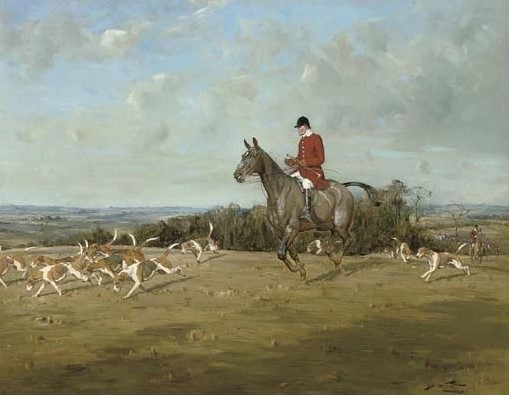 Frank Freeman: 21 years as huntsman to the Pytchley / Painting by George Wright (British)
What follows is an excerpt from The History of Foxhunting by Patrick Chalmers. Therein, the following text is quoted from Lord Chaplin’s introduction to Lord Henry Bentinck’s Foxhounds and Their Handling in the Field.
I was rather late one morning in arriving at a gorse covert in the Belvoir Country…into which the hounds had just been put to draw. I…saw at once it wasn’t the huntsman who was in the covert with the hounds, and I was told it was the first whip, Freeman, who had never hunted them before, the huntsman being disabled by a fall the previous day. So I went into the covert to see if I could help him.
“You are handling the hounds, I understand,” I said, “for the first time today?”
“Ah, yes, Squire,” he said, “and I can do nothing with them.”
“Well,” I said, “I’ve been at it all my life, and perhaps I could tell you one or two things which might be useful.”
“I should be most grateful if you would,” he said.
He had been blowing his horn whenever the fox crossed a ride, with the same note that ought only to be used when he has gone away, or he has caught him.
So I replied, “Put your horn into its case to begin with, and don’t blow it again like you have been doing, or till your fox has gone away, or until you want to draw your hounds out of covert, which you should do with one or two long-drawn notes; or till you have caught your fox and got him lying dead before you. Then you may blow the notes you’ve been using as long as you like. That is one thing.”
“The next thing is this: when you’ve gone away with your fox, and come to a check, don’t go to help your hounds till they ask you, and the way you will know they are asking you is this, and these hounds (who at that time were constantly interfered with) will ask you immediately because they are accustomed to it.”
“You will see them standing with their heads up, wagging their tails, and doing nothing to feel for the scent or to help themselves. When you see that, go straight into the middle of the pack, turn your horse, say ‘cop-cop’ or anything you like, trot off, and they will go with you like a flock of sheep.”
“Trot gently up to wherever you think your fox is most like to have gone, and if you are lucky enough to hit off his line, they will go all the easier with you the next time.”
“Now,” I said, “that is enough for today, and I shall stay out to see how you get on.”
I stayed out till quite late in the evening. It was in the Spring. He was fortunate enough to hit off his fox the first time, and before the evening the hounds had taken to him completely, and he could do anything he liked with them.
He was so nice and modest-minded a fellow that he came half a mile out of his way to meet me on his way home, and when we met he said, “I couldn’t go home, Squire, without thanking you for what you told me this morning. The ambition of my life is to be a huntsman. I am most anxious to learn, and you are the first person, gentleman or huntsman, who has ever told me a single thing.”
Freeman’s future and the fame of it are, of course, common property. And, as Lord Chaplin writes, “it is easier to find a good Prime Minister than a good huntsman.”
Posted May 20, 2021