A Conversation with the Author, Grosvenor Merle-Smith
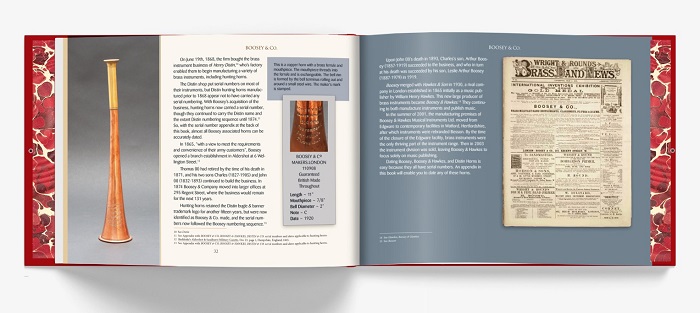
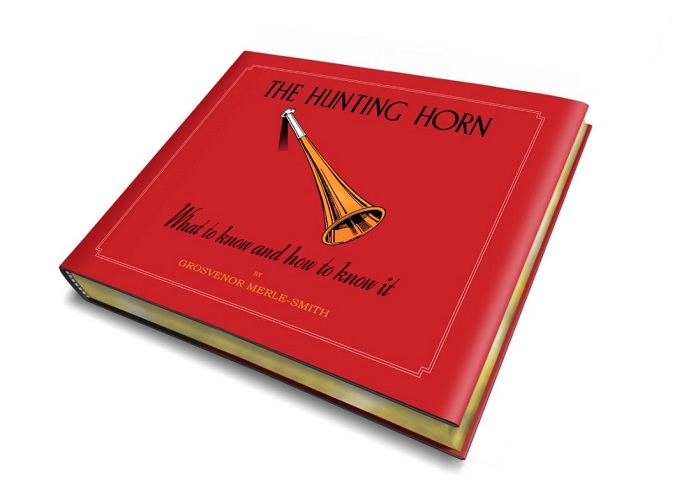 The Hunting Horn: What to Know and How to Know It, Grosvenor Merle-Smith, introduction by Tony Leahy, former president, MFHA, Dementi Milestone Publishing, 2021, hardcover, landscape, color, 8.5 x 11 inches, 288 pages, ISBN 978-1-7360885-5-5, $75.00. Order from the website, or contact via email.
Grosvenor Merle-Smith’s new book is a labor of love. Between its covers, you’ll find everything you ever wanted to know―even things you never knew you wanted to know―about hunting horns.
Your editor knows of no resource that compares to this meticulously researched, artistically designed, and lavishly produced book. The book’s title and cover design were heavily influenced, with the author’s tongue in his cheek, by an old pamphlet written by L.C. Cameron for Köhler and Sons, The Hunting Horn: What to Blow and How to Blow It. That pamphlet was the subject of a recent Foxhunting Life article. For any foxhunting library, these two publications―Merle-Smith’s and Cameron’s―constitute the sum and substance of just about all that’s known concerning the hunting horn, its history, materials, manufacture, sources, and music used in hunting the fox with hounds.
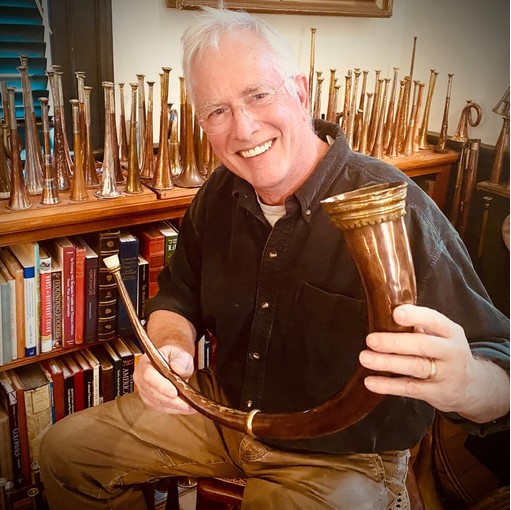 Grosvenor Merle-Smith and a few hunting horns
A former Master and huntsman of the Bull Run Hunt (VA) and the Tennessee Valley Hunt (TN), Grosvenor has studied, researched, and collected all manner of hunting horns used primarily from the early nineteenth century forward. He and your editor talked.
FHL – What made you wake up one morning and decide to collect and publish everything known about hunting horns?
GMS – I had a couple of horns that I hunted hounds with. Then a friend, Eddie Coles, gave me an old horn that had belonged to Grover Vandevender, who had been the Farmington Hunt Club Huntsman for thirty-two seasons. Eddie explained how it was an unusual horn with a threaded exchangeable mouthpiece, manufactured by a company extremely interesting to horn collectors. This intrigued me. It was a horn made by Boosey. I was really only aware of Köhler hunting horns and had never thought of hunting horns as “collectible.”
Conversations with other huntsmen seemed to indicate that there was next to nothing known about our horns, and so I started to collect information on the various branded horns around me.
That was about thirty years ago. It has been a long road since, and along the way somehow a “collection” and a book did eventually evolve.
FHL – What boundaries did you set for the book project? (i.e., all horns used for hunting with hounds? Starting when? Valved horns, too? No coaching horns, right?)
GMS – I didn’t think in terms of parameters. I was only interested in the type of horn I used in my job, and so this was the focal point. In the book, I do give an overview of the various horns used historically for hunting, but really only to place the small English hunting horn into context. The timeline for the book starts with the initial use of this style of horn around 1800, through to the present day.
Initially, I was only aware of a few makes of these horns and wanted to find out about the companies that supplied them. The problem was that time and time again I discovered a new company and so the project kind of took on a life of its own. A few companies grew into a study eventually of over eighty.
FHL – How did you organize your research? Was there information you were looking for, but couldn’t find?
GMS – I suppose the simple answer is alphabetically. Really! Then within a company history, chronologically. However, there’s a great spiderweb of company relationships within the book that I’ve tried to acknowledge yet keep clear.
There are horns I’ve yet to find, but that I’m sure exist, from companies that advertised hunting horns. There are individuals and connections that I’m sure existed, but as of yet I’ve been unable to prove. More documents are available every day on-line, and so new discoveries will be there for the digging.
FHL – Who, specifically, did you write your book for? The obvious people to me will be huntsmen, huntsmen hopefuls, ambitious staff members, some field members, sporting museums and libraries, and collectors. Who, else?
GMS – First and foremost this is a reference book whereby one can look up a hunting horn by its mark, date it, and learn about the company that marked it. So, in this regard, the book will primarily be of interest to a group such as you cite.
I found that quite a few of the companies I was researching had lost their records and their histories through extensive bombing during WWII. In recent years so much searchable primary information such as newspapers, church, and census records, has become available through new computer programs and the Internet, that I’ve been able to recreate historical timelines for some of these companies for the first time in many years. So much seemingly lost information was gathered using primary sources that an official record of my research was important for some of the actual companies involved.
But the book will have even a wider appeal than that. I discovered that digging into these company histories provided me with an interesting perspective providing historical context for the last 200 years of foxhunting. In the process of researching this book, I came upon horns that had been owned by many of the great hunting men associated with the sport and so by including many of these horns as examples in the book along with some of their backstories, I hope to create more of an awareness of the sport’s history.
I’ve further embellished the book with historical tidbits related to specific horns that will be of interest to any followers of the sport. So yes, I’d like to think it should be of interest to all foxhunters.
FHL – Tell us how to order.
GMS – Order from the website, or contact the publisher via email.
Posted March 4, 2021