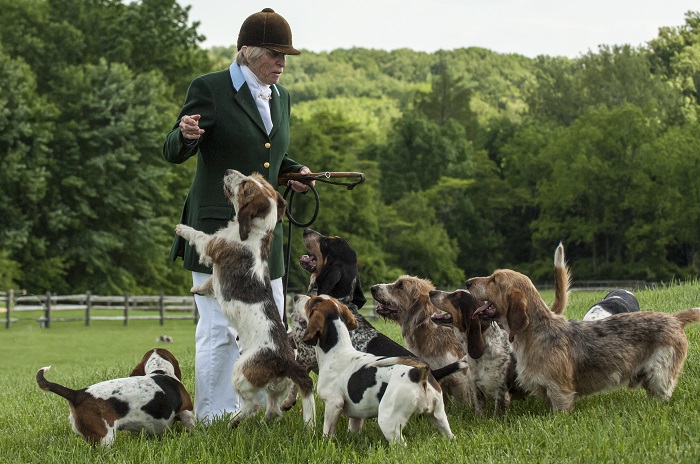
 Jeep Cochran and her Calf Pasture Bassets
As dedicated, passionate—some might even say fanatical—members of the global sporting community of those who hunt with hounds, we all feel the loss of our treasured activities as the COVID pandemic rages across our countries. During this time of suffering it seems insensitive to mourn the departure of a single individual from our sporting scene, but in this case a large group of people has lost the opportunity to celebrate the career, times, and exemplary hunting life of the retiring Master of the Calf Pasture Bassets, Evelyn “Jeep” Cochran.
What? Is she dead? Emphatically not! But the pandemic has robbed all her friends of the chance to celebrate her life, her hounds, her triumphs too numerous to tally…at hound shows, at field trials, and over the course of a sporting life lived over an impressive span of years.
Having settled and raised a family in Reisterstown, Maryland, Jeep foxhunted with the Green Spring Valley Hunt in the Les Grimes* era, and was elementally influenced by watching this artist at work hunting foxhounds. Her family had always had Basset Hounds as pets, and in the 1980s she was given two AKC Registered Basset bi*ches that were no longer wanted by their owner. These two were enthusiastic hunters, and became anchors for Jeep’s growing numbers of hounds.
Encouraged by Charles and Meena Rogers of the Timber Ridge and also by Tewksbury’s Master James S. Jones, Jeep built a lovely kennel and named her emerging pack the Calf Pasture. Recognized by the National Beagle Club in 1988, the Calf Pasture was a palpable force from the outset as Jeep transported her beloved hounds to joint meets, competitions, and hound shows in at least ten states and Canada, as well as hunting her home country several days a week.
Her crowning achievements? Perhaps her twenty-four years as Chairman of the Basset Committee of the National Beagle Club (N.B.C.), from which she retired in 2016, or her dedication to the restoration of the N.B.C. Field Trial grounds at the Institute Farm in Aldie, Virginia, or her tireless encouragement of new packs, or the steady stream of championships won at the Bryn Mawr Hound Show, or the frequent victories scored by her pack at the Institute Farm Trials, or her invitation, twice, to judge the Bassets at England’s Peterboro Hound Show, or the Julian Marshall Award which she received at the Bryn Mawr Hound Show in 2017. This award is an enormous honor and the capstone of a career, given, as it is, to an individual who has made extraordinary contributions to the world and science of hounds and hunting.
All that said, and looking at Jeep’s long connection with her hounds, I believe that one of her unique attributes has been her capacity to reach a rapport with the many people she met along the way, and to use that connection to enhance their lives, and her own, with the spectacle of a day with Basset Hounds. I first became deep friends with Jeep in the 1980s when she made annual winter trips with her hounds to her mother’s Twickenham Plantation in South Carolina. After her mother’s death, the property passed on to her half- brother, but Jeep still had full run of the place in mid-winter, and it was at Twickenham that she first invited me to join her. At that time I was hunting foxhounds, but New York’s Dutchess County is often inhospitable to mounted foxhunting in late January and a junket to the south was usually both welcome and workable.
I recall vividly my first day with my own Bassets in South Carolina. My poor hounds, fresh from the snows of New York’s Hudson Valley, encountered hot, windblown sand, greenbrier coverts, impenetrable swamps, and rabbits that not only swam with abandon but were known to climb trees. Jeep’s Bassets handled all of this with aplomb and panache. So much so that when my pack finally managed to account for their rabbit after a long run, Jeep asked why they had taken so long! Notably, our relationship survived this, and endured through her annual March trip to our Hunting Festival, and onward through innumerable joint trips to Ontario to hunt the European Hare in the countries of the Hamilton, the Toronto and North York, and the Eglinton and Caledon Foxhounds. We look back on those days of sport, as guests of the Tintern Harehounds and the above Foxhound packs, with awe and nostalgia.
On one morning in November, the Sandanona hunted a large and enterprising hare for almost three hours through a pastiche of plough, potato fields and evergreens. We finally picked hounds up at a check to spare her, as she had run wonderful and repeated figures of eight through the field, was viewed on multiple occasions, and was clearly tiring. It was a subdued group that gathered at the Toronto and North York Kennels for a mid-day bite, clearly hoping for a quiet easy afternoon. This was not to be.
When hunting resumed, Jeep’s Calf Pasture hounds immediately jumped a hare under an evergreen tree close to the kennels and raced almost two miles straightaway to the foot of the Niagara Escarpment. I was nearly incapable of forward motion at that point, but fortunately thought of the Calf Pasture truck and trailer. This move paid off, as I eventually spied Jeep’s whipper-in, Lee Reeser, looming out of the mist on a side road near the top of the Escarpment, with hounds checked in a grove of evergreens just below the road. They had run a three-mile point (though the last mile was vertical) and everyone was most grateful for the chance to hitch a ride back to the meet.
Jeep was also a conservationist, and it came to pass in the early years of this century that she found herself on a ranch in Montana, on a trip sponsored by the Coldwater Conservancy, a group dedicated to preserving the freshwater habitat of trout. The ranch, the Lazy EL, was located near Red Lodge in the foothills of the Bitterroot-Absaroka range, just north of Yellowstone, and was not just home to trout streams; jackrabbits in quantity were part of the spectacular scenery.
The notion that we could drive our two packs, the Calf Pasture and the Sandanona, two thousand miles across America to spend a week on horseback hunting these magical critters was outrageous, but that is exactly what Jeep conjured up and organized, and exactly what we did.
She recruited her friends. The eight Septembers during which these lucky people traveled to the Lazy EL Ranch remain a magical indelible memory for those—virtually all foxhunters—fortunate enough to be invited to share in Jeep’s determination, vision, and imagination. This group would agree, probably unanimously, that those days following these amazing short-legged (but not slow!) hounds across that incomparable country was the most fun they had ever had with hounds, on horseback or otherwise.
“Bassets?” you ask. “Really?” By the end of their week, the “short leggeds” wore out every horse on the ranch.
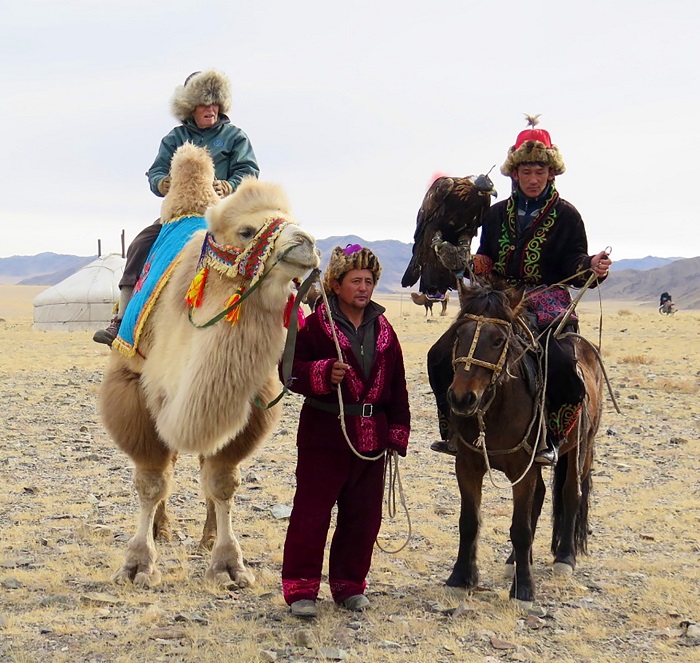 Some people will go anywhere for their sport. Jeep Chochran in Mongolia.
Jeep is the real deal. Her strength, courage, generosity, kindness, and wicked sense of humor continue to refresh and illuminate the lives of her many friends, allies, and colleagues. She and I have shared roughly 36,000 miles behind the wheel, in the cab of one truck or another, driving our hounds to Montana and back, an exercise that I cannot even imagine surviving with anyone else. We salute you. We have shared experiences unique in their time, and in this world, and which may never be repeated. Twickenham has been sold. The European hares have gone; they flourished for a century in New York’s Hudson Valley and in Ontario, but they were not native to North America. Horses have gone from the Lazy EL; all their cattle work is now done with four-wheelers. Perhaps Jeep’s example might challenge today’s younger generation of dedicated hound people to leap over boundaries and imagine new outcomes. Jeep certainly has.
Posted January 13, 2021
* Les Grimes has been honored as a huntsman of fame by his induction into the Huntsman’s Room at the Museum of Hounds and Hunting, N.A. in Leesburgh, Virginia.