
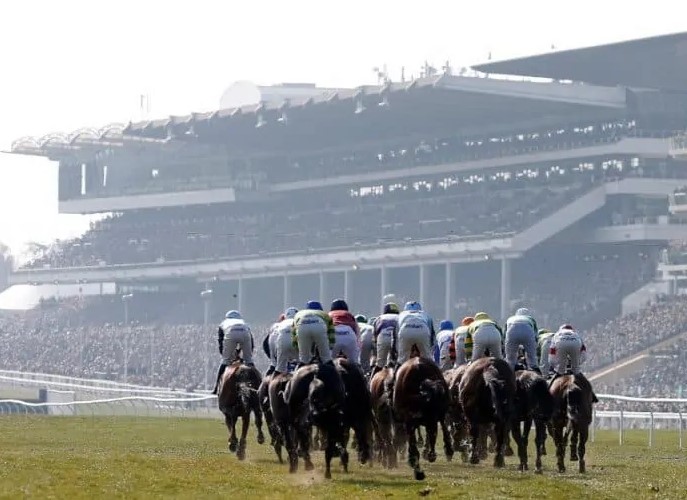
 Cheltenham, the Home of Jump Racing in Britain
What came first, the chicken or the egg is a conundrum that is unlikely ever to be solved. The same question concerning foxhunting and point-to-point racing, on the other hand, is quite simple to answer. We have to go back as far as the fifteenth century and maybe even earlier to discover the origins of foxhunting. In its beginnings, it’s likely the same hounds were used for hunting both hares and stags.
It was in the eighteenth century that foxhunting as we know it started to take shape, and for this we can thank Hugo Meynell, the father of modern foxhunting, and his period of Mastership at the Quorn. It wasn’t long before the sport became a favourite pastime of the well-to-do crowd.
Though steeplechase racing began in Ireland later in the eighteenth century, the first use of the term point-to-point in connection with a horse race appeared in Bell’s Life on 10 January 1874. The first reference to a hunt holding a point-to-point came in 1875, when the Sporting Gazette contained a detailed account of a Monmouthshire Hunt Point-to-Point chase held on 12 January 1875. These early races inspired events such as the St James’ Foxhunters Chase which features annually at The Gold Cup hosted at Cheltenham Racecourse. It was in the same century that the sport also began in America with races mainly taking place along the Atlantic coast. Because jumping fences is involved, it’s no surprise that there are close links between point-to-points and steeplechasing.
There’s no doubt foxhunting has its critics and is often a controversial subject, especially in England. Many English farmers would disagree with most of the criticism as it was they who started chasing foxes with their dogs in Norfolk in 1543 as a way of pest control. Foxes don’t always hunt for the sole purpose of feeding themselves; they often kill just for the fun of it. It’s for this reason that British farmers welcomed the hunt on their land in the past before it was banned in England; it was a way of preserving their livestock.
Foxhunting as a sport has had to overcome many difficulties over the years. One of the most significant problems occurred when the patterns of land ownership began to change as the once-great landowners were now beginning to be replaced by numerous smallholders. The latter wouldn’t be so welcoming to the huntsmen and their hounds.
Introduction of the railroads, barbed wire fencing, and hardships caused by both world wars, each in its time, led many to predict the end of foxhunting time and again. But it continued to flourish. Demonstrations by anti-cruelty protestors made things even harder. Despite these problems, the sport continued in Britain and America in the second half of the twentieth century, beginning at the gathering of the harvest up until the crops started to grow in late April.
Sadly, everything came to an end in Britain after the millennium, with Scotland being the first country to ban the sport in 2002. Two years later the British house of commons prohibited the killing of wild mammals by hound led hunts. This was made law in 2005 despite numerous legal challenges. Foxhunting still continues today in Britain, albeit in a far different form. Today a previously laid scent is tracked by the hounds, and if a fox is found, it must be shot by the huntsman rather than killed by hounds.
Luckily, point-to-point races have not run into the same problems. From around fifty races a year at the turn of the twentieth century this almost quadrupled to nearly two hundred in the second half of the century. Today the sport goes from strength to strength, with horses owned and ridden by members of an affiliated hunt taking place all over the country at over one hundred point-to-point courses.
Both foxhunting and point-to-point have its place in the beautiful landscapes of Britain, and despite the former having been banned in its natural form, both still maintain their prominence in the storied British countryside.
Posted September 29, 2020
The author is a passionate horse racing enthusiast looking to increase the popularity of horse racing as it has brought him and his family so much joy.