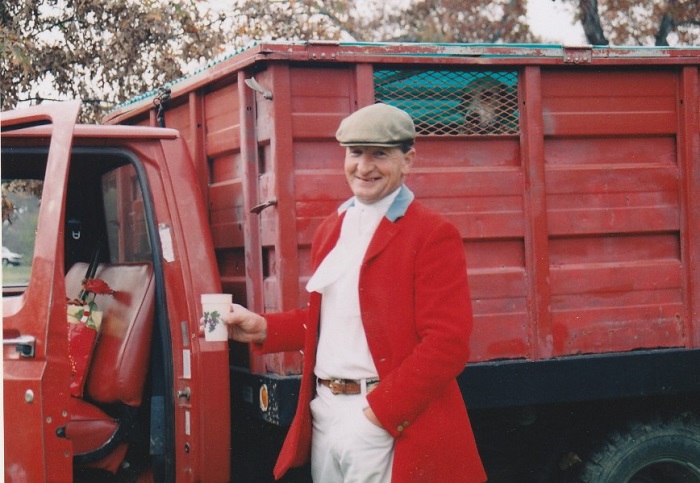
One day some years ago while recuperating from whatever had me grounded at the moment, I decided to follow my home pack, the Blue Ridge foxhounds, by vehicle. Fortunately, Chris Howells had an open seat, so I climbed into his blue pickup truck.
I knew that whatever would be seen of the action that day from any vehicle would be seen from Chris’s truck first. Every road follower wants to ride with Chris. If there’s no room, they do their best to follow him. Chris knows the country and how the foxes run.
Chris hunted the Blue Ridge foxhounds from 1973 to 2001 during the Mastership of Judy Greenhalgh. Since his retirement from the saddle, Chris has been following hounds on the roads for another almost twenty years. He serves as the principal road whip and remains a valued and knowledgeable member of the staff.
The following article was first published in the November 1983 edition of “Horseplay” magazine. –Ed.
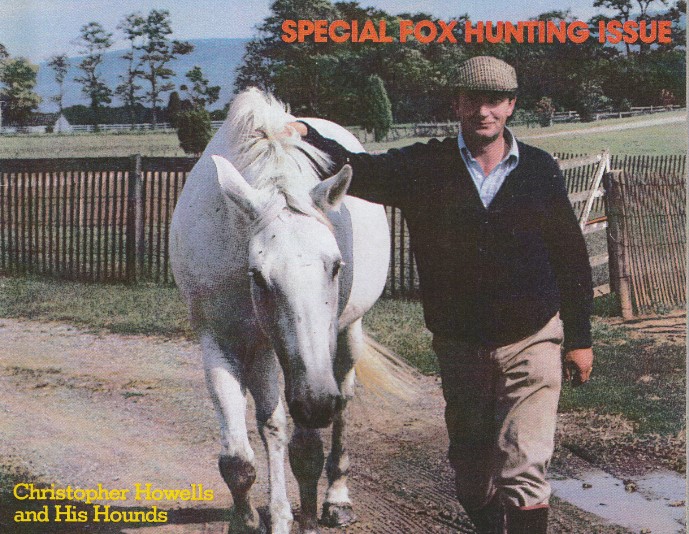
The early morning light shows a solitary figure on his way to the kennels, a terrier at his heels and a can of Pepsi in his hand. Christopher P. Howells, huntsman for the Blue Ridge Hunt in Boyce, Virginia, is about to start another busy day. Hounds greet him with an enthusiastic din, but turn quiet as he speaks to them in his soft English accent and sees to the feeding.
Chris was born in Yorkshire, England, but moved to Northumberland at the age of five when his father became huntsman for the North Northumberland Foxhounds. He soon found himself immersed in a life of hunting, hounds, and horses and remains so to this day. Having been raised with the sport, no future other than hunt service was desired or considered, and, after leaving school, he was second horseman for his father for a season. He then moved to the Cottesmore Foxhounds, where he was second whipper-in to Major Robert Hoare for three years. From there, he went to the Middleton Middleton East Foxhounds, where he was first whipper-in to Lord Halifax and Dennis Sturgeon from 1963 to 1965.
“My hunting in England was on a grander scale, and there were five of us to do the kennel work, plus the grooms and terrier men, who helped with the country as well. So we were rather a large family. It was not unusual to have sixty couple of hounds in the kennel and fifteen or more horses in the stable for staff use. Of course, one must remember that we hunted four days a week, rain or shine, and all used two horses a day. We regularly hunted until dark—a five or six hour day—and we worried about having enough sound horses. That was when we hoped for a few days of frost.”
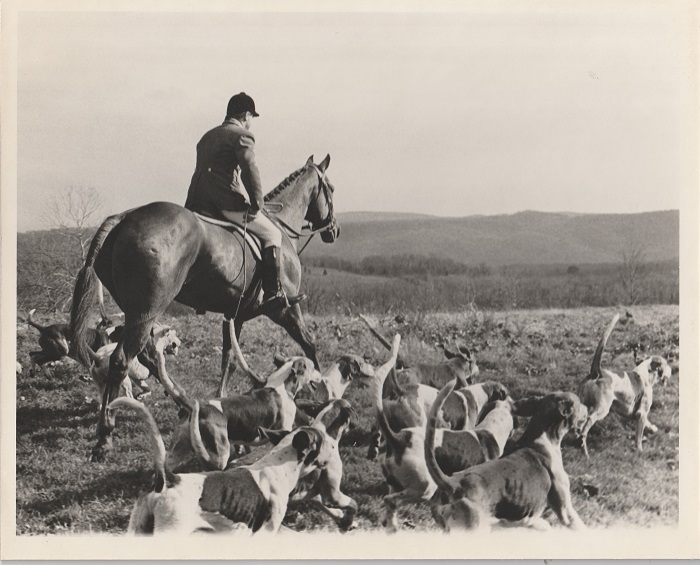 Huntsman Chris Howells with hounds in Virginia / Gamecock photo
The next step was a big one, for Chris answered an advertisement in Horse and Hound and soon found himself in Virginia as first whipper-in to Gordon Erriker, who was then huntsman at Deep Run Hunt near Richmond. Chris became huntsman of the Deep Run in 1968, and hunted hounds for five seasons. Unfortunately, he broke his neck the March of his last year by riding into a guy wire, and spent four long months in a body cast. When asked why he hadn’t seen it, he replied, “The hounds were hunting so well that I just couldn’t take my eyes off them.”
In the late summer of 1973, Chris came as huntsman to the Blue Ridge Hunt (VA), which had the added English flavor brought by Mrs. George P. (Judy) Greenhalgh, MFH, who was born in Warwickshire. She grew up in Ireland, where her father, Captain A.H. Hornby, was Master of the Muskerry Foxhounds until 1940. On her return to England after the outbreak of World War II, she hunted with the Pytchley, the Fernley, and the Atherstone before becoming Master of the Blue Ridge Hunt (VA) in 1971.
When Mrs. Greenhalgh and Chris Howells started working together at Blue Ridge, they had both English and Crossbred hounds in kennels. Since they had both hunted English hounds all their lives and found them to be extremely biddable, it was decided to let the Crossbreds die out and breed a pure English pack. They found them to have the drive necessary for this country, along with the nose and cry. Since then, they have imported six hounds directly from England. The last two are wooly Welsh hounds from the Bicester and Warden Hill.
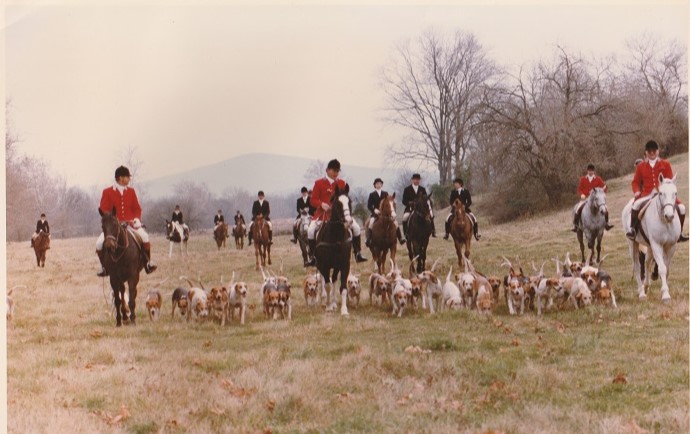 Chris Howells (center) with staff and hounds in the Blue Ridge country. Flanking Chris are whippers-in Bobby Jo Pillion (left) and Cliff Hunt (right). Circa 1980
The Blue Ridge Line
Not everyone can appreciate the time and effort that go into an effective hound breeding program. It takes generations of hounds to find a combination that endures. One great lines at Blue Ridge is Berkeley Bowsprit ‘63 by the Duke of Beaufort’s Brimstone ‘58, out of Berkeley Dossier ‘61. Bowsprit was bred to Tipperary Grenadier ‘65, and the only bi*ch to survive was Brevity ‘72, who was bred to Blue Ridge Beaver of English parentage. This produced Broker ‘75, who was an outstanding hound in many ways. Not only did he win every Stallion Hound and Three of His Get classes which he entered (he retired the Glanara Challenge Trophy at Oatlands last year), but he had the nose, drive, and speed to make any Master and huntsman proud. You could depend on him to be true on a line, and he was usually in front of the pack.
I have known Broker for many seasons and have had the honor of walking several of his forty-odd get. I remember an outstanding day when a large red fox was “holloaed” away from the Annefield wood. Broker spoke, and the rest of the pack honored him. As they broke from covert, he was running easily in front. Then Charlie made his mistake. He slowed to look over his shoulder, and at that moment broker saw him. He lifted his head and shifted into high gear. With this hound’s magnificent drive and speed, the fox had no chance at all and was brought down.
Obviously, all the hard work has paid off, for the Blue Ridge has an excellent pack of English hounds which show continuous good sport under difficult scenting conditions and have repeated wins at the hound shows.
The Differences in American Hunting
Hunting English hounds in Virginia represented many changes for Chris, the two very obvious being the weather and the fact that we don’t kill many foxes. Instead of wearing a kennel coat with a tie and bowler for hound exercise, he found himself in shirt sleeves trying to keep cool in 85-degree heat at 7:oo A.M. He hunts his hounds the same way he would in England, regardless of the weather, feeling that they must only try harder with the lack of moisture.
Due to the scarcity of foxes, he didn’t want to kill a brace a day, and soon found himself almost on speaking terms with his quarry—which coverts they were in and how they ran. His terriers follow him around the kennels and hunt rats and mice instead of bolting foxes, but seem necessary to complete the picture.
I asked him if he thought the jumping here was easy and was surprised when he answered seriously, “No. For two or more seasons these chicken coops put my heart in my mouth. I was used to jumping hedge and ditch and the odd gate, which would break if you hit it hard enough, but these were solid. Back home I sometimes averaged fifteen falls a season, but the ground was a lot softer, and you didn’t seem to worry so much about landing.”
Other differences: “Foxhunting doesn’t get the exposure here it does in England, and perhaps that accounts for the lack of anti-blood sport people. I should hate to have to contend with a mob interfering with my hounds and messing about in the coverts. Not as many people get involved here, especially your farmers. I’d like to see more people understand foxhunting.”
As a huntsman, Chris has many varied duties, and his days start early, especially during cubbing season. Not only is he responsible for the breeding, exercise, showing, , and care of all the hounds, but he helps the kennelman collect dead stock and with the paneling and clearing of the country.
“I never have time to wonder what I’m going to do next, and during regular hunting season, there never seems to be enough hours in the day. The hours spent on a horse aren’t as numerous as they were when I hunted in England, but hunting days are as long as they were fifteen years ago. I like to hunt a mixed pack, so the day starts in the draw yard with my selection of about sixteen-and-a-half couple of hounds. After hunting they must be fed and cared for, as well as my horse; and hopefully, the kennelman has dealt with the other regular chores. Many a time I then drive around the hunted country with my horn, looking for a hound that has not yet come in. Somehow, though, it all seems worthwhile.”
Chris Howells has spent twenty-four years in hunt service and feels he has had the best of both worlds. He now drinks Pepsi instead of tea, but he still has his pack of English hounds and clings tightly to a way of life and the sport that means so much to him.
Posted July 8, 2020
American-born Linda Jenkins Armbrust has been MFH of packs in both England and America. She served as Master of the Blue Ridge Hunt (VA) from 2000 to 2017.