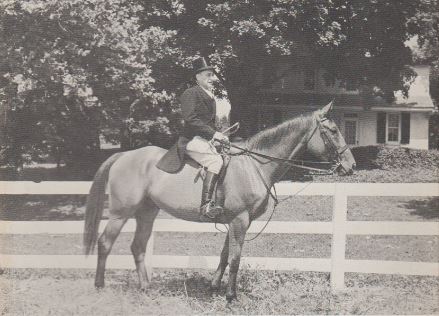
 Stuart Rose: foxhunter, race rider, publisher, author
This tale of a Thanksgiving hunt in Pennsylvania around the middle of the twentieth century is from Stuart Rose’s excellent book, There’s a Fox in the Spinney: Memories of Fox-hunting, Racing and Publishing (Doubleday, 1967).
Rose’s father intended to send his son to Harvard, but upon completing secondary school the young man joined the U.S. Calvary instead, by lying about his age. He wanted to ride horses.
Early in his memoir Rose explains the cavalry training of the period. It was thorough and rigorous and produced many world-class horsemen. Rose saw duty in Texas against Mexican rustlers and later in World War I. After mustering out he entered the publishing business in New York City at the bottom; married Frances Bogart, a New Yorker whose brother Humphrey was struggling for acting parts on the New York stage; championed the first works of several icons of American literature, John Steinbeck for one; and completed a long and successful career as Editor-in-Chief of the Saturday Evening Post. One hugely popular feature of the Post was its serialization of books written by the world’s finest English-speaking writers—a job at which Rose excelled, both in choice of material, working with the authors, and editing for serialization.
With a small home in Pennsylvania, Rose particularly loved to hunt with the Brandywine Hounds, founded first as Mr. Mather’s Hounds in 1892. The extensive Brandywine hunting country was bordered on the east by Mr. Stewart’s Cheshire Foxhounds and to the west by the old Rose Tree Foxhunting Club, though its country was most similar to the Cheshire.
Brandywine was still a private pack when Charles Mather’s son, Gilbert, became Master in 1937. Gilbert Mather served as president of the Masters of Foxhounds Association from 1954 to 1959. Mather hunted the pack for twenty years, and being a private pack the fields were kept deliberately small, much to Rose’s liking. Rose led a busy life in two parts—literature and horses. He was an important figure in the publishing world which supported his passion for foxhunting and racing. He was busy as a gentleman rider up and down the eastern seaboard, riding good horses for wealthy owners and also his own mounts which were necessarily few. What follows is a mildly abridged account of a Thanksgiving hunt with the Brandywine from Rose’s memoir.
***
On Thanksgiving Day hounds met at ten o’clock at Lenape. I had with me, hunting one of my horses, our house guest, the sixteen-year-old daughter of close friends of ours in New York. She had been a frequent visitor in our household since her tenth year, had long since graduated from ponies to riding my hunters, which she did with considerable éclat, and was very close to all of our family. The field, because of the holiday, was a large one, the weather was fine and all of us hoped for a good day’s sport.
Gilbert drew the first covert blank but there was nothing unusual in that and we proceeded to draw another which also produced no quarry. This kept on for hours, covert after covert, until Gilbert, when he lifted his hounds to draw still another, was the picture of despair and his usually cheerful voice had taken on a mournful note.
In the course of their search for a fox Gilbert and his hounds had described a large circle several miles in circumference so that we found ourselves presently only a couple of miles from Lenape where we had started out in the morning and where we had left our vans and trailers. I looked at my wrist watch and noted that it was approaching three o’clock and that we had been riding just short of six hours. I observed to my companion, as Gilbert drew again, that if hounds failed to find a three o’clock fox it would be well for us to get back to the Lenape Road, ride to the trailer and take the horses home as they had had a long enough day. A large proportion of the field had already pulled out, probably to avoid being late for their Thanksgiving dinners.
There was not a sound to be heard as we regained the road and walked slowly down it. We were within two or three hundred yards of our trailer when I fancied I heard hounds in the distance but then all was silent again and I decided my imagination was playing tricks. We were within fifty or sixty yards of our destination when I heard them again, unmistakably this time, to our right and much closer. A dismounted man ran into the road shouting and beckoning to us and I recognized that it was my friend and neighbor Lou Lamborn who helped me out with my horses.
“Stu, Vicki” he called. “Come on, come on.”
We put our horses into a canter and, sixty or seventy yards ahead of us, the hunted fox crossed the road running hard. We pulled up to wait for hounds to cross, which they did perhaps a half minute later, closely followed by Gilbert Mather and Johnny White. After they had crossed we scrambled up the bank, jammed our hats down hard, and took up the pursuit. After crossing two or three fields the fox turned left-handed and, hard pressed by hounds, headed straight upcountry, away from Lenape and the Brandywine Creek. Followed fifty-odd minutes of galloping after a straight-necked fox who never faltered, never deviated from his course. Hounds finally marked him to ground a couple of miles above the hamlet of Northbrook where we pulled up our tired horses with mixed feelings of elation and relief for they could not have held that pace for much longer. Only then did the remainder of the field straggle up, on horses even tireder than ours, winnowed down now to a scant dozen riders. Vicki and I had had all the best of it.
Now came the long hack back to the vans at Lenape, down the roads behind the hounds and the hunt staff, at hounds’ pace—a most uncomfortable gait—walk, jog, trot. We were glad when we reached the trailer as hounds continued across the bridge toward the kennels.
[This wasn’t quite the finish of a long day for Rose and his guest as they drove wearily home with two tired horses. Another car approaching in the dark of the narrow country road struck the left side of the horse trailer and sheared off the left wheel. After exchanging information with the teenaged driver of the offending car (which had seen better days), a stranger stopped, drove Vicki the remaining five miles, and contacted Lou Lamborn who arrived to help Rose with the horses. Rose finishes his tale as follows.]
I relate all this because it illustrates a point that I made earlier: that the harder one works for one’s sport the more one appreciates it. It had been a long, hard, and eventful day but I shall never forget the swift and brilliant run of that three o’clock Thanksgiving Day fox and I could retrace practically every step of it now.
Posted December 11, 2019