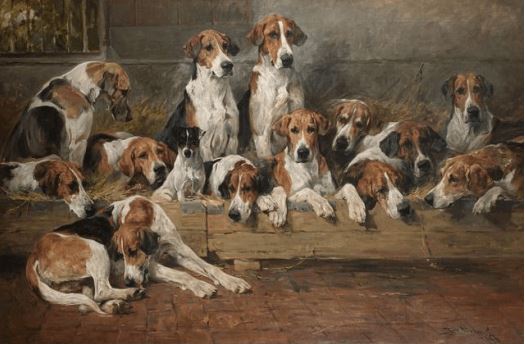
 The New Forest Foxhounds by John Emms
John Emms (1843–1912) is one of the most admired animal painters of the nineteenth century. He was an avid foxhunter himself, and his paintings of foxhounds are easily recognizable as clearly and uniquely his work. The postures, characteristic attitudes, and expressions of Emms foxhounds, in kennels especially, confirm his hand before even seeing his signature. I can stare from one hound to the other and the essence of his foxhounds will awaken even my olfactory senses and suggest my presence in a well-kept foxhound kennel.
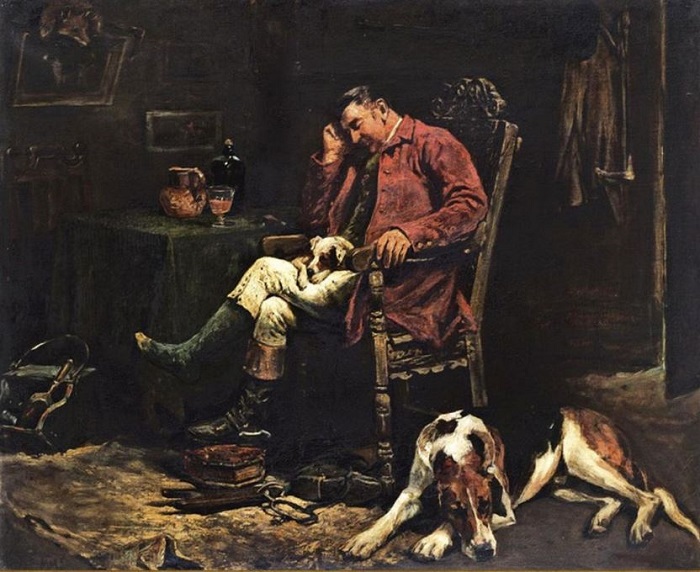 After the Hunt by John Emms
Born on April 21, 1843, the son of an amateur artist in Norfolk, England, the young Emms moved to London where he apprenticed with the great academic painter, Lord Frederick Leighton. Emms very quickly developed his own distinctive style, however, and soon struck out on his own.
In studios in London and in the New Forest area of England where he hunted, he painted images that capture the beauty of English country life. He was quite prolific, and painted many breeds of sporting dogs in addition to foxhounds and terriers.
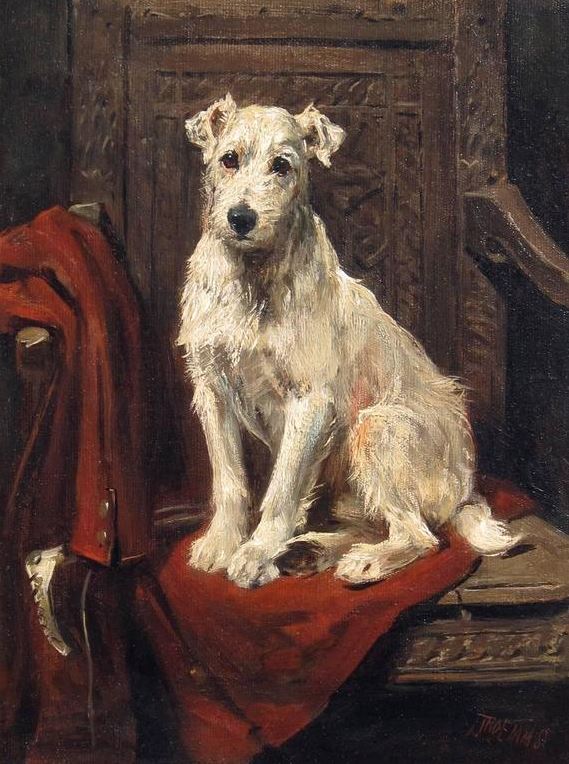 Lord Edward on his Masters Coat by John EmmsEmms’s earlier work is said to be more polished, but his style evolved to be characterized by short, confident, heavily paint laden brush strokes intended to quickly capture the essence of his subjects. His work soon gained a following among the sporting gentry of the day. One of his terrier paintings hangs in the National Gallery of Scotland.
One of Emms’ well-known works, “The New Forest Foxhounds,” sold at auction in 2006 for $843,250. Hunting in the New Forest harks back to 1089 when William the Conqueror established it as a Royal Hunting Forest. Foxhunting was first recorded there in 1675, and the New Forest Hunt was established in 1781.
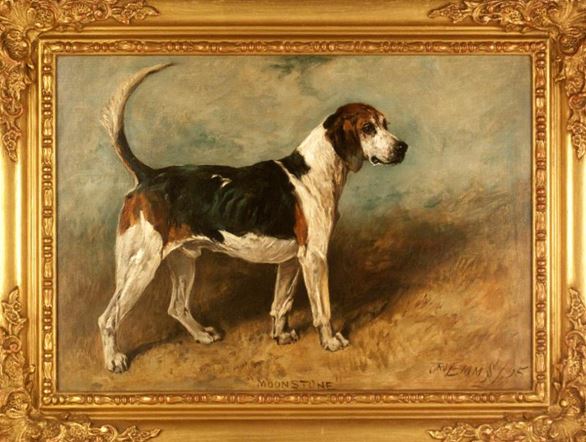 Moonstone by John Emms. A beautiful portrait of the old heavily-built English foxhound in style at the time, later disparagingly refered to as the Shorthorn era.
Emms exhibited his work extensively at the Royal Academy and won numerous awards and prizes in both London and Paris. He married Fanny Primer in 1880 and settled in London. Eight years later the couple moved to a large house and studio in the village of Lyndhurst in the New Forest where he lived and worked until his death in 1912.
Posted September 26, 2019
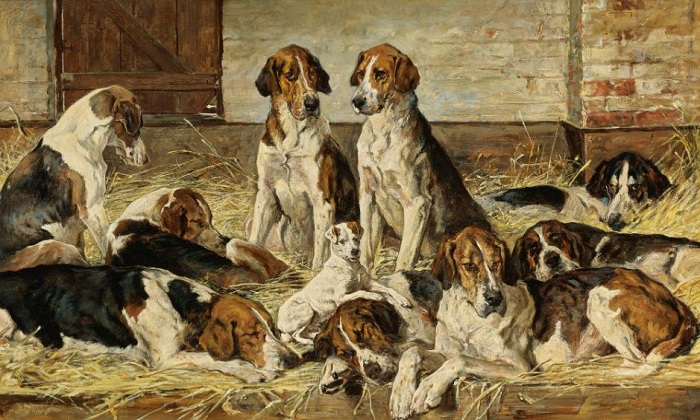 Hounds at Rest by John Emms