
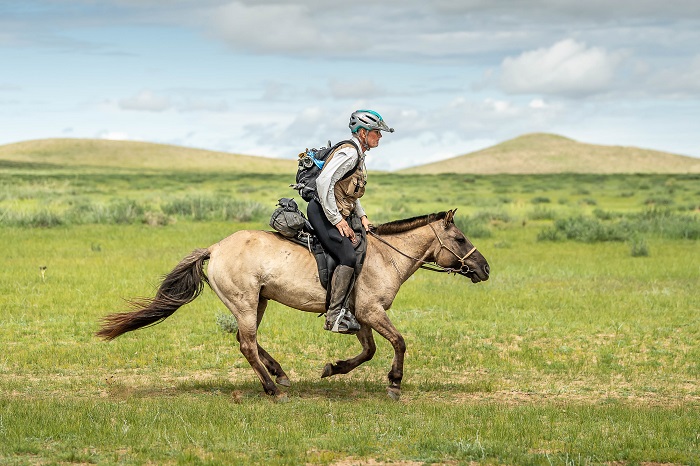
 American western horseman Bob Long wins eleventh running of the Mongol Derby. / Sarah Farnsworth photo
There are crazy things to do. And then there’s the Mongol Derby.
Foxhunters have been known to compete in the Mongol Derby, as if the post-and-rail line fences in Mr. Stewart’s Cheshire country, the wire in New Zealand, the banks and ditches of Ireland, or the hedges of the English Shires aren’t enough of a challenge. The Mongol Derby, according to the Guinness Book of Records, is the world’s longest and toughest horse race. This year forty-five men and women from eleven countries gathered to race one thousand kilometers (621 miles) across Mongolia on semi-wild horses.
Finishing strongly, seventy-year-old Robert Long, originally from Cheyenne, Wyoming but now living in Boise, Idaho, was the undisputed winner of this year’s race. Long reached the finish at 11:03 am Mongolian time on August 14, 2019, seven days after the starting gun. Competitors will continue to cross the finish line for another three days.
Long is the oldest winner in the eleven years of the competition. According to Liz Ampairee from the Adventurists Press Office, who witnessed the race, Long demonstrated extraordinary horsemanship, fortitude, and navigational skill in his victory. “In doing so he battled the weather gods, who threw everything they had at our brave crazy riders, from torrential rain to burning sun and then freezing temperatures, and harsh terrain,” she said. “All on the back of semi-wild, tough-as-teak Mongolian horses, who like to start the day by bucking their riders off just to show who’s boss.”
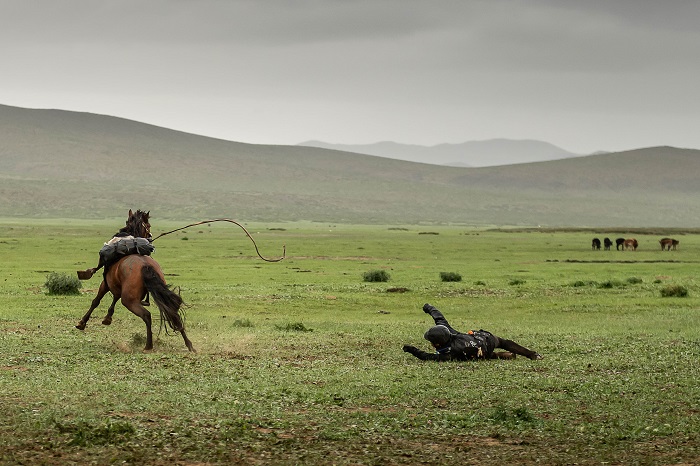 Sorting out who’s boss / Sarah Farnsworth photo
The race recreates Genghis Kahn’s ancient horse messenger system in epic fashion. The hardy and semi-wild native horses of Mongolia reprise their traditional role as the legs and lungs of the adventure and the horse stations, or morin urtuus, are manned by nomadic herding families as they traditionally were. The messengers themselves are played by the horsemen and adventurers who come each year from around the world to ride up to 160 kilometers a day, navigating independently, and changing horses at 40 kilometer intervals.
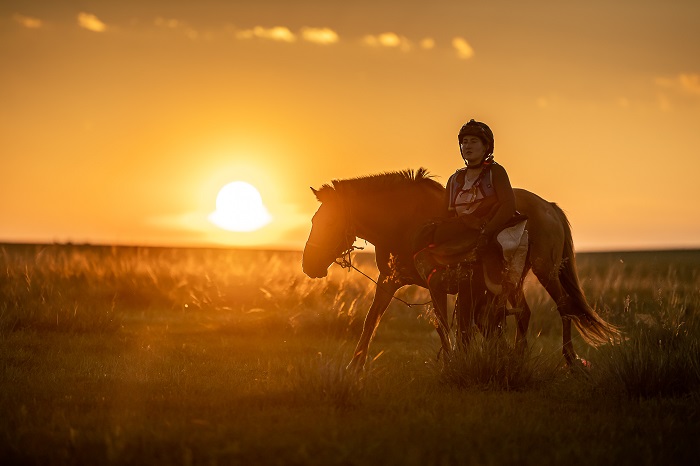 New Zealander Elise Stables allows her pony to lower its respiration rate by walking into station 18. / Sarah Farnsworth photo
Competitors change horses twenty-eight times, giving each of them twenty-eight additional opportunities to be bucked off as their fresh horses leap forward in a mad gallop as soon as the rider mounts. At each station or urtuu, incoming horses are carefully checked by vets. If the respiration rate is too high on a horse just completing it’s leg, the rider is detained from mounting his or her next horse until the respiration rate comes back down to the required level. The rule serves as a self-inflicted time penalty. All of Long’s horses vetted cleanly throughout the race, meaning he conserved them properly and received no veterinary time penalties. Plenty of the riders received medical treatment for “minor” injuries, such as a broken nose, concussion, and dehydration, but not Long. His solo adventure across the steppe has been one of the most impressive performances seen in the history of the Derby.
Long’s life has been built around horses. He trained and sold broncs to fund his university education, rode and trained mules for packing and hunting, and worked with young Appaloosas and Quarter Horses. He is a master at the competitive sport of Extreme Mountain Trail, and has many awards in that discipline—an ideal preparation for the Mongol Derby, the most extreme race of them all. He also pursues Ranch Horse Versatility—Ranch Cow Cutting, Ranch Reining, Ranch Riding, Ranch Trail, and Ranch Working Cow. Multiple disciplines that require a multitude of skill sets to be successful.
Long has a PhD in Public Health, and in 2013 retired from Healthwise, a company he helped build from the ground up.
The race? “It’s nothing; you just ride 650 miles. There’s nothing to it,” joked Long. “I’ve only stayed overnight at one horse station; I’ve been staying (a euphemism for camping out) with local families. They’re spectacular.”
Asked how it felt to be the oldest winner of the Derby, he replied dismissively: “Age is just a number.”
How soon they forget! Asked how he was feeling just the day before completing the race, while he was still in the saddle and making his way to the finish, Long replied succinctly, “Like hammered shit.”
Nevertheless, he has become a legend on the steppe among the Mongolian herders, who know a horseman when they see one. Herders from miles around came to greet Long. The horse is an integral part of Mongolian culture, and they recognised another truly instinctive horseman in Long.
Why did he enter in the first place? In Long’s words: “To accept the challenge of selecting and managing a good horse across a historical, storied, and difficult landscape. To interact with the legendary and best horsemen of all time. To test my skill, my nerve, and my mental fortitude. To experience and compete in the ultimate horse event that will exceed all my past experiences. And I’d hate to think I can’t….”
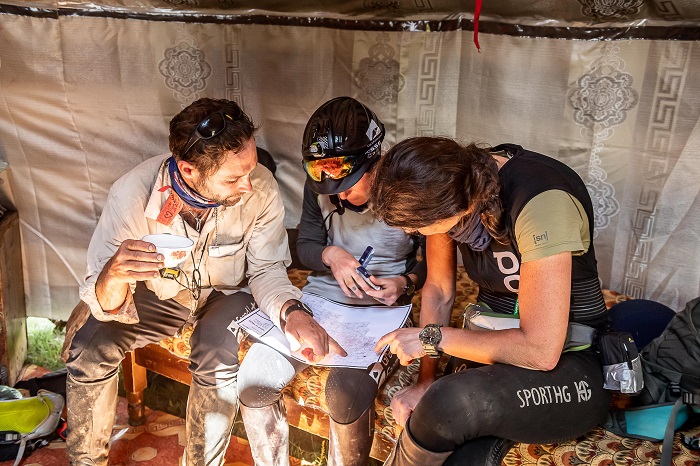 Route Planning / Sarah Farnsworth photo
Entries this year ranged from a fifty-six-year-old Texas cowboy to a helicopter pilot from Australia, a paleo-botanist from The Netherlands, and a management consultant from South Africa, via a host of saddle-hardened (they need to be) girls and boys from the racing world. All arrived fearless and ready for the most extreme adventure of their lives.
South Africa’s Wiesman Nel finished a very worthy second, and a group consisting of Margreet Voermans (The Netherlands) and three Aussies—Jesse Byrne, Justine Hales, and Sarah Brown—crossed the line in joint-third. They were closely followed by Texan Frank Winters and Australia’s Sam Chisholm, and then Hungary’s Zsofia Homor.
Mr. Tom, head honcho of The Adventurists (the race organisers), said, “Bob isn’t just the oldest, he has ridden better and stronger, camping out more than anyone else. We opened up the course this year to make navigation a key skill again, and Bob absolutely nailed it. The man is tougher than a box of concrete.”
Posted August 16, 2019